Get consulting from Sterling
Expert and experienced consultants, 8,100+ client engagements in 60+ countries, from gap assessment to a system ready for its certification audit.
Talk to a Sterling consultantPractitioner training · Good practice (GxP)
EU GVP pharmacovigilance training is for the person who has to make an EU pharmacovigilance system work and stand up at inspection: a new QPPV or deputy, a drug safety officer processing cases against 15- and 90-day clocks, a local safety contact, or a quality lead whose master file and audit programme an inspector will ask for on day one. If your case processing is done by a parent company or a service provider outside the EU, the split of duties is exactly where inspectors look.
This practitioner course explains EU pharmacovigilance as the law and the EMA's Good Pharmacovigilance Practices set it out: the system and its quality system, the QPPV and the master file, collecting reports, valid ICSRs and EudraVigilance, signal management, PSURs and the EURD list, risk management plans, risk minimisation, post-authorisation safety studies, and audits and inspections. One EU marketing authorisation holder in Dublin runs through every module.
EU GVP pharmacovigilance training teaches how marketing authorisation holders meet EU pharmacovigilance law and the EMA's Good Pharmacovigilance Practices: running a pharmacovigilance system and quality system, the QPPV and master file, adverse reaction reporting to EudraVigilance, signal management, PSURs, risk management plans, safety studies, audits and inspections.
Training a team? Get a quote for your organisation
Part of: Pharmaceutical GMP and GDP Training
Part of: GMP & Medical Devices
Secure payment by Stripe · for yourself or for your team
What you get
About 3 hours, with captions. Watch at your own pace on any device.
Short questions check your understanding before you move on.
Multiple choice, with immediate retakes if you need them.
Industry experts, domain specialist trainers and globally renowned auditors with 30+ years in ISO and GRC.
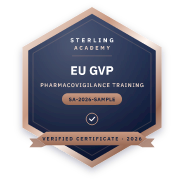
Verifiable certificate with a QR code anyone can scan, plus a digital badge to add to your LinkedIn profile.
See how verification works →Standard and editionEU pharmacovigilance: Directive 2001/83/EC Title IX and GVP modules
Last updated31 October 2026
EU authorities inspect pharmacovigilance systems routinely, and safety signals keep changing product information for widely used medicines. Two recent cases open the course.
The EU Pharmacovigilance Inspectors Working Group's annual report for 2024, adopted in September 2025, recorded 59 human pharmacovigilance inspections in the programme for holders of centrally authorised products. CHMP-requested inspections found 87 deficiencies, 29 of them major, and the top three areas were management and reporting of adverse reactions, the quality management system and the master file. Major findings on adverse reactions included submission and follow-up, medical review and coding, and literature screening.
In June 2025 EMA's safety committee concluded a review of a rare eye condition, NAION, with semaglutide, finding roughly a two-fold risk in adults with type 2 diabetes and updating the product information. It started from a PSUR assessment: routine pharmacovigilance doing its job.
The course is for people who run or support pharmacovigilance for medicines authorised in the EU, whether based in the EU or not. It suits you if you are:
You will learn the whole EU pharmacovigilance system and the clocks, documents and decisions inside it.
Module 1, Why pharmacovigilance matters: two real EU cases, four lessons, JKL Pharma Europe, the course and how you learn.
Module 2, The EU framework and who does what: the legal texts, GVP, the bodies, EudraVigilance and a role map.
Module 3, The system and its quality system: the quality cycle, people, procedures, records and indicators.
Module 4, The QPPV and the master file: the QPPV's role and backup, the master file, its annex and logbook.
Module 5, Collecting adverse reaction reports: the duty to collect, spontaneous and solicited sources, literature and special cases.
Module 6, Valid ICSRs and EudraVigilance: the four minimum criteria, seriousness, day zero, 15 and 90 days, follow-up and E2B(R3).
Module 7, Signal management: what a signal is, the steps, validation, the 2025 change, emerging issues and a signal log.
Module 8, Periodic safety update reports: PSUR content, the EURD list, 70 and 90 days, generics and single assessment.
Module 9, Risk management plans: the duty, the seven parts, safety concerns, generics, updates and a register.
Module 10, Risk minimisation and communication: routine and additional measures, effectiveness, safety letters, announcements and the black triangle.
Module 11, Post-authorisation safety studies: what a safety study is, rules for every study, imposed studies and the register.
Module 12, Audits and inspections: risk-based audits, findings, inspections under GVP Module III Rev 2, 2024 findings and penalties.
Module 13, Putting it together: one case from a call to an inspection, a road map, the takeaways, reform status and the exam.
EU pharmacovigilance rests on Title IX of Directive 2001/83/EC, Regulation (EC) No 726/2004 for centrally authorised products, and Commission Implementing Regulation (EU) No 520/2012, amended by Implementing Regulation (EU) 2025/1466 of July 2025. The EMA's Good Pharmacovigilance Practices modules explain how to meet them, and GVP Module III Rev 2 on inspections took effect on 10 September 2026.
The core duties fall on the marketing authorisation holder: a pharmacovigilance system with its own quality system, a QPPV residing and operating in the EU, a master file permanently available for inspection, recording all suspected adverse reactions brought to its attention, and submitting serious cases within 15 days and non-serious EU cases within 90 days to EudraVigilance. Signal management, PSURs to the EURD list dates, risk management plans and post-authorisation safety studies complete the system.
The course covers post-authorisation pharmacovigilance for human medicines; clinical trial safety reporting follows separate rules.
You can fit this training course around shifts and deadlines. It runs online as 13 on-demand video modules, about 3 hours of video in total, on a laptop, tablet or phone, and it remembers where you stopped. Each module ends with practice questions that show straight away whether the point has landed. After key modules, 4 practice exercises give you a realistic task to work through, such as checking entries in a master file, validating reports and setting the EudraVigilance clock, and building a PSUR and safety-review calendar, and then show a model answer to compare with your own; they do not count toward the result.
The course closes with a scenario-based multiple-choice final exam drawn from the course question bank. Score 60% or more and you receive a Sterling Academy Certificate of Competence in your name, ready to file with your training records; if the first attempt falls short, one retake is included. You follow JKL Pharma Europe, a built example: a Dublin marketing authorisation holder for three generic medicines, with its QPPV in Dublin and case processing done by its parent company's safety team in Mumbai under a written agreement.
You will be able to carry out the everyday pharmacovigilance tasks inspectors examine.
Pharmacovigilance involves people well beyond the safety team: medical representatives, call centre staff and local contacts who first hear of a case. A company plan trains the core team in depth, so every role knows its part in the reporting clock.
A client administrator adds people, assigns courses and follows progress through reports, so when an inspector or customer auditor asks who has been trained on what, the answer is ready. The organisation receives one invoice for the whole plan. Get a quote for your organisation and we will size the plan to your team.
Sterling Academy courses are built by industry experts, domain specialist trainers and globally renowned auditors with 30+ years of experience in ISO and GRC.
Sterling Academy is the training arm of Sterling International Consulting, with 8,100+ client engagements in 60+ countries over 20+ years. Every course teaches the current edition of its standard or guidance: this course reflects Directive 2001/83/EC, Regulation (EC) No 726/2004, Implementing Regulation (EU) No 520/2012 as amended in 2025, and the GVP modules on the EMA page as read in October 2026.
Preview this course
Watch a sample from Pharmacovigilance Training (EU GVP) before you enrol.
Inside the course
13 modules, 13 practice checkpoints, 4 practice exercises and a final exam. Video runtimes are approximate; allow additional time for the practice questions and the final exam. Modules marked optional can be skipped; the others are studied in any order.
What EU pharmacovigilance (GVP) training covers and why it matters, using EMA inspection findings and the semaglutide NAION review.
Opens with a doctor telling a sales representative that a patient lost part of their sight, and a self-rating on your QPPV and master file. Covers two cases: EMA inspectors' 2024 report, where adverse reaction reporting, the quality management system and the master file were the most common areas of findings, and PRAC's June 2025 review of NAION with semaglutide, found across many sources. Turns them into four questions: do we capture every report, send it on time, look for patterns, and can we show it? Introduces JKL Pharma Europe and its three generics, clears four myths, and outlines the thirteen modules in three parts, the exercises, the final exam and the certificate. It ends with a recap and three practice questions.
What you will be able to do
Why it matters
Seeing what inspectors find most often tells you which everyday safety tasks to check first in your own team.
Practice: Practice: Why pharmacovigilance matters · 3 questions
The EU pharmacovigilance legal framework, GVP modules, EMA, PRAC, national authorities and the holder's role map.
Starts with a Spanish agency request on liver reactions with metformin that either stays in JKL's Spanish office or reaches the QPPV in Dublin the same day. Covers the rulebook: the Directive, the Regulation, the implementing regulation as amended in 2025, and EMA's GVP modules. Explains who is who: the marketing authorisation holder, national authorities, EMA, the PRAC, the CMDh for nationally authorised medicines, and EudraVigilance at the centre. Shows JKL's role map, the first page of its safety manual, with written agreements and subcontracts, and the evidence that roles are real, including ringing the QPPV's published number out of hours. Ends with reviewing the map whenever a law, module or partner changes. It ends with a recap and three practice questions.
What you will be able to do
Why it matters
Knowing who answers to whom means an authority's request gets one complete, on-time reply instead of a partial local one.
Practice: Practice: The EU framework and who does what · 3 questions
The pharmacovigilance system and its quality system under GVP: the quality cycle, Article 11 procedures, records, training and indicators.
Opens with JKL's safety database down for three working days: with no plan, four serious cases pass day fifteen; with a business continuity procedure, a controlled log and triage keep them on time. Explains the quality cycle of plan, adhere, control and assure, and improve. Covers enough trained people, the procedures Article 11 of the implementing regulation lists, records kept for the right period, including master file elements for at least five years, and a training matrix by role. Shows JKL's monthly indicators, management review, and how a slow rise in late cases can reveal a staffing problem. Ends with three checks that show a working quality system, not just a quality manual. It ends with a recap and three practice questions.
What you will be able to do
Why it matters
A quality system that is measured and tested keeps cases on time even when the safety database fails.
Practice: Practice: The system and its quality system · 3 questions
The QPPV role, the deputy, and the pharmacovigilance system master file: content, annex, logbook and keeping it current.
Starts with Irish inspectors at JKL Pharma Europe in Dublin finding a master file that names an old literature vendor and a replaced database, set against a current file whose logbook shows each change, who approved it and why. Adds a Milan generics company that moved its master file. Covers the QPPV, who resides and operates in the EU, is qualified and has enough authority, and backup arrangements for permanent and continuous cover. Explains the master file content set by Article 2, its annex, the logbook and what it need not record, location in the EU, and updating EMA's database within thirty calendar days. Shows JKL's last four logbook entries. In the exercise you check five entries against Articles 2 to 7. It ends with a recap, three practice questions and a practice exercise.
What you will be able to do
Why it matters
A master file that describes the system you run today lets inspectors spend their time on the work, not on doubts.
Practice: Practice: The QPPV and the master file · 3 questions
Collecting adverse reaction reports under EU GVP: spontaneous and solicited reports, social media, literature screening and special situations.
Opens with a Sunday social media post in the Netherlands about a rash from JKL's amoxicillin, hidden by a marketing agency in one version and sent to safety within one working day in the other. Adds a Lisbon pharmacist whose email through a general contact form was found the same morning. Covers the duty to record all suspected reactions from the EU and beyond, refuse no report, and keep them at one point in the EU. Explains spontaneous and solicited reports, digital media, literature screening with EMA's service, and special situations. Shows JKL's intake map, listing every door and its route, the short form for sales and medical staff, agreements, monthly reconciliations, training, and mock reports to test each door. It ends with a recap and three practice questions.
What you will be able to do
Why it matters
Making every door lead to the safety team stops reports being lost in marketing, call centres or partner inboxes.
Practice: Practice: Collecting adverse reaction reports · 3 questions
Valid ICSRs under EU GVP: the four minimum criteria, seriousness, day zero, the fifteen and ninety day EudraVigilance deadlines, and E2B(R3).
Starts with a second-hand call in Rotterdam about a fit after ceftriaxone, which is not yet a valid case until the patient herself calls on Thursday with her details. Covers the four minimum criteria: an identifiable reporter, an identifiable patient, a suspected reaction and a suspect medicine. Explains seriousness, day zero counted in calendar days from when anyone working for you knew, serious cases from anywhere within fifteen days and non-serious EU cases within ninety. Covers follow-up that restarts the clock for significant news, avoiding duplicates, masking personal data, and the mandatory E2B(R3) format. Shows a week of JKL's clock log in November 2026. In the exercise you set the deadline for each of JKL's cases. It ends with a recap, three practice questions and a practice exercise.
What you will be able to do
Why it matters
Getting day zero and validity right means cases go out on time without submitting reports nobody can assess.
Practice: Practice: Valid ICSRs and EudraVigilance · 3 questions
Signal management under EU GVP Module IX: detecting, validating and assessing signals, emerging safety issues, and the 2025 changes.
Opens with five reports of the same eye disorder with ceftriaxone over six months, each processed well but seen as a pattern only when JKL's monthly review groups related MedDRA terms and checks EudraVigilance and the literature. Explains what a signal is, and the steps from detection and validation to analysis, assessment and action, with Member States in the lead for nationally authorised medicines. Covers emerging safety issues, reported to the authorities and EMA within three working days, and the August 2025 change to the procedure for EudraVigilance signals. Shows a line from JKL's signal log, linked to case numbers, queries and meeting minutes, and comparing it with PRAC's published signals each month. It ends with a recap and three practice questions.
What you will be able to do
Why it matters
A signal review that groups cases means your company finds a pattern before an authority finds it for you.
Practice: Practice: Signal management · 3 questions
Periodic safety update reports (PSURs) under EU GVP: the EURD list, data lock points, the rule for generics and the single assessment.
Starts with JKL's Mumbai team writing an annual PSUR for amoxicillin since 2016 out of habit, sent by email outside the EU route, without checking the EU list of reference dates. Explains what a PSUR evaluates and its format under the ICH periodic benefit-risk evaluation report guideline and GVP Module VII, and one PSUR per active substance. Covers the EURD list setting frequency and data lock point, reports due within seventy or ninety calendar days, why generics do not submit routinely unless the list requires it, and applying single assessment outcomes. Shows JKL's calendar and signal review timing for metformin. In the exercise you read the EURD entries for JKL's three substances. It ends with a recap, three practice questions and a practice exercise.
What you will be able to do
Why it matters
Reading the list instead of following habit avoids both needless reports and missed ones.
Practice: Practice: Periodic safety update reports · 3 questions
EU risk management plans under GVP: the seven parts, the safety specification, safety concerns, generics and keeping the plan current.
Opens with an updated, published list of safety concerns for one of JKL's substances that JKL either misses for years or tracks and submits through the right variation. Covers the risk management system required for every medicine authorised since July 2012, and the seven parts set by the implementing regulation in a fixed template. Explains the safety specification: important identified risks, important potential risks and missing information, and why generics follow the reference product unless justified. Shows JKL's register, reviewed monthly and signed by the QPPV, and a tracker of commitments with owners and due dates, so each concern matches what the PSUR evaluates and the signal log watches. It ends with a recap and three practice questions.
What you will be able to do
Why it matters
A plan kept current with published outcomes means your company can explain its risk measures to any authority.
Practice: Practice: Risk management plans · 3 questions
Risk minimisation measures and safety communication under EU GVP: safety letters, educational materials, public announcements and the black triangle.
Starts with a required safety letter to doctors that JKL's local office either rewrites with its own wording or sends as the agreed text, on the agreed date, with all holders. Covers routine risk minimisation for every medicine and additional measures only where needed, such as guides, a checklist, a patient card or a diary, with templates in GVP Annex II, never promotional and always evaluated for effect. Explains safety letters to healthcare professionals with content and plan agreed with the authority, JKL's distribution log, public announcements reaching the authorities before or with the public, how JKL answers a journalist, and additional monitoring with the black triangle. Ends with rehearsing the first hour of a safety announcement. It ends with a recap and three practice questions.
What you will be able to do
Why it matters
One agreed message at the agreed time protects patients and keeps your company clear of conflicting statements.
Practice: Practice: Risk minimisation and communication · 3 questions
Post-authorisation safety studies under EU GVP: imposed and voluntary studies, protocol endorsement and the EU study register.
Opens with a study imposed by the Spanish agency on how a dosing warning is followed, where JKL's research partner starts collecting pharmacy data before the protocol is endorsed. Covers what a non-interventional safety study is and rules for every study: no promotion, payment only for time and expenses, watching for new risks, and reporting within twelve months. Explains extra rules for imposed studies: an endorsed protocol before data collection, approval of substantial amendments, a final report with an abstract in the set formats, entry in EMA's electronic study register since February 2026, and keeping the analytical dataset for inspection. Shows JKL registering its first study and one tracker linked to the risk plan and PSURs. It ends with a recap and three practice questions.
What you will be able to do
Why it matters
Following the study rules from the start means the data you collect counts and the company stays within the law.
Practice: Practice: Post-authorisation safety studies · 3 questions
Pharmacovigilance audits and inspections under EU GVP: risk-based audit programmes, subcontractors, inspection findings and penalties.
Starts with JKL's case processing done by its parent's team in Mumbai: never audited in one version, so inspectors find a two-year literature gap, and audited every two years in the other. Adds a contract provider in Amsterdam sharing one audit calendar with clients. Covers the audit duty and its 2025 changes, independent auditors such as JKL's group team in Singapore, risk-based planning that covers all activities and every subcontractor, group companies included. Explains routine and for-cause inspections under the new GVP revision, what inspectors look at, the 2024 findings, corrective actions that fix the cause, and penalties. In the exercise you plan a risk-based audit programme for JKL and its subcontractors. It ends with a recap, three practice questions and a practice exercise.
What you will be able to do
Why it matters
When your own auditor finds a weakness first, it is fixed before an inspector writes it up.
Practice: Practice: Audits and inspections · 3 questions
One serious adverse reaction case followed through an EU pharmacovigilance system end to end, with a ten-step road map and the final exam.
Opens with a hospital pharmacist in Hamburg calling JKL's German line on Thursday the fourth of March 2027 about a fifty-eight-year-old woman with severe breathing difficulty after ceftriaxone. Follows the case through the four questions on the call centre script, validity that day, submission to EudraVigilance in E2B(R3) on day five, follow-up on a new clock, quality checks, the QPPV's signed decision in the signal log, and an inspector's questions a year later. Shows what JKL puts on the table: call log, current master file and logbook, signal log, PSUR calendar and risk plan register. Gives a ten-step road map, the key takeaways, what is changing in EU law, and the final exam with its 60% mark.
What you will be able to do
Why it matters
Tracing one case end to end shows whether your system really works, and where it would break.
Practice: Practice: Putting it together · 3 questions
Frequently asked questions
About Pharmacovigilance Training (EU GVP), its certificate and enrolment.
Ask SterlingYes. Sterling Academy's EU GVP training is built by the Sterling consulting group, which has taken organisations to certification across 8,100+ client engagements in 60+ countries over 20+ years. It is always on the current edition, with practice questions that show the right answer. Each course ends with a final exam and a verifiable certificate that anyone can check online, plus a LinkedIn badge, and client administrators can show an auditor exactly who has been trained. You will be able to apply Pharmacovigilance Training (EU GVP) at work and show your competence with confidence. Sterling Academy courses carry the same content as Sterling's classroom training, whose certificates are trusted and accepted by all major certification bodies, as evidence of training at client audits for over 20 years.
EU GVP pharmacovigilance training teaches how marketing authorisation holders meet EU pharmacovigilance law and the EMA's Good Pharmacovigilance Practices. This course covers the system and quality system, the QPPV and master file, ICSRs and EudraVigilance, signals, PSURs, risk management plans, safety studies, audits and inspections.
Pharmacovigilance and drug safety staff, QPPVs and deputies, local safety contacts, regulatory affairs and quality teams of EU marketing authorisation holders need it, as do service providers and non-EU companies that hold or support EU authorisations. EU law requires initial and continued training for all personnel involved in pharmacovigilance.
Serious suspected adverse reactions, from the EU or elsewhere, must be submitted to EudraVigilance within 15 days, and non-serious reactions from the EU within 90 days, counted from day zero when the minimum information is received. Module 6 covers validity, day zero and follow-up.
A PSUR is a periodic report evaluating the benefit-risk balance of a medicine at set intervals, often set by the EURD list. A risk management plan describes the safety profile and the measures to prevent or minimise risks. Modules 8 and 9 cover each.
The course takes about 3 hours of video across 13 modules, plus practice questions, four practice exercises and the final exam. Most learners spread it over several sessions, and the platform remembers where you stopped on any device, so it fits around case deadlines.
The course follows Directive 2001/83/EC, Regulation (EC) No 726/2004, Implementing Regulation (EU) No 520/2012 as amended in July 2025, and the GVP modules in force, including Module III Rev 2 on inspections from September 2026. It notes planned GVP updates without teaching drafts as requirements.
Yes, you receive a Sterling Academy Certificate of Competence in your name when you score 60% or more in the final scenario-based multiple-choice exam. One retake is included if the first attempt does not reach the mark, and the certificate can be filed with your training records.
The course costs US$99 per learner, including the 13 video modules, practice questions, four practice exercises with model answers, the final exam and the certificate. For safety teams and service providers, contact us for a quote for a company plan for your organisation.
Yes, a company plan is designed for this. A client administrator adds people, assigns the course, follows progress in reports and receives one invoice, so the training records an inspector asks for are complete for every person in your pharmacovigilance system.
Your certificate
You will be able to apply Pharmacovigilance Training (EU GVP) at work and show your competence with confidence. Your certificate can be verified online in seconds, so certification body auditors, employers and clients can confirm your training instantly.
Complete the course and its final exam and you receive a Sterling Academy Certificate of Completion, verifiable online by QR code, with a LinkedIn badge to share.
Sterling Academy courses carry the same content as Sterling's classroom training, whose certificates are trusted and accepted by all major certification bodies, as evidence of training at client audits for over 20 years.
Ask about course requirementsYour next step
Not sure which course?