Get ISO/IEC 27001 consulting from Sterling
Expert and experienced consultants, 8,100+ client engagements in 60+ countries, from gap assessment to a system ready for its certification audit.
Talk to a Sterling consultantAwareness training · Information security
Part of the ISO/IEC 27001:2022 learning path → Step 2
Online training to help every employee play their part in information security.
The training helps you build a clear understanding of information security, the purpose of an information security management system and each person’s responsibilities at work.
Secure payment by Stripe · for yourself or for your team
Add another course and save 15%, up to 25%
What you get
About 105 minutes, with captions. Watch at your own pace on any device.
Short questions check your understanding as you go.
Multiple choice, with one retake if you need it.
Industry experts, domain specialist trainers and globally renowned auditors with 30+ years in ISO and GRC.
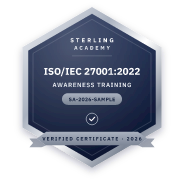
Verifiable certificate with a QR code anyone can scan, plus a digital badge to add to your LinkedIn profile.
See how verification works →Save when you take more than one course
The discount is added automatically in your basket.
Standard and editionISO/IEC 27001:2022
Last updated26 September 2026
Preview this course
Watch a sample from ISO/IEC 27001:2022 Awareness before you enrol.
What learners say
Rated 10/10 by a learner
Amazing course
A professional who finished ISO/IEC 27001:2022 Awareness Training
US$19
More courses professionals rated 10/10
Best value
All-Access Pass
A pharma and life sciences professional from the USA started with one course, then upgraded to the All-Access Pass.
Every Sterling Academy course for 12 months.
US$499
See the passA selection of comments from learners who finished a course and answered our feedback request, shortened from their own words. Client names available on request.
Learning outcomes
Connect the subject to the responsibilities and decisions people encounter in their roles.
Part of: Information Security and ISO 27001 Training
Part of: Information Security & Privacy
Inside the course
13 modules, 4 practice checkpoints and a final exam. Video runtimes are approximate; allow additional time for the practice questions and the final exam.
Uses six real incidents, from Jaguar Land Rover to fairlife, to show what a bad day costs and what decides how much damage follows.
Opens the ISO/IEC 27001:2022 awareness course, meant for everyone in the organisation, with how it works, then asks how long your organisation could run if nothing worked on Monday morning. Walks through incidents at Jaguar Land Rover, Marks and Spencer, CrowdStrike, Cloudflare, Starwood and Marriott, and fairlife. Shows that three things decide the damage: how early you notice, how quickly you recover and how far it spreads. Adds breach cost figures.
What you will be able to do
Why it matters
Gives a concrete case for why noticing early, containing and recovering quickly matter to the business, and why people are part of the answer.
Explains information as data that has value, where it lives in every department, the forms it takes and the stages of its life cycle.
Compares the care you give a new phone with the care information deserves, and answers the claim that ISO/IEC 27001 is only about IT. Defines information as data that has value, then shows where it sits in finance, strategy, operations, sales, HR and IT. Covers its electronic, paper and spoken forms, including the printout forgotten on the printer. Follows the life cycle from creation to secure disposal.
What you will be able to do
Why it matters
Helps you see that ISO/IEC 27001 is about business information in every department and every form, not only IT.
Introduces confidentiality, integrity and availability as the three pillars of information security, with how each is protected and a payroll exercise.
Starts with a banking app that says service unavailable, to show security can fail without theft or change. Defines confidentiality, integrity and availability, the three things the controls in ISO/IEC 27001:2022 and your company's security policies exist to protect, and gives the protections for each, such as multi-factor authentication, version control and tested backups. Shows all three working in one online bank transfer. Ends with three payroll situations to match to a pillar.
What you will be able to do
Why it matters
Gives you a simple test for any incident: which of the three pillars is affected, so you can see what could go wrong in your own work.
Practice: Checkpoint 1: information and why it matters · 5 questions
Shows what an information asset is, how organisations list, classify and own assets, and what labels and acceptable use mean for your daily handling.
Defines an information asset as anything that holds, handles or carries information, including the air conditioner in the server room. Covers the five kinds of asset and the four things an organisation does: identify, classify, assign an owner and consider risk. Explains labels such as public, internal, confidential and restricted, the acceptable use policy, leaving or changing role, departmental examples, and daily habits.
What you will be able to do
Why it matters
You cannot protect what you do not know you have, and the label tells you how to handle each piece of information.
Clarifies who publishes ISO/IEC 27001:2022, who issues certificates, what the name means and how the standard is built, with a tip for checking a certificate.
Corrects two common mistakes: that ISO is an acronym and that ISO audits and certifies. Explains the three parts of the name ISO/IEC 27001:2022, ISO and IEC, 27001 and 2022, and what an information security management system is. Compares related names such as ISO/IEC 27701, PCI DSS, SOC 2 and HIPAA. Describes the structure: clauses 1 to 3, requirements in clauses 4 to 10, and Annex A with 93 controls.
What you will be able to do
Why it matters
Lets you talk about the standard and certification correctly, and spot a certificate that does not add up.
Covers where the requirements begin: the organisation's context, its interested parties and the scope of its information security management system.
Makes the point that certification to ISO/IEC 27001:2022 is not a one-time project but an ongoing commitment led by top management. Explains context of the organisation as self-examination, with internal and external issues, including climate change since 2024. Uses a doctor's visit as an analogy, then covers interested parties and the three questions to ask about each one, and the scope, with an example from Dubai and Manila.
What you will be able to do
Why it matters
Helps you notice changes early, such as a new tool or supplier, and pass them to your manager before they become risks.
Practice: Checkpoint 2: assets, the standard and scope · 5 questions
Explains the information security policy as top management's written promise, the policies beneath it, and how SMART objectives and a plan turn it into action.
Covers the three commitments in the information security policy, which ISO/IEC 27001 requires to be written down, why there is one policy for the whole organisation, and what it contains. Explains how it is communicated and the topic-specific policies you meet at work, such as acceptable use and clear desk. Then teaches SMART objectives with vague and better examples, the five questions a plan answers, and how progress is measured and reported.
What you will be able to do
Why it matters
Shows that a policy achieves nothing without objectives, a plan and monitoring, and what you can say if an auditor asks about it.
Teaches the five-step risk management cycle, from identifying and scoring risks to treating them, reassessing and recording the results in a risk register.
Starts with why controls such as blocked USB ports exist: in ISO/IEC 27001, risk comes first and controls follow. Walks through the five steps, in line with ISO 31000: identify, analyse, evaluate, treat and reassess. Covers risk owners, threat and vulnerability, likelihood times impact scoring, risk acceptance criteria and the four ways to treat a risk. Explains the treatment plan, checking controls against Annex A, residual risk and the risk register.
What you will be able to do
Why it matters
Explains why the controls around you exist, and why reporting a new risk or never bypassing a control keeps the risk from returning.
Introduces the 93 Annex A controls in four themes and the Statement of Applicability, with a situations exercise and the changes in the 2022 edition.
Begins with a customer who asks for the certificate and the Statement of Applicability. Explains the 93 controls of Annex A in the 2022 edition of ISO/IEC 27001: 37 organisational, 8 people, 14 physical and 34 technological. Gives numbered examples, such as 5.3 segregation of duties, 6.7 remote working, 7.7 clear desk and 8.23 web filtering. Includes an exercise on four situations, what changed in 2022 and how the Statement of Applicability records each decision.
What you will be able to do
Why it matters
Shows which controls depend on you and why customers ask for the Statement of Applicability alongside the certificate.
Shows how people, supplier and document controls depend on HR, purchasing and document owners, and how you should handle documents and records.
Opens by asking who verified your background, who checked a new supplier and who approved the procedure you followed. Covers people: roles, competence, training, NDAs and the joining, moving and leaving steps. Then suppliers: identifying risks, requirements, written agreement and a clean exit. Ends with documented information, including a master list, documents against records, five stages of document control and how long records are kept, where privacy laws such as the GDPR limit personal data.
What you will be able to do
Why it matters
Shows that the management system depends on every department, and how keeping records in the right place gives auditors evidence.
Practice: Checkpoint 3: policy, risk, controls and people · 5 questions
Explains events, incidents and weaknesses, how to report one, the clocks on personal-data breaches and how a problem is fixed at its root.
Begins with a phishing e-mail that has already captured a password. Distinguishes an event from an incident and explains reporting weaknesses. Covers personal-data breaches and reporting deadlines in several regions, including the GDPR duty to tell a client without undue delay, how to report, and what not to do. Then explains nonconformity in clause 10.2 of ISO/IEC 27001, its six steps, correction against corrective action, and a root cause example ending in multi-factor authentication.
What you will be able to do
Why it matters
Shows that the first minutes after a mistake matter most, and that fixing the cause protects everyone, not only the person who clicked.
Describes the two checks in the standard, the internal audit and the management review, and how to answer an auditor with evidence.
Explains the internal audit that ISO/IEC 27001 requires, the organisation checking its own system, planned through a programme, a plan, a report and any nonconformity. Uses an example table and an auditor's sampling of leavers. Covers three habits before an audit, the four kinds of finding, a major or minor exercise, and following a finding to closure. Then covers the management review: the three questions, its agenda and its recorded decisions.
What you will be able to do
Why it matters
Shows that an audit finding is help, not blame, and that the review is only as good as the records you keep.
Sets out the eight-step road to certification, what audit days involve for you, the documents and records auditors ask for and four daily habits.
Lists the eight steps an organisation follows, and the two-stage certification audit by an independent certification body. Explains what audit days look like for staff, how the certificate is decided, and the surveillance and recertification cycle over three years. Groups the evidence into core documents, required records and proof that controls run, including the Annex A asset inventory and incident records. Closes with four habits for your part and a recap.
What you will be able to do
Why it matters
Prepares you for the audit cycle that returns every year, and shows how the records you make by doing your job become evidence.
Practice: Checkpoint 4: incidents, audit and your part · 5 questions
Frequently asked questions
About ISO/IEC 27001:2022 Awareness, its certificate and enrolment.
Ask SterlingYes. Sterling Academy's ISO/IEC 27001 courses are built by the Sterling consulting group, which has taken organisations to certification across 8,100+ client engagements in 60+ countries over 20+ years. They cover the awareness, implementation, internal auditor and specialist levels, always on the current edition, with practice questions that show the right answer. Each course ends with a final exam and a verifiable certificate that anyone can check online, plus a LinkedIn badge, and client administrators can show an auditor exactly who has been trained. You will understand what ISO/IEC 27001 asks of you, contribute to your organisation's implementation and audit readiness, and play your part with confidence when the auditor visits. Sterling Academy courses carry the same content as Sterling's classroom training, whose certificates are trusted and accepted by all major certification bodies, as evidence of training at client audits for over 20 years.
Awareness: ISO/IEC 27001:2022 Awareness · Implementation: ISO/IEC 27001:2022 Implementation Training · Internal auditor: ISO/IEC 27001:2022 Internal Auditor Training · Specialist: ISO/IEC 27002:2022 Information Security Controls
It is for employees across your organisation, at every level, in organisations that use or are working towards an information security management system. It explains confidentiality, integrity and availability, information assets and risks, and each person's responsibilities at work. No prior knowledge of ISO/IEC 27001 is needed, so it suits new starters as well as experienced staff.
The course is organised in three parts: information and why it matters; the standard, risk and controls; and incidents, review and improvement. Learners learn to explain confidentiality, integrity and availability, recognise information assets and common security risks, understand policies, controls and individual responsibilities, recognise and report incidents, and see how audits and continual improvement support the management system.
ISO/IEC 27001:2022 Awareness is a set of short video modules followed by practice questions and a final exam. The course page shows the current number of modules and the approximate video runtime; allow additional time for the practice questions and the exam. With 12 months of access, you can complete it in one sitting or spread it over several sessions.
Yes. Learners who reach the 70% pass mark in the final exam receive a Sterling Academy Certificate of Completion for ISO/IEC 27001:2022 Awareness. Each certificate carries a unique number and a QR code, and anyone can check it online using the certificate number and the holder's surname. It is a training certificate for the individual learner.
Yes. ISO/IEC 27001:2022 Awareness is a self-paced online course made of short video modules, in English with captions. You study at your own pace during 12 months of access, and practice questions after modules help you check your understanding before the final exam. If a point is unclear, questions are answered by a Sterling consultant.
ISO/IEC 27001:2022 Awareness is US$19 per learner. Teams save 20% for 11 to 50 learners and 30% for 51 to 200 learners; 201 or more learners are priced on request. Client administrators can track their team's progress. Prices are in US dollars, excluding taxes, and Sterling confirms final pricing and enrolment.
It gives your people the knowledge ISO 27001 asks of them, and each learner's verifiable certificate is evidence of that training when the auditor asks. The Certificate of Completion is a training certificate: it shows that one person completed ISO/IEC 27001:2022 Awareness and reached the pass mark in its final exam. An organisation is certified by an independent certification body after that body's own audit.
ISO/IEC 27001:2022 sets the requirements for an information security management system, and its Annex A lists 93 information security controls. ISO/IEC 27002:2022 gives implementation guidance for those controls across four themes: organisational, people, physical and technological. This awareness course introduces the management system; Sterling Academy's ISO/IEC 27002:2022 Information Security Controls course covers the 93 controls in depth.
Learning path
Start here
Recognise cyber threats and build safer habits at work.
View courseThis course
Help every employee understand their role in protecting information.
Next step
Apply the 93 Annex A controls using ISO/IEC 27002 implementation guidance.
View courseNext step
Help every person know their part when a disruption strikes.
View courseNext step
Put an information security management system in place, clause by clause and control by control, from scope and risk assessment to the Statement of Applicability, audit and certification.
View courseYour certificate
You will understand what ISO/IEC 27001 asks of you, contribute to your organisation's implementation and audit readiness, and play your part with confidence when the auditor visits. Your certificate can be verified online in seconds, so certification body auditors, employers and clients can confirm your training instantly.
Complete the course and its final exam and you receive a Sterling Academy Certificate of Completion, verifiable online by QR code, with a LinkedIn badge to share.
Sterling Academy courses carry the same content as Sterling's classroom training, whose certificates are trusted and accepted by all major certification bodies, as evidence of training at client audits for over 20 years.
Ask about course requirementsYour next step
Not sure which course?