Get consulting from Sterling
Expert and experienced consultants, 8,100+ client engagements in 60+ countries, from gap assessment to a system ready for its certification audit.
Talk to a Sterling consultantAwareness training · Regional laws and regulations
Online training course to help every employee handle consumer data the way California and other US states expect.
This awareness training course explains the California Consumer Privacy Act as amended by the California Privacy Rights Act, with the regulations in effect from January 2026: which businesses it covers, personal and sensitive personal information, notices, consumer rights and requests, sale and sharing, opt-out preference signals, contracts with service providers, risk assessments, cybersecurity audits and automated decisionmaking. Other state privacy laws are named with their status. A fitness app company in Los Angeles runs through the course.
Secure payment by Stripe · for yourself or for your team
Add another course and save 15%, up to 25%
What you get
About 111 minutes, with captions. Watch at your own pace on any device.
Short questions check your understanding before you move on.
Multiple choice, with one retake if you need it.
Industry experts, domain specialist trainers and globally renowned auditors with 30+ years in ISO and GRC.
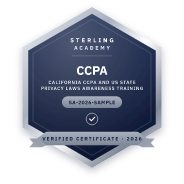
Verifiable certificate with a QR code anyone can scan, plus a digital badge to add to your LinkedIn profile.
See how verification works →Save when you take more than one course
The discount is added automatically in your basket.
Standard and editionCalifornia CCPA as amended by the CPRA, and US state privacy laws
Last updated10 November 2026
Preview this course
Watch a sample from California CCPA and US State Privacy Laws Awareness Training before you enrol.
What learners say
Every course is built by the experts behind 8,100+ client engagements in 60+ countries, so you learn what auditors and regulators actually expect. Here is what professionals said after finishing their course.
Informative
10/10 for Philippines Data Privacy Act and DPO Training
Best value
All-Access Pass
A pharma and life sciences professional from the USA started with one course, then upgraded to the All-Access Pass.
Every Sterling Academy course for 12 months.
US$499
See the passA selection of comments from learners who finished a course and answered our feedback request, shortened from their own words. Client names available on request.
Learning outcomes
Connect the subject to the responsibilities and decisions people encounter in their roles.
Part of: Privacy and Data Protection Training
Inside the course
10 modules, 10 practice checkpoints and a final exam. Video runtimes are approximate; allow additional time for the practice questions and the final exam. Modules marked optional can be skipped; the others are studied in any order.
Introduces the California Consumer Privacy Act, as amended by the CPRA, its regulator CalPrivacy and recent enforcement cases.
Opens the California CCPA and US State Privacy Laws Awareness training course by asking whether a customer's request to stop selling data would reach every system. Describes the Attorney General's settlements with The Walt Disney Company and General Motors, and CalPrivacy's decisions against American Honda and Tractor Supply. Introduces the CCPA, the CPRA and the regulations updated from 1 January 2026, who counts as a consumer, including job applicants and staff, and the four everyday moments. Presents PXR Fitness Inc., the Los Angeles gym and app business the course follows, and notes the course is not legal advice.
What you will be able to do
Why it matters
A privacy choice is only real if every system respects it, and recent cases have cost businesses millions of dollars.
Practice: Practice: Why California privacy law matters · 3 questions
Explains who the CCPA covers: the definition of a business, the three thresholds, service providers, contractors and third parties.
Starts with a small gym operator in Fresno that believes the privacy law is only for big companies. Explains the four parts of the definition of a business and the three thresholds, of which only one need be met, and how CalPrivacy adjusts the money figures for inflation. Covers group companies sharing common branding, the end of the exemption for staff and job applicants on 1 January 2023, and the roles of service provider, contractor and third party. Introduces CalPrivacy and the Attorney General, the main exemptions, and a four-question check, with examples from San Jose and San Diego. The rest of the training course applies these roles.
What you will be able to do
Why it matters
Small revenue does not settle coverage, so checking all three thresholds each year avoids a wrong assumption.
Practice: Practice: Who the CCPA covers · 3 questions
Covers personal information and sensitive personal information under the CCPA, including cookies, device IDs, inferences and exclusions.
Begins with a PXR analyst who assumes a file of device IDs, heart-rate readings and check-in times is anonymous. Explains the broad definition of personal information, covering households and any format, including AI systems, and the categories the Act lists, with unique identifiers such as cookies and pixel tags. Sets out sensitive personal information, from ID numbers and precise geolocation to neural data, biometrics and health, and inferences used to build profiles. Covers publicly available, deidentified and aggregate information and their conditions, with examples from a San Diego clinic and a Fresno car dealer.
What you will be able to do
Why it matters
Data without names is often still in scope, so labelling what you hold correctly underpins notices, rights and contracts.
Practice: Practice: Personal and sensitive information · 3 questions
Explains the CCPA notice at collection, the privacy policy, the purpose limitation rule and how long personal information may be kept.
Starts with a partner insurer offering to pay for members' running routes from PXR's app. Covers the four things people must be told at or before collection, where the notice must appear, and what it must contain, shown at a PXR gym desk in Los Angeles. Explains the privacy policy and its yearly update, then the rule that each use must be reasonably necessary and proportionate and fit people's reasonable expectations, with the regulations' factors, minimum data and consent for other purposes. Revisits the General Motors case and explains retention, with examples from San Jose and Oakland.
What you will be able to do
Why it matters
A notice tells people the purpose but does not stretch it, so starting with the purpose keeps new uses lawful.
Practice: Practice: Notices, purposes and keeping data · 3 questions
Covers CCPA consumer rights to know, delete and correct, how requests arrive, the forty-five day deadline and verification.
Opens with a PXR contact-centre agent who tells a caller asking for deletion to send an e-mail instead, and forgets to log the call. Explains the rights to know, delete and correct, the look-back period, the exceptions to deletion and telling service providers and third parties to delete too. Covers the designated request methods, confirming receipt within ten business days, responding within forty-five calendar days and the one extension, and reasonable verification. Describes CalPrivacy's Honda decision, the rule against retaliation and the staff member's part, with examples from San Francisco and Sacramento.
What you will be able to do
Why it matters
The clock starts when the request arrives, so logging and routing it the same day keeps the business within the law.
Practice: Practice: Consumer rights and requests · 3 questions
Explains selling and sharing under the CCPA, the right to opt out, opt-out preference signals, young people and the right to limit.
Starts with PXR's marketing manager, whose website pixels send visitors' data to an advertising network and which she calls analytics. Defines selling and sharing for cross-context behavioural advertising, and the disclosures that are neither. Covers the right to opt out, the required links, the regulations' rules on methods and the fifteen business day limit, and opt-out preference signals such as the Global Privacy Control. Revisits the Disney settlement and describes the Todd Snyder decision. Explains opt-in for under sixteens and the right to limit sensitive data, with examples from a San Jose games app and a San Diego clinic.
What you will be able to do
Why it matters
An opt-out only counts if every system honours it, so testing tags and signals avoids the failings seen in recent cases.
Practice: Practice: Selling, sharing and opting out · 3 questions
Covers consent and dark patterns under California's privacy regulations, the five design principles, and the contracts the CCPA requires.
Begins with PXR's app team redesigning a sign-up screen with a large Yes button, a small Ask me later link and a false countdown clock. Defines consent and dark patterns, and explains that agreement obtained through dark patterns is not consent. Sets out the five principles for designing requests and consent, with the regulations' examples of symmetry, confusing language, choice architecture and friction, and trained staff on request lines. Revisits the Honda decision, then explains the agreements required for disclosures to third parties, service providers and contractors, with examples from Oakland and Fresno.
What you will be able to do
Why it matters
If the design pushes people the consent does not count, so fair screens and the right contracts decide how the law treats data.
Practice: Practice: Dark patterns and contracts · 3 questions
Explains reasonable security, cybersecurity audits, risk assessments and the new CCPA rules on automated decisionmaking technology.
Follows PXR's HR adviser, whose screening tool rejects the lowest-scoring job applications with no one reading them. Covers the reasonable security duty and consumer lawsuits after certain breaches, then the annual cybersecurity audit, who must complete one and the staged first deadlines. Explains which processing needs a risk assessment and the deadlines, then automated decisionmaking technology, significant decisions, the Pre-use Notice, opt-out or human appeal, and access, due by 1 January 2027, with the narrow hiring exception. Notes that CalPrivacy's 2026 preliminary comment periods are not regulations, and sets out PXR's plan.
What you will be able to do
Why it matters
If nobody really decides the technology decides, so trained reviewers and clear notices keep significant decisions lawful.
Practice: Practice: Security, assessments and ADMT · 3 questions
Covers other US state privacy laws: Virginia's Consumer Data Protection Act, the Connecticut Data Privacy Act and the Texas Act.
Starts with PXR's growth into Virginia, Connecticut and Texas, and the question of whose rules apply to new customers. Explains the common shape of these laws: controllers, processors, rights, opt-outs and consent for sensitive data. Covers Virginia's thresholds, its exclusion of the employment context, rights, appeals and Attorney General enforcement with a cure period. Explains Connecticut's tests, opt-out preference signals, assessments and protection for minors under eighteen, and the Texas Data Privacy and Security Act. Compares the four laws, notes California's browser signal setting from 1 January 2027, and adds examples from Richmond and Dallas.
What you will be able to do
Why it matters
Similar laws are not identical, so knowing whose data you hold and where they live avoids applying the wrong state's rules.
Practice: Practice: Other US state privacy laws · 3 questions
Explains CCPA enforcement, fines per violation, the lessons of recent cases, other states' enforcement and your everyday habits.
Opens with an imagined letter from CalPrivacy to PXR after a member complains that her opt-out did not work. Sets out the fines per violation and their inflation-adjusted figures, and looks back at the Honda, Todd Snyder, Tractor Supply, Disney and General Motors cases, including Tractor Supply's wider commitments. Draws four lessons, explains how cases begin with consumer complaints, and covers enforcement in Virginia, Texas and Connecticut. Gives what to do with a regulator's letter, eight everyday habits and who to ask, with examples from San Diego and San Jose, and closes the training course.
What you will be able to do
Why it matters
Every case came down to a form, a link, a tag or a contract, so everyday habits stop small problems becoming cases.
Practice: Practice: Enforcement and your role · 3 questions
About this course
California's privacy law is being enforced, and the amounts are growing. In September 2025, the California Privacy Protection Agency, now known as CalPrivacy, fined a national retailer $1.35 million, partly for failing to tell job applicants about their rights and for not offering an effective way to opt out. In February 2026, the Attorney General announced a $2.75 million settlement with a major entertainment company whose opt-outs stopped at a single device. In May 2026, a carmaker agreed to $12.75 million in civil penalties for selling drivers' location data and keeping it long after it was needed. New regulations took effect on 1 January 2026, bringing risk assessments, cybersecurity audits and rules on automated decisionmaking technology, with deadlines from 2027. Most failures start with everyday work: a form, a website tag or a missing contract.
The course is taught from the official texts: the California Consumer Privacy Act as published by CalPrivacy and updated in January 2026, the CCPA Regulations effective 1 January 2026, and official pages from the Attorneys General of California, Connecticut and Texas and the Code of Virginia. Every rule is cited, and every date is shown. It covers which businesses the law reaches and who it protects, including staff and job applicants, personal and sensitive personal information, notices and purpose limits, the rights to know, delete and correct, selling and sharing, opt-out links and browser signals, young people, dark patterns, contracts, security, risk assessments, cybersecurity audits and automated decisionmaking. Real cases come only from the regulators' own releases. One fitness company with its head office in Los Angeles runs through every module.
The course is written for everyone who handles the personal information of California residents: front-desk, contact-centre and customer service staff who collect details and receive requests; marketing and web teams who run advertising pixels, cookies and consent screens; HR teams who recruit and manage staff; IT, security and product teams who build systems and choose suppliers; outsourcing teams abroad who work on Californians' data; and team leaders and managers. A short module covers the laws of Virginia, Connecticut and Texas for businesses with customers in several states. No legal background is needed. It is awareness training, not legal advice: decisions about your own organisation belong with your privacy lead or a qualified lawyer. For EU law, Sterling Academy's GDPR Awareness course is separate.
After the course, you can tell whether the CCPA covers a business and what role each company plays, recognise personal and sensitive personal information, and make sure people get the right notice at or before collection. You can judge whether a use fits what people were told and would expect, and how long data should be kept. You can recognise a request to know, delete or correct in any words, log it and route it the same day, and understand the time limits and verification rules. You can spot selling and sharing, honour opt-out links and browser signals, apply the rules for under sixteens, design fair choices without dark patterns, and check that supplier contracts are in place. The scenario-based final exam leads to the Sterling Academy Certificate of Completion for those who reach the final exam's pass mark, with one retake included.
Module 1: introduces the California Consumer Privacy Act, as amended by the CPRA, its regulator CalPrivacy and recent enforcement cases. Module 2: explains who the CCPA covers: the definition of a business, the three thresholds, service providers, contractors and third parties. Module 3: covers personal information and sensitive personal information under the CCPA, including cookies, device IDs, inferences and exclusions. Module 4: explains the CCPA notice at collection, the privacy policy, the purpose limitation rule and how long personal information may be kept. Module 5: covers CCPA consumer rights to know, delete and correct, how requests arrive, the forty-five day deadline and verification. Module 6: explains selling and sharing under the CCPA, the right to opt out, opt-out preference signals, young people and the right to limit. Module 7: covers consent and dark patterns under California's privacy regulations, the five design principles, and the contracts the CCPA requires. Module 8: explains reasonable security, cybersecurity audits, risk assessments and the new CCPA rules on automated decisionmaking technology. Module 9: covers other US state privacy laws: Virginia's Consumer Data Protection Act, the Connecticut Data Privacy Act and the Texas Act. Module 10: explains CCPA enforcement, fines per violation, the lessons of recent cases, other states' enforcement and your everyday habits.
Frequently asked questions
About California CCPA and US State Privacy Laws Awareness Training, its certificate and enrolment.
Ask SterlingYes. Sterling Academy's California CCPA and US State Privacy Laws Awareness training is built by the Sterling consulting group, which has taken organisations to certification across 8,100+ client engagements in 60+ countries over 20+ years. It comes with practice questions that show the right answer. Each course ends with a final exam and a verifiable certificate that anyone can check online, plus a LinkedIn badge, and client administrators can show an auditor exactly who has been trained. You will be able to apply California CCPA and US State Privacy Laws Awareness at work and show your competence with confidence. Sterling Academy courses carry the same content as Sterling's classroom training, whose certificates are trusted and accepted by all major certification bodies, as evidence of training at client audits for over 20 years.
It is for employees, team leaders and managers who handle consumer, customer or employee data for businesses that serve people in California or other US states, including marketing, e-commerce, customer service, HR and IT teams, and outsourcing providers working for US clients. No legal background is needed. One Los Angeles company is the example throughout.
Yes. It uses the CCPA text and the CCPA Regulations published by the California Privacy Protection Agency with effect from 1 January 2026, including the rules on risk assessments, cybersecurity audits and automated decisionmaking technology, each with the dates on which its duties apply. Proposals that are still in preliminary rulemaking are named as proposals only.
Short practice questions after each module help you check your understanding; they do not count toward the result. The course ends with a scenario-based multiple-choice final exam. Learners who reach the final exam's pass mark receive a Sterling Academy Certificate of Completion, and one retake is included. Each certificate carries a unique number and a QR code for online checking.
It teaches the California law in depth, because it is the most detailed and widely applied. Other state consumer privacy laws are named, with their status and dates checked on each state's official site, so that you know which ones may apply and when to ask your privacy team. It does not teach each state's law in detail.
The course is in preparation. Register on this page with “Notify me when it opens” and we will send you one e-mail when it opens for enrolment, with the price per learner and the details for team enrolment. The course page will then show the full module list and the video runtime.
Sources
Your certificate
You will be able to apply California CCPA and US State Privacy Laws Awareness at work and show your competence with confidence. Your certificate can be verified online in seconds, so certification body auditors, employers and clients can confirm your training instantly.
Complete the course and its final exam and you receive a Sterling Academy Certificate of Completion, verifiable online by QR code, with a LinkedIn badge to share.
Sterling Academy courses carry the same content as Sterling's classroom training, whose certificates are trusted and accepted by all major certification bodies, as evidence of training at client audits for over 20 years.
Ask about course requirementsYour next step
Not sure which course?