Ready to put this into practice?
Expert and experienced consultants, 8,100+ client engagements in 60+ countries, from gap assessment to a system ready for its certification audit.
Talk to a Sterling consultantPractitioner training · Risk management
Part of the ISO 9001:2026 learning path → Step 3
Online training to bring a structured approach to risk decisions.
The training follows the risk management process from identification to treatment, using ISO 31000:2018 as the foundation for a consistent approach.
Built on ISO 31000:2018, the training applies one method to the risk requirements of ISO 9001, ISO/IEC 27001 and ISO 45001.
Secure payment by Stripe · for yourself or for your team
Add another course and save 15%, up to 25%
What you get
About 3 hours, with captions. Watch at your own pace on any device.
Short questions check your understanding before you move on.
Multiple choice, with one retake if you need it.
Industry experts, domain specialist trainers and globally renowned auditors with 30+ years in ISO and GRC.
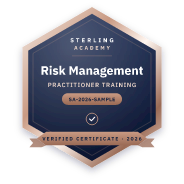
Verifiable certificate with a QR code anyone can scan, plus a digital badge to add to your LinkedIn profile.
See how verification works →Save when you take more than one course
The discount is added automatically in your basket.
Standard and editionISO 31000:2018
Last updated28 September 2026
Preview this course
Watch a sample from Risk Management (ISO 31000:2018) before you enrol.
What learners say
Rated 10/10 by a learner
Truly enjoyed
A professional who finished Risk Management (ISO 31000:2018) Training
US$29
More courses professionals rated 10/10
Best value
All-Access Pass
A pharma and life sciences professional from the USA started with one course, then upgraded to the All-Access Pass.
Every Sterling Academy course for 12 months.
US$499
See the passA selection of comments from learners who finished a course and answered our feedback request, shortened from their own words. Client names available on request.
Learning outcomes
Connect the subject to the responsibilities and decisions people encounter in their roles.
Inside the course
26 modules, 26 practice checkpoints and a final exam. Video runtimes are approximate; allow additional time for the practice questions and the final exam.
Shows that everyday caution is already risk management and defines risk as the effect of uncertainty on objectives.
Opens with four everyday situations, such as crossing a busy road or sharing a card number, to show that people already weigh how likely and how bad. Gives that instinct its name, compares dictionary meanings with the ISO 31000:2018 definition tied to objectives, and shows how objectives differ in quality, information security, food safety, medical devices and health and safety. Outlines the method, what ISO 9001 and ISO/IEC 27001 ask, the ISO 45001 view of health and safety, and keeping the work alive between audits.
What you will be able to do
Why it matters
One method for every standard means the same two questions, how likely and how bad, work in quality, security and safety alike.
Practice: Practice: Your instinct already has a name · 3 questions
Explains why every risk must start from a real objective, and builds a risk from three blocks with two questions.
Argues that organisations manage risk to reach their objectives, not to satisfy an auditor, and that generic rows such as 'IT failure' have no objective behind them. Builds a risk from three blocks: an objective, an uncertainty and its effect. Introduces the two questions, how likely and how bad (ISO 31000 speaks of likelihood and consequence), then tries the idea on eight jobs, including an HR officer, a bank cashier, a purchase manager and a maintenance engineer, with model answers.
What you will be able to do
Why it matters
Rows tied to objectives show why each risk matters, so the register protects the business and not only the audit.
Practice: Practice: No objective, no risk · 3 questions
Describes risk management as coordinated action before an incident, not firefighting, and shows how to find the risks that keep people awake.
Starts from worst cases such as fire, ransomware and a failed investment, then explains risk management in ISO 31000's terms as coordinated, proactive effort woven into every part of the organisation. Contrasts firefighting with asking 'what if?' in advance, lists what it covers, including opportunities, and goes department by department through operations, IT, HR, finance and health and safety, using what keeps people awake as the test for the register.
What you will be able to do
Why it matters
Asking the question before the incident means the answers are already in the register, with someone working on them, when an auditor asks.
Practice: Practice: Before the incident: what keeps you awake · 3 questions
Looks at the evidence that formal risk management pays, real cases where the whole business paid, and how the main frameworks fit together.
Presents the 2022 PwC survey result and six benefits of a formal approach, noting that it measured confidence and expected growth. Reviews cases involving Ford, Pratt & Whitney, BT, Change Healthcare and PhilHealth, where the whole business paid. Then places ISO 31000 as the umbrella over COSO, ISO/IEC 27005 and NIST, with techniques such as FMEA and HACCP working inside the process rather than instead of it.
What you will be able to do
Why it matters
Seeing that the whole business pays helps you make the case for risk work to leadership in terms they care about.
Practice: Practice: Why it pays, and when it fails · 3 questions
A workshop in which you write five risks for your own function and test each one with three questions to turn worries into risks.
Works as a hands-on exercise. You write five risks for your own function, with prompts from quality, delivery, people, information and safety, and near misses as clues. Each is tested with three questions: which objective it threatens, what the uncertain event is, and what it would cost. Vague lines such as 'cyber attack' or 'our systems are old' are sharpened into risks that a stranger could read and act on. The module closes the first part of the course.
What you will be able to do
Why it matters
Specific rows can be scored, owned and acted on, while vague ones such as 'IT issues' cannot.
Practice: Practice: Your turn: risk, or just a worry? · 3 questions
Presents the purpose of ISO 31000:2018 and its eight principles, each turned into a test you can run on your own risk process.
Opens with a register written only for the auditor, then states the purpose of risk management as creating and protecting value. Walks through all eight principles, from integrated to continual improvement, each turned into a test. The customised principle is illustrated by two BPOs in Manila, and a Dubai site that copies a Pune register. Ends with three tests to run this week on a recent supplier, two departments' scores and the oldest unchanged row.
What you will be able to do
Why it matters
The tests show where your risk process is weak and keep the register useful to real decisions, not just to the auditor.
Practice: Practice: Eight principles, one purpose · 3 questions
Shows the evidence an auditor sees when risk management is real, the seven steps of the method and the consultation thread through them.
Starts with the auditor's question, 'show me where risk changed a decision last quarter', and lists four signs of real evidence: risk in meetings, one matrix and format, rows that name real things, and dated updates. Sets out the seven steps drawn from ISO 31000:2018, from scope, context and criteria to recording and reporting, with communication and consultation throughout. Uses an unnamed BPO's ISO/IEC 27001 audit where HR described something different from the corporate register.
What you will be able to do
Why it matters
Consulting the people who run each process before deciding, and sharing decisions afterwards, makes the register theirs and not one person's.
Practice: Practice: What real looks like, and the thread · 3 questions
Explains what must be agreed before any scoring: scope, context and written criteria, including appetite, tolerance and who may accept which risk.
Starts from an audit in which nobody knew the written acceptance criteria. Sets out the three things fixed first: scope, context and criteria. Explains risk appetite and tolerance, which ISO 31000:2018 sets at the start and ISO/IEC 27005 defines formally, with numeric examples, and turns appetite into a rule for low, medium, high and critical risks, tested on a forklift walkway case in a Jeddah warehouse. Insists the rules are written, communicated and frozen before scoring, then reviewed when the context changes.
What you will be able to do
Why it matters
Agreed rules keep scores comparable across departments and across the year, and make acceptance decisions defensible.
Practice: Practice: Rules first: scope, context, criteria · 3 questions
Teaches one formula for writing a risk statement, cause, event and impact on an objective, and the three parts of risk assessment.
Separates risk assessment into identification, analysis and evaluation, then gives one formula, using ISO 31000:2018 words such as risk source and consequence: a cause may result in an event, leading to an impact on an objective. Explains what makes each part good, introduces the outsider test, and notes that the same formula can describe an opportunity. Rewrites two-word rows such as staff turnover, IT failure and late delivery for a BPO in Cebu, a hotel group in Dubai and a garment maker in Chennai.
What you will be able to do
Why it matters
A row that a stranger can score and act on lets you prioritise and decide what to fix.
Practice: Practice: Write the risk so anyone can act · 3 questions
Covers the six risk categories and the many sources that should feed the register all year, so that no category inside your scope is left blank.
Opens with a forty-row register that has no legal or people risks. Names six categories: strategic, operational, legal and compliance, health, safety and environment, information security, and quality, product, service and projects. Lists sources inside and around the organisation, including near misses, audits, change and suppliers, with the Heathrow substation fire and a government portal breach in Australia as examples. Explains a category sweep and writes sample rows as full sentences.
What you will be able to do
Why it matters
A sweep by category and source finds the blind spots one team's view leaves, such as missing legal or people risks.
Practice: Practice: Every category, every source · 3 questions
A workshop in which you write eight to ten risks for your own company, check them against the six categories and compare with a model answer.
Sets the task: write eight to ten risks for your own company as cause, event and impact, with at least four on quality or operations, three on information and one on people. Then compares your list with a model from a 150-person food-packaging company near Pune, checked against the grid of six categories. Names two common mistakes: one category taking over the list, and statements that name no process, supplier or system.
What you will be able to do
Why it matters
A first register built on your own processes gives the later scoring and treatment modules something real to work on.
Practice: Practice: Your turn: ten risks for your company · 3 questions
Builds anchored likelihood and impact scales from 1 to 5 so that scores rest on evidence, and shows why the worst impact applies.
Explains that analysis counts existing controls and then scores likelihood and impact from 1 to 5, noting that no ISO standard fixes the numbers. Builds the house likelihood scale with frequency, chance and evidence at each level, and an impact scale across money, legal, operations and reputation, and people. Shows that the worst dimension sets the impact, and how to handle differing scores, which ISO 31000 asks to be written down and shared, starting from a server room case in Manila.
What you will be able to do
Why it matters
Scales with clear anchors replace arguments about seniority with arguments about evidence, so scores can be defended.
Practice: Practice: Scales you can defend · 3 questions
Turns likelihood times impact into one of four zones and a decision, and shows why a credible worst impact of 5 goes to top management.
Opens with the BT emergency-call failure of June 2023 and the Ofcom fine. Explains the score from 1 to 25 and the four zones: low, medium, high and critical. Scores three rows with you, and shows that equal scores can call for different decisions. States the house rule that any credible worst impact of 5 goes to top management, citing ISO 31000 on hard-to-quantify events and ISO/IEC 27005 on thresholds for extreme consequences, then returns to BT to ask which dimension should set its impact.
What you will be able to do
Why it matters
A fixed matrix shows where to look first among hundreds of risks and what each zone requires you to do.
Practice: Practice: One matrix, four zones, three rows scored · 3 questions
Covers deciding between accepting and treating a risk against written criteria, who must sign, and why a treated risk is scored twice.
Starts with an operations manager accepting a warehouse fire risk in one line of e-mail. Explains evaluation against written acceptance criteria, when a high risk may be accepted (ISO/IEC 27005 asks for explicit justification), the other outcomes ISO 31000 adds, and the three things that must then happen. Sets out who signs for low, medium, high and critical risks, and the difference between inherent and residual scores, ending with an IT services case from Bengaluru.
What you will be able to do
Why it matters
Clear sign-off authority means no high risk is carried in silence, and leadership knows which serious risks the business accepts.
Practice: Practice: Accept or treat, and who signs · 3 questions
Covers the four Ts and the wider ISO 31000 options, the new risks a response can create, and a treatment plan someone can sign.
Introduces the four Ts: terminate, transfer, tolerate and treat, with the wider ISO 31000 options, a similar list in a note to clause 6.1.2 of ISO 9001:2026 and the March 2026 drone strikes on cloud data centres in the Gulf as a case of transfer. Applies them to three invented risks, warns that every response can create a new risk, and sets out a treatment plan with the risk, controls, owners, dates, resources and a measure, ending with the owner's signature, shown for a Brisbane flood risk.
What you will be able to do
Why it matters
A signed plan with a measure turns the decision to treat a risk into action, and shows when the treatment is not yet working.
Practice: Practice: Four Ts, new risks and the plan · 3 questions
A workshop on building register rows from cause to signed residual, with worked rows, then scoring and treating your own top five risks.
Begins with a fragile roof fall in Northumberland and the HSE finding of no risk assessment. Walks through the register columns: identify, owner, inherent, treatment and residual, using rows for multi-factor authentication, a single supplier and the roof. Then you score the risks from Module 11, choose responses for your top five and name one owner for each. Shows one register serving ISO 9001, ISO/IEC 27001 and ISO 45001 at once. Names three common mistakes, including scores that ignore existing controls and residuals of zero.
What you will be able to do
Why it matters
A complete row lets a stranger carry on if the owner leaves, and stands up when an auditor checks the arithmetic.
Practice: Practice: Your turn: build the register · 3 questions
Explains how to keep a register alive through two review loops, the records to keep, and reporting to owners, leadership and the board.
Describes step six of the ISO 31000 process as two loops: monitoring the risks and reviewing the process, with a quarterly, annual and trigger-based rhythm. Works through a rescoring case after a phishing wave. Lists the four records to keep, reporting for each audience, a risk management system such as Effivity, and turning a risk into money for leadership. Closes with the NHTSA consent order against Ford and its US$165 million penalty.
What you will be able to do
Why it matters
Dated reviews and minutes show an auditor a working tool, and give leadership the picture it needs to act.
Practice: Practice: Keep it alive: review, record, report · 3 questions
Shows where risk appears in ISO 9001:2026, from context to management review, and what the 2026 edition changed for risks and opportunities.
Notes that the ISO management system standards all address risk, then explains how little method ISO 9001 imposes: you decide, and show evidence. Maps risk through clauses 4.1, 4.2, 6.1, 6.3, 8.1, 9.1.3 and 9.3.2, with a BPO example in the Philippines. Covers the 2026 changes: separate clauses 6.1.2 and 6.1.3 for risks and opportunities, and climate change as a question in context.
What you will be able to do
Why it matters
Knowing the clause map lets you show an auditor evidence that risks were found, acted on and checked.
Practice: Practice: ISO 9001:2026: where risk lives · 3 questions
Finds quality risk process by process with the people who run each one, and follows each risk round the loop an auditor traces.
Shows that risks live in processes such as enquiry handling, recruitment and final inspection, found by asking what can go wrong when work is done perfectly and when it is done poorly. Walks one process at an IT services firm in Pune into three register rows. Follows the loop through clauses 6.1, 8.1, 9.1.3, 9.3.2 and 10.2.1 of ISO 9001, uses the RTX and Pratt & Whitney powder metal case, and says ISO 9001 requires no documented risk procedure.
What you will be able to do
Why it matters
Involving process owners finds risks where the work happens, and the closure check stops the register going stale.
Practice: Practice: ISO 9001:2026: process by process · 3 questions
Shows why risk is the engine of ISO/IEC 27001 and what it adds to the method: criteria, the C, I, A lens, owners, threats and weaknesses.
Contrasts ISO 9001, where risk is one feature, with ISO/IEC 27001, where criteria, assessments, owners, treatment plans and approvals are required. Separates strategic risks under clause 6.1.1 of ISO/IEC 27001 from operational risks under 6.1.2, then defines threat and vulnerability, and confidentiality, integrity and availability, with model pairs. Closes with the PhilHealth ransomware attack of September 2023.
What you will be able to do
Why it matters
Naming threat, weakness and loss makes an information risk precise enough to treat, and meets an auditor's request for criteria and owners.
Practice: Practice: ISO/IEC 27001 (1): risk is the engine · 3 questions
Compares event-based scenarios from the top down with asset-based analysis from the bottom up, and shows when to use each or both.
Explains the two ways to find information security risks and that ISO/IEC 27001 requires neither, as ISO/IEC 27005 confirms. The event-based approach builds scenarios from risk sources, paths, targets and consequences, and the asset-based approach lists threats and weaknesses for each asset. Applies both to the same BPO in Manila serving a bank's card customers, lists six sample rows, and has you choose the approach for a board strategy day, 40 servers and a new client portal.
What you will be able to do
Why it matters
Boards get scenarios they can fund and control owners get detail they can act on, from the same underlying risk.
Practice: Practice: ISO/IEC 27001 (2): scenarios or assets · 3 questions
Takes information security risks through treatment to the Statement of Applicability, and shows what one missing control can cost.
Opens with the Change Healthcare attack of February 2024, where a portal lacked multi-factor authentication. Sets out the six steps of clause 6.1.3 of ISO/IEC 27001, in which the risk decides and Annex A checks, and the four themes of 93 controls. Shows what a Statement of Applicability line says, then clauses 8.1, 8.2, 8.3 and 9.3 of ISO/IEC 27001, the documents required, and why risk owners approve the plan and accept the residual risk.
What you will be able to do
Why it matters
A control tested on every path, and traceable to a risk, stands up when an auditor points at one line of the Statement.
Practice: Practice: ISO/IEC 27001 (3): risks to the SoA · 3 questions
Applies the risk method to people's safety: what a hazard is, where to look for hazards before harm, and how to size the risk honestly.
Introduces the third lens under ISO 45001, in which a hazard leads to an event or exposure and then to injury or ill health. Lists kinds of hazard, and six things the hazard-finding process must look at, including non-routine work, human factors, contractors, change and past incidents. Covers scoring on a method and criteria the organisation defines, as ISO 45001 asks, that counts only controls that work, then opportunities, legal requirements and emergencies, using a loading bay in Riyadh and a night jam in Laguna.
What you will be able to do
Why it matters
Finding hazards before anyone is hurt means safety work does not wait for an injury to write the assessment.
Practice: Practice: Hazards, found before harm · 3 questions
Explains consultation and participation of workers under ISO 45001, the barriers to speaking up, and the right to step away from danger.
Contrasts consultation, asking for views before deciding, with participation, taking part in the decision, under clause 5.4 of ISO 45001:2018. Lists where non-managerial workers should take part. Uses a foundry night shift in Chennai to show the cost of silence, then four barriers: fear of reprisal, language, literacy and nobody replying. Ends with the right to step away from imminent, serious danger, tested on a new starter's first day in Leeds.
What you will be able to do
Why it matters
Bringing in the people who do the work finds hazards that an assessor walking past would miss.
Practice: Practice: The workers who know the hazards · 3 questions
Puts controls for people in order from elimination to PPE, keeps the duty when contractors work for you, and assesses change in advance.
Walks the five levels of the hierarchy in clause 8.1.2 of ISO 45001: eliminate, substitute, engineering, administrative and PPE, using the Northumberland roof row. Explains why handing work to a contractor does not eliminate a hazard, with a conveyor repair in Pune. Applies the order to a laundry chemical in Dubai, where cost never decides alone, then covers change, with a 12-hour night shift in Dammam, and revisiting assessments after incidents under clause 10.2 of ISO 45001.
What you will be able to do
Why it matters
Putting the harness last gives stronger protection for everyone, and a change assessed in advance does not become an incident.
Practice: Practice: Controls for people: the hierarchy · 3 questions
Brings quality, information and safety risks into one register with clear roles, a five-step roll-out and signs of a living risk culture.
Shows how separate registers give contradictory scores, as with a Dubai warehouse system risk, and recommends one register with each row tagged by lens. Sets out the roles of top management, the coordinator, risk owners, control owners and an optional risk committee. Gives five roll-out steps, from setting the structure to going live, and four signs that the culture has arrived. Closes the course with the final exam and the Certificate of Completion.
What you will be able to do
Why it matters
One register and one method give management review a single score for each risk, instead of contradictory ones.
Practice: Practice: One register, clear roles, a living culture · 3 questions
Frequently asked questions
About Risk Management (ISO 31000:2018), its certificate and enrolment.
Ask SterlingYes. Sterling Academy's Risk Management (ISO 31000:2018) training is built by the Sterling consulting group, which has taken organisations to certification across 8,100+ client engagements in 60+ countries over 20+ years. It comes with practice questions that show the right answer. Each course ends with a final exam and a verifiable certificate that anyone can check online, plus a LinkedIn badge, and client administrators can show an auditor exactly who has been trained. You will be able to apply Risk Management (ISO 31000:2018) at work and show your competence with confidence. Sterling Academy courses carry the same content as Sterling's classroom training, whose certificates are trusted and accepted by all major certification bodies, as evidence of training at client audits for over 20 years.
It is for risk owners and management system practitioners: managers, process owners and team members who identify, assess or treat risk, or who discuss risk decisions in their organisation. It suits people working with any ISO management system, as well as anyone who wants a structured, consistent way of talking about and managing risk.
The course follows the risk management process from identification to treatment, using ISO 31000:2018 as the foundation for a consistent approach. Learners understand the stages of the process, connect risk identification and assessment to treatment decisions, and learn to use a consistent approach when discussing and managing risk with colleagues and management. Built on ISO 31000:2018, the training applies one method to the risk requirements of ISO 9001, ISO/IEC 27001 and ISO 45001.
Risk Management is a set of short video modules followed by practice questions and a final exam. The course page shows the current number of modules and the approximate video runtime; allow additional time for the practice questions and the exam. With 12 months of access, you can complete it in one sitting or spread it over several sessions.
Yes. Learners who reach the 70% pass mark in the final exam receive a Sterling Academy Certificate of Completion for Risk Management. Each certificate carries a unique number and a QR code, and anyone can check it online using the certificate number and the holder's surname. It is a training certificate for the individual learner.
Yes. Risk Management is a self-paced online course made of short video modules, in English with captions. You study at your own pace during 12 months of access, and practice questions after modules help you check your understanding before the final exam. If a point is unclear, questions are answered by a Sterling consultant.
Risk Management is US$29 per learner. Teams save 20% for 11 to 50 learners and 30% for 51 to 200 learners; 201 or more learners are priced on request. Client administrators can track their team's progress. Prices are in US dollars, excluding taxes, and Sterling confirms final pricing and enrolment.
The course uses ISO 31000:2018, the international guidance standard on risk management, as the foundation for a consistent approach. It follows the risk management process from identification through assessment to treatment, so that learners can apply the same structured thinking to risks in quality, information security, health and safety or any other management system.
Your certificate
You will be able to apply Risk Management (ISO 31000:2018) at work and show your competence with confidence. Your certificate can be verified online in seconds, so certification body auditors, employers and clients can confirm your training instantly.
Complete the course and its final exam and you receive a Sterling Academy Certificate of Completion, verifiable online by QR code, with a LinkedIn badge to share.
Sterling Academy courses carry the same content as Sterling's classroom training, whose certificates are trusted and accepted by all major certification bodies, as evidence of training at client audits for over 20 years.
Ask about course requirementsYour next step
Not sure which course?