Get consulting from Sterling
Expert and experienced consultants, 8,100+ client engagements in 60+ countries, from gap assessment to a system ready for its certification audit.
Talk to a Sterling consultantAwareness training · Good practice (GxP)
Part of the Pharmaceutical GMP learning path → Step 1
GMP training for operators is what you need when new starters join the line next week, an inspection is coming, or your last audit found entries back-dated and gowning that slipped. You need people on the shop floor who understand why each rule exists, not only that it does.
This online training course turns good manufacturing practice into ten golden rules an operator can use on every shift: follow the instruction, record as you go, speak up, check identity and status, clear the line, dress and wash for the area, report when unwell, use clean and ready equipment, keep contamination out and protect the data. Each rule is linked in one line to the US FDA and EU GMP texts, and the course follows operators at a tablet and sterile injectables maker in Mumbai and Singapore through real situations.
GMP training for operators teaches production, packing, warehouse and cleaning staff the good manufacturing practice habits they apply on every shift: following instructions exactly, recording at the time, reporting deviations, preventing mix-ups, hygiene and gowning, clean equipment, contamination control and protecting electronic data, so that every batch they touch is safe for patients.
Training a team? Get a quote for your organisation
Part of: Pharmaceutical GMP and GDP Training
Part of: GMP & Medical Devices
Secure payment by Stripe · for yourself or for your team
What you get
About 103 minutes, with captions. Watch at your own pace on any device.
Short questions check your understanding before you move on.
Multiple choice, with immediate retakes if you need them.
Industry experts, domain specialist trainers and globally renowned auditors with 30+ years in ISO and GRC.
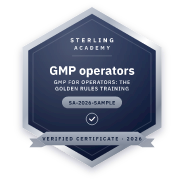
Verifiable certificate with a QR code anyone can scan, plus a digital badge to add to your LinkedIn profile.
See how verification works →Standard and editionGood manufacturing practice: 21 CFR Parts 210 and 211; EudraLex Volume 4
Last updated31 October 2026
Most serious GMP failures start with one person, one shift and one rule that slipped. The cases used in this course show it plainly.
In August 2023 a manufacturer recalled one lot each of digoxin tablets 0.125 mg and 0.25 mg because bottles of each strength contained the other, a label mix-up with risks of overdose and underdose for heart patients. In July 2023 FDA issued a warning letter to an Indian manufacturer after inspectors found bags of torn original GMP documents in scrap areas and on a truck, and an analyst who weighed samples several times without reporting all the results. In April 2026 the Croatian authority issued statements of non-compliance to a sterile medicine maker in India, citing poor gowning, poor personnel hygiene and deviations on the floor that went unaddressed until inspectors pointed them out.
None of these needed advanced science to prevent. They needed operators who check, record honestly and speak up.
The course is written for the people who make, pack, move and clean the product, and for the supervisors who train them. You will recognise your own day in it if you are:
By the end you will be able to explain each golden rule in your own words and show what it looks like at your workstation.
Module 1, Why your work protects patients: three real cases, what GMP means on the shop floor, the ten golden rules and the JKL Pharma example.
Module 2, Rule 1, follow the instruction: why exact steps matter, the instructions you use, being trained, and what to do when an instruction is unclear.
Module 3, Rule 2, record as you go: good entries, what your signature means, open corrections and what you must never do, such as pre-filling or back-dating.
Module 4, Rule 3, speak up: what a deviation is, the first minutes after one, honesty about mistakes and what happens next.
Module 5, Rules 4 and 5, identity and line clearance: status labels, the second-person check, labels on the floor, line clearance and printed materials.
Module 6, Rule 6, dress and wash for the area: why people are the main risk, clothing by area, clean hands, gowning, behaviour and access.
Module 7, Rule 7, report when you are unwell: what to report, who decides, health checks, sterile areas and returning to work.
Module 8, Rule 8, use only clean, ready equipment: four checks before use, cleaning, time limits, calibration, defects and the logbook.
Module 9, Rule 9, keep contamination out: cross-contamination, dust, beta-lactams, microbes, sterile basics, pests and waste.
Module 10, Rule 10, protect the data: your login, audit trails, what you never do, correcting mistakes and system failures.
Module 11, Putting the rules together: one shift with all ten rules, how to talk to an inspector, a recap and the final exam.
The golden rules are Sterling's own wording, but every one rests on the GMP texts inspectors use. In the US that is 21 CFR Parts 210 and 211, the current good manufacturing practice regulations for finished pharmaceuticals; in the EU it is the EU GMP Guide, EudraLex Volume 4, Part I. Both apply to any site that supplies those markets, wherever the site is.
You do not need to memorise the texts. The course shows, in one line per rule, where the requirement sits: for example, 21 CFR 211.28 on personnel responsibilities and hygiene, 211.100 on following written procedures and recording at the time, Chapter 4 of the EU guide on documentation, and Annex 11 on computerised systems and access. That one line is enough to answer an inspector who asks why you do what you do.
The course teaches the principles both regions share. It does not replace training on your own site procedures; it gives operators the reasons behind them, which makes the site training stick.
You can fit this training course around shifts and deadlines. It runs online as 11 on-demand video modules, about 2 hours of video in total, on a laptop, tablet or phone, and it remembers where you stopped. Each module ends with practice questions that show straight away whether the point has landed.
The course closes with a scenario-based multiple-choice final exam drawn from the course question bank. Complete the course and its assessed final exam (pass mark 70%, one retake included) and you receive a Sterling Academy Certificate of Completion in your name, ready to file with your training records. Throughout, you follow operators by role at JKL Pharma, a built example of a tablet site in Mumbai and a sterile injectables site in Singapore, so every rule is seen in a real production setting.
The training course is built around actions an operator takes at the workstation, so the change shows on the next shift, not after months.
Inducting a new shift, onboarding contractors or bringing a whole site up to the same standard before an inspection? A company plan puts everyone on the same course and the same ten rules, so supervisors can refer to them by number on the floor.
A client administrator adds people, assigns courses and follows progress through reports, so when an inspector or customer auditor asks who has been trained on what, the answer is ready. The organisation receives one invoice for the whole plan. Get a quote for your organisation and we will size the plan to your team.
Sterling Academy courses are built by industry experts, domain specialist trainers and globally renowned auditors with 30+ years of experience in ISO and GRC.
Sterling Academy is the training arm of Sterling International Consulting, with 8,100+ client engagements in 60+ countries over 20+ years. Every course teaches the current edition of its standard or guidance: this course reflects 21 CFR Part 211 and EudraLex Volume 4 Part I as currently published.
Preview this course
Watch a sample from GMP for Operators: the Golden Rules before you enrol.
Inside the course
11 modules, 11 practice checkpoints and a final exam. Video runtimes are approximate; allow additional time for the practice questions and the final exam. Modules marked optional can be skipped; the others are studied in any order.
GMP for operators: three real recalls and findings, the ten golden rules of good manufacturing practice, and how this GMP training course works.
Opens by asking you to think back to your last shift and what could have harmed a patient. Three real cases follow, each starting with something small on a shop floor, beginning with an August 2023 recall of digoxin tablets packed in bottles labelled with the wrong strength. Explains what GMP means for operators and sets out the ten golden rules, from following the instruction to protecting the data, each linked to the US FDA rules in 21 CFR Part 211 and to the EU GMP Guide. Introduces JKL Pharma, which makes tablets and capsules in Mumbai and fills a sterile antibiotic into vials in Singapore. Ends with how the eleven modules, practice questions, final exam and certificate work, and a three-point recap.
What you will be able to do
Why it matters
Seeing how a wrong label or a missing check reached real patients makes the reason behind each daily GMP habit clear.
Practice: Practice: Why your work protects patients · 3 questions
GMP rule 1 for operators: following the approved batch instruction and SOP every step, being trained first, and what to do when it is unclear.
Starts on a late shift at JKL Pharma's Mumbai site, where binder solution for a metformin granulation was added in three minutes instead of ten, and the batch had to be investigated. Explains rule one in plain words and what the US rules and the EU GMP Guide expect, then why validated steps change only through change control. Covers the two kinds of instruction: SOPs, batch and machine instructions, and the batch records, logbooks, forms and checklists where you show what you did. Shows training before working alone, three quick checks on the instruction itself, a good shift handover, and JKL Pharma's two-minute check at the start of every batch, with examples from a cream maker in Dublin and an active substance plant in Hong Kong. Ends with a quick check for your shift and a recap.
What you will be able to do
Why it matters
Following the tested steps protects you from time pressure and keeps today's batch as good as the batches that were validated.
Practice: Practice: Rule 1: follow the instruction · 3 questions
GMP rule 2, good documentation practice for operators: recording as you go, what your signature means, and correcting batch record errors.
Opens on a blister packing line at JKL Pharma's Mumbai site, where an end-of-line check written and signed in advance made the batch record false when the line stopped before the check was done. Explains rule two: record each step at the time, yourself, clearly, permanently and completely, on paper and on screen alike. Shows five marks of a good entry, what your signature states, and the July 2023 warning letter to Intas Pharmaceuticals describing torn and destroyed original documents. You then see a real page of a JKL Pharma packing record and how to correct an entry openly with one line, the new value, initials, date and reason. Examples come from a tablet maker in London and a sterile site in Boston. Ends with a quick check for the end of every task and a recap.
What you will be able to do
Why it matters
A record written before or after the event can stop a batch; entries made at the time let everyone trust what was done.
Practice: Practice: Rule 2: record as you go · 3 questions
GMP rule 3 for operators: speaking up about deviations and mistakes, what to do in the first minutes, and what happens after you report.
Starts with an April 2026 finding by Croatia's medicines authority at a sterile medicines maker in India, where inspectors saw production deviations that had never been reported, assessed or investigated, recorded as a critical deficiency. Explains rule three: report every deviation, mistake and unusual event without deciding yourself whether it is serious. Looks honestly at what stops people speaking up, such as fear of blame and time pressure. Covers what to do at once: stop if needed, secure the material, tell your supervisor and record the facts. Then shows what happens next, a good deviation report from JKL Pharma's Mumbai site, and how investigations look for system causes rather than someone to blame, with examples from a contract packer in Frankfurt and an inhaler maker in Tokyo. Ends with a quick end-of-shift check and a recap.
What you will be able to do
Why it matters
Speaking up early lets a problem be fixed before it reaches a patient, and an unreported deviation can cost a site its certificate.
Practice: Practice: Rule 3: speak up · 3 questions
GMP rules 4 and 5 for operators: checking material identity and status labels, and line clearance before every start to prevent mix-ups.
Returns to the August 2023 digoxin recall, where bottles of two strengths were labelled the wrong way round, a mix-up these two rules are meant to prevent. Explains rule four: read the name, code and batch on every material, container and item, use only released material, and never use anything in quarantine, rejected or unlabelled. Shows a real dispensing check at JKL Pharma's Mumbai site and the common mix-ups to watch for. Then explains rule five, line clearance before every start using a checklist, including hidden places, a second check and a signature, and accounting for every printed item, shown on the vial labelling line at JKL Pharma's Singapore site. Examples come from a generics maker in Sydney and a cream maker in Dublin. Ends with a quick check before every start and a recap.
What you will be able to do
Why it matters
Mix-ups are a common cause of recalls; label checks and line clearance stop the wrong product from reaching a patient.
Practice: Practice: Rules 4 and 5: identity and line clearance · 3 questions
GMP rule 6 for operators: gowning, hand hygiene and personal habits for each production area, from the warehouse to sterile filling.
Starts with the April 2026 finding by Croatia's medicines authority at a maker of sterile antibiotic powders in India, covering aseptic technique, the sterility of garments and disinfectants, and poor gowning and hygiene. Explains rule six: wear the clothing your area's procedure sets, inspect it before you put it on, change anything damaged at once, and wash your hands properly. Shows how the clothing changes across JKL Pharma's areas, from the warehouse uniform to the full sterile suit, hood, mask and goggles in Singapore, then follows a morning in the gowning room of the Singapore sterile site. Covers leaving food, jewellery and personal items outside and moving with care, with examples from a tablet maker in London and an eye drop maker in Hong Kong. Ends with a quick check before every entry and a recap.
What you will be able to do
Why it matters
People are a main source of contamination, so correct gowning and hygiene protect the product, and the patient, on every shift.
Practice: Practice: Rule 6: dress and wash for the area · 3 questions
GMP rule 7 for operators: reporting illness, open wounds and skin conditions before work, and how your supervisor decides what you can do.
Opens with a common choice: going in with a stomach bug and saying nothing because the line is short of people. Explains rule seven in plain words and what the US rules and the EU GMP Guide say about reporting health conditions and keeping people with an illness or open wound away from product. Covers what to report, including coughs, colds and skin conditions, and reporting before work or as soon as symptoms begin during the shift. Follows one morning at JKL Pharma's Mumbai site, when four operators spoke to their supervisor before the shift, and shows how the supervisor and medical staff decide what each person can do and when they return to normal work. Examples come from a sterile site in Frankfurt and a syrup maker in Boston, followed by how the rule is usually broken. Ends with a quick check and a recap.
What you will be able to do
Why it matters
An illness that seems minor to you can contaminate a medicine; reporting early protects the batch and the people who take it.
Practice: Practice: Rule 7: report when you are unwell · 3 questions
GMP rule 8 for operators: using only clean, calibrated, working equipment, with cleaning records, equipment logbooks and fault tagging.
Explains rule eight in plain words: before using any equipment, make sure it is clean and in date, calibrated where it measures, working properly and the right one for the job. Covers what the US rules and the EU GMP Guide expect: written cleaning procedures, calibration at defined intervals, logbooks for major equipment signed by the person who cleaned and the person who checked, and clear labels on defective equipment. Follows the start of a shift in JKL Pharma's Mumbai granulation and compression area, where the granulator is checked against the batch record and a balance fails its check. Then covers cleaning exactly as the procedure says, storing equipment clean and dry, and tagging faults instead of repairing them, with examples from a cream maker in Paris with an expired calibration sticker and a tablet maker in Tokyo with chipped tablets. Ends with common mistakes and a recap.
What you will be able to do
Why it matters
Equipment touches every dose, so a quick check before use stops dirty or faulty equipment from damaging a whole batch.
Practice: Practice: Rule 8: use only clean, ready equipment · 3 questions
GMP rule 9 for operators: preventing contamination and cross-contamination from dust, other products, microbes, pests and waste.
Returns to the April 2026 finding by Croatia's medicines authority on cross-contamination risk in beta-lactam production and people reaching into the most critical zone during aseptic work. Explains that contamination is kept out in two ways: by how the site is designed and by how each person works in it. Covers keeping dust down with extraction, closed containers, correct spill cleaning and shut doors, and how to clean a room so it really is clean. Shows the borders of separated areas, such as JKL Pharma's dedicated amoxicillin block in Mumbai with its own air handling, and the exit procedure, then follows one week at the Mumbai site. Covers microbes, pests and waste, with examples from a capsule maker in New York and a sterile site in Dubai. Ends with a quick check for every shift and a recap.
What you will be able to do
Why it matters
Cross-contamination can harm patients who never took the other product; daily habits keep each product as it was made.
Practice: Practice: Rule 9: keep contamination out · 3 questions
GMP rule 10 for operators: data integrity, why your login is your signature, and correcting paper and electronic batch record data openly.
Returns to the July 2023 FDA warning letter about torn original GMP records found in scrap areas and a recorded time changed by hand in an electronic batch record, with no audit trail review by quality. Explains rule ten: your login is your signature, so never share it, never use anyone else's, and lock the screen when you step away. Covers what you must never do: delete data, change times, throw away originals or quietly repeat a test, and what the EU GMP Guide and the EU rules for computerised systems expect on paper and on screen. Shows small events from the electronic batch records at JKL Pharma's Singapore site, with examples from a tablet maker in Frankfurt and a laboratory in Sydney. Ends with how the rule is usually broken, a quick check when you leave a screen, and a recap.
What you will be able to do
Why it matters
If the data cannot be trusted, neither can the medicine; protecting your login and records keeps every batch release defensible.
Practice: Practice: Rule 10: protect the data · 3 questions
All ten GMP golden rules across one operator's shift, how to answer an inspector's questions, and how the final GMP exam works.
Follows an operator on the metformin tablet line at JKL Pharma's Mumbai site through a whole shift: reporting a small cut at the gate, gowning in the change room, checking the tablet press against the batch record, completing entries and leaving everything right for the next person at the end of the shift. Shows how the ten rules connect and the habit behind them all: when in doubt, ask. Covers how to answer an inspector honestly and simply by showing the procedure or record and never guessing, with examples from Dubai and London. Gives you a short checklist to take to your own shift, recaps the ten rules, and explains the scenario-based final exam and the 60% score needed for the Certificate of Completion.
What you will be able to do
Why it matters
Seeing the rules across a whole shift shows that none takes long, and prepares you to answer an inspector with confidence.
Practice: Practice: Putting the rules together · 3 questions
Frequently asked questions
About GMP for Operators: the Golden Rules, its certificate and enrolment.
Ask SterlingYes. Sterling Academy's GMP courses are built by the Sterling consulting group, which has taken organisations to certification across 8,100+ client engagements in 60+ countries over 20+ years. They cover the awareness and specialist levels, always on the current edition, with practice questions that show the right answer. Each course ends with a final exam and a verifiable certificate that anyone can check online, plus a LinkedIn badge, and client administrators can show an auditor exactly who has been trained. You will understand what GMP asks of you, contribute to your organisation's implementation and audit readiness, and play your part with confidence when the auditor visits. Sterling Academy courses carry the same content as Sterling's classroom training, whose certificates are trusted and accepted by all major certification bodies, as evidence of training at client audits for over 20 years.
Awareness: Good Documentation Practice (GDocP) Training · Specialist: Cleaning Validation Training
GMP training for operators teaches shop-floor staff the good manufacturing practice habits they apply every shift. This course presents them as ten golden rules, from following the instruction and recording as you go to line clearance, gowning, clean equipment, contamination control and protecting data, each linked to the US FDA and EU GMP texts.
Anyone whose work can affect the quality of a medicine needs GMP training. That includes production and packaging operators, warehouse and dispensing staff, cleaning and maintenance technicians, contractors and team leaders. US and EU GMP rules both require personnel to be trained in GMP and in the operations they carry out.
Yes, GMP training is a regulatory requirement for staff in medicine manufacturing. 21 CFR 211.25 in the US and Chapter 2 of the EU GMP Guide require personnel to be trained in GMP and in their own tasks, with training carried out on a continuing basis. Your site decides the exact programme; this course covers the GMP part.
The course takes about 2 hours of video across 11 modules, plus the practice questions and the final exam. Most learners complete it in one or two sittings. Because it is on demand, operators can also take one module at the start or end of a shift and pick up where they stopped.
The ten golden rules in this course are: follow the instruction, record as you go, speak up about deviations, check identity and status, clear the line, dress and wash for the area, report when you are unwell, use only clean and ready equipment, keep contamination out, and protect the data with your own login and signature.
GMP for Operators builds the core habits from the start, one rule per module, so it suits new starters and inductions. The Annual GMP Refresher assumes those basics and revisits them each year with recent inspection findings and changes, so it suits staff who have already been trained and need their periodic update.
Yes, you receive a Sterling Academy Certificate of Completion in your name when you complete the course and take the final multiple-choice exam. The exam is assessed with a pass mark of 70%, and one retake is included if the first attempt does not reach it. You can file the certificate with your site training records.
The course costs US$19 per learner for full online access to the 11 video modules, the practice questions, the final exam and the certificate. Organisations training several people can ask for a company plan; contact us for a quote that fits the size of your team.
Yes, a company plan is designed for this. A client administrator adds operators, assigns the course, follows progress in reports and receives one invoice for the organisation. It is a simple way to give every shift, contractor and new starter the same GMP foundation before an inspection.
Yes, it covers both at an operator's level. Most rules apply in any area, and the modules on gowning, illness reporting and contamination add the basics of working in sterile areas, with examples from a tablet site and a sterile injectables site. Detailed aseptic processing is covered in our EU GMP Annex 1 course.
Your certificate
You will understand what GMP asks of you, contribute to your organisation's implementation and audit readiness, and play your part with confidence when the auditor visits. Your certificate can be verified online in seconds, so certification body auditors, employers and clients can confirm your training instantly.
Complete the course and its final exam and you receive a Sterling Academy Certificate of Completion, verifiable online by QR code, with a LinkedIn badge to share.
Sterling Academy courses carry the same content as Sterling's classroom training, whose certificates are trusted and accepted by all major certification bodies, as evidence of training at client audits for over 20 years.
Ask about course requirementsYour next step
Not sure which course?