Ready to put ISO 28000 Security and Resilience into practice?
Expert and experienced consultants, 8,100+ client engagements in 60+ countries, from gap assessment to a system ready for its certification audit.
Talk to a Sterling consultantAwareness training · Supply chain security
Online training to help every employee recognise security risks and protect the organisation and its supply chain.
Built by industry experts, domain specialist trainers and globally renowned auditors with 30+ years in ISO and GRC. 8,100+ client engagements in 60+ countries.
What you will be able to do
ISO 28000:2022 Security and Resilience Awareness explains how a security management system protects people, assets and the supply chain. Learners understand security risk assessment and treatment, security plans for response and recovery, incident reporting and the part every employee plays. The course is online and self-paced, and it finishes with a final exam and a verifiable certificate.
The training is a practical introduction to ISO 28000:2022, Security and resilience — Security management systems — Requirements: security risk assessment, security strategies and plans, the supply chain, and each person's part in security.
How the course works
Every Sterling Academy course takes you through the same stages, so you leave with a skill, not just a summary.
What you get
About 107 minutes, with captions. Watch at your own pace on any device.
Short questions check your understanding before you move on.
Multiple choice; retakes are unlimited and included in the price.
Industry experts, domain specialist trainers and globally renowned auditors with 30+ years in ISO and GRC.
Preview this course
Watch a sample from ISO 28000:2022 Security and Resilience Awareness before you enrol.
Inside the course
13 modules, 13 practice checkpoints and a final exam. Video runtimes are approximate; allow additional time for the practice questions and the final exam.
Shows what one security breach can cost a supply chain, how far security reaches beyond locks and guards, and what a management system adds.
Starts from a freight forwarder in Manila that loses cartons of phones from a sealed container. Lists the costs of a breach: the client, money, delays and reputation. Describes what security covers, including theft, tampering, things slipped in, access and information, and where supply chains break, at hand-overs and in quiet places. Explains how a security management system helps you assess, decide and align, and that ISO 28000:2022 sets its requirements, and corrects four common beliefs, using a device maker, a hotel and a bakery chain.
What you will be able to do
Why it matters
Shows why security belongs to everyone who touches goods, sites or information, not only to the guards.
Practice: Practice: Why security management matters · 3 questions
Introduces ISO 28000:2022: what it requires of an organisation, how it is built on plan, do, check, act, and who does what in certification.
A Singapore warehouse loses a tender to a rival with a working system. Explains the four things ISO 28000 asks of an organisation and the plan, do, check, act cycle with requirements in clauses four to ten, a structure shared with ISO 9001, ISO 14001, ISO/IEC 27001, ISO 22301 and ISO 45001. Separates it from ISO 28001, explains ISO 28000:2022 and the 2024 amendment, and shows that ISO writes the standard while a certification body audits. Lists four mistakes.
What you will be able to do
Why it matters
Helps you describe the standard accurately to customers, and avoid claiming that ISO itself audited or certified you.
Practice: Practice: ISO 28000: what it is and how it is built · 3 questions
Explains the purpose of security management and the eight principles the standard recommends, with the point that culture matters as much as equipment.
Opens with a Rotterdam customs broker whose card readers were bypassed by a stranger in a hi-vis vest. Says security management exists to create value and above all to protect it. Covers the eight principles in two groups of four, from leadership to relationships, how they appear in a port services firm and a university, four ways they get lost, and examples from an air cargo shed and a hospital.
What you will be able to do
Why it matters
Shows why security is how the business is run and not only a department, since equipment works only when people do.
Practice: Practice: The principles of security management · 3 questions
Covers the first steps of building the system: understanding context, interested parties, legal requirements and a written scope.
Begins with a Mumbai pharmaceutical distributor that missed a new storage rule and relied on one transport firm. Explains internal and external issues and the supply chain's requirements, which ISO 28000 adds to other standards, interested parties and their needs, a process for legal and other requirements, and the 2024 climate change amendment. Then the scope, including controlling outsourced processes. Uses a chemicals plant, a school, a Brisbane warehouse and a London jewellery retailer.
What you will be able to do
Why it matters
Makes sure the system starts from the real world, so that risks nobody thought to look for do not surprise you.
Practice: Practice: Context, parties, legal requirements and scope · 3 questions
Explains what top management must do for security, what the security policy contains and why roles and authorities must be assigned and known.
Opens with a Johannesburg trucking company whose security requests were noted and never decided. Covers visible leadership and examples from a cargo airline and a department store, the duties of the security policy, the option of an internal policy with a short public summary, and assigning roles, including the two responsibilities that must always exist. Ends with common mistakes and a cold store that displayed too much detail.
What you will be able to do
Why it matters
Shows that security needs an owner at the top who decides and funds it, otherwise requests wait and losses follow.
Practice: Practice: Leadership, the security policy and roles · 3 questions
Shows how an organisation finds, rates and prioritises security risks, using a simple scale and six areas the assessment must consider.
Starts from a Sydney cargo handler whose leaver's badge still opened the shed. Separates the two kinds of risk in ISO 28000, risks to the system and security risks, explains threat, vulnerability, likelihood and consequence with a household story, and lists the six areas the assessment must consider, including suppliers' interdependencies. Describes the identify, analyse, evaluate and treat steps, the method pointer to ISO 31000, Sterling's 1 to 5 scoring approach, four common mistakes and examples from a Jakarta clinic and a mill in Istanbul.
What you will be able to do
Why it matters
Helps you find gaps such as a leaver's working badge before someone else does, and rank risks so the top ones are treated first.
Practice: Practice: Assessing security risks · 3 questions
Explains how treatments are chosen and tested, the people and equipment controls the standard names and how to handle change safely.
Opens with a Bangkok seafood exporter that hired a new haulier by phone without checks. Uses a bicycle story to introduce the tests for a treatment strategy, then three questions for choosing between options. Covers the two families of controls, people and security equipment, instruments and IT, and the kinds of change that need a security risk check first, including new suppliers. Examples include a Hyderabad warehouse, a Glasgow office and a Perth supplier.
What you will be able to do
Why it matters
Shows how one rushed change, such as a new supplier or software, can undo years of good security if it is not checked first.
Practice: Practice: Treating risks: strategies, controls and change · 3 questions
Shows how to set measurable security objectives, plan how to reach them and plan changes to the system itself.
Begins with a Birmingham fulfilment centre whose objective was only improve security. Gives the tests every objective must meet, examples with a number, a date and an owner, and the five planning questions: what, resources, who, when and how results are judged. Covers tracking, reviewing and reporting progress upwards, and planning changes to the system. Examples include a ferry operator in Athens, a bank in Dhaka and a Cape Town pharmacy chain.
What you will be able to do
Why it matters
Gives customers and insurers measured results to look at, since only a measured objective can show whether security improved.
Practice: Practice: Security objectives and planning changes · 3 questions
Covers the people side of the system: competence, security clearance, awareness and planned communication, inside and outside the organisation.
Opens with a Colombo exporter whose new supervisor was never shown the seal check. Explains how competence is determined, ensured, checked and recorded, with clearance for key roles. Describes the four things everyone under the organisation's control must be aware of, and how communication is decided in advance: what, when, with whom, how, and how sensitive, a question ISO 28000 adds. Examples include a Muscat guard company, a Lisbon hotel, a Singapore screener and a Chicago parcel depot.
What you will be able to do
Why it matters
Targets the most common gap of all: people who lack training, awareness or the right number to call.
Practice: Practice: People: competence, awareness and communication · 3 questions
Explains how documented information is protected and controlled as an asset, and how security operations run to set criteria with evidence.
Starts with a Frankfurt distributor whose route plan reached sixty addresses and a robbery followed. Defines documents and records, explains that documented information is an asset to protect, as ISO 28000 adds, and lists six controls on availability, protection, approval and removal of old versions. Then operational planning and control: criteria, running to them, and keeping evidence. Examples include a Mombasa store, a Singapore law firm, a Durban depot and a Bengaluru data room.
What you will be able to do
Why it matters
Keeps route plans, gate codes and procedures from becoming the weak point that undoes every lock you own.
Practice: Practice: Documented information and operational control · 3 questions
Covers security plans: a response structure, warning and communication procedures, usable plans and a documented way back to normal security.
Begins with a Lagos container depot where the call list had an old number and no deputy. Explains the response structure with named alternates, what the response team should be able to do with life safety first, and warning and communication procedures that must be exercised. Lists what each security plan should contain, and describes recovery from temporary measures. Examples include a Toronto rail yard, a Cairo hotel and a Mexico City mall.
What you will be able to do
Why it matters
Helps you decide who acts, and how, before the alarm sounds, because minutes decide whether a load is lost.
Practice: Practice: Security plans: response, warning and recovery · 3 questions
Looks at checking the system through monitoring and measurement, internal audit and management review, with facts in and decisions out.
Opens with a Riyadh courier hub whose thirty cameras had recorded nothing for a month. Covers what to monitor and measure and common indicators such as time to detect, respond and recover. Explains the risk-based internal audit programme, objective auditors and verifying that equipment and personnel are really deployed, which ISO 28000 adds. Then management review inputs and outputs. Examples include a Jeddah cold store, an Edinburgh library and a Dallas logistics park.
What you will be able to do
Why it matters
Replaces the assumption that equipment is working with checks, so a false sense of safety does not last until the day of a loss.
Practice: Practice: Monitoring, internal audit and management review · 3 questions
Closes the course with nonconformity, corrective action, continual improvement, the path to a working system and each person's part.
Begins with a Pune parts maker that ignored three false alarms before a real theft. Explains nonconformity and the three steps to react, find the cause and act and check, what ISO 28000 asks you to investigate, and why corrective actions are risk assessed first. Sets out Sterling's recommended sequence to a working system and a three-word personal approach: observe, report, record. Examples include a Lahore tyre maker and an Oslo clinic.
What you will be able to do
Why it matters
Turns near misses and false alarms into improvements, since serious losses are often preceded by warnings nobody followed up.
Practice: Practice: Improving, the road ahead, and your part · 3 questions
Your certificates
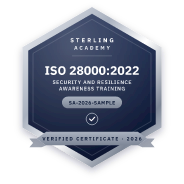
Verifiable certificate with a QR code anyone can scan, plus a digital badge to add to your LinkedIn profile.
See how verification works →You will understand what ISO 28000 asks of you, contribute to your organisation's implementation and audit readiness, and play your part with confidence when the auditor visits. Your certificate can be verified online in seconds, so certification body auditors, employers and clients can confirm your training instantly.
Complete the course and its final exam and you receive a Sterling Academy Certificate of Completion, verifiable online by QR code, with a LinkedIn badge to share.
Who built this course
Sterling has 20+ years and 8,100+ client engagements in 60+ countries. The course is built by industry experts, domain specialist trainers and globally renowned auditors with 30+ years in ISO and GRC, on the current edition of the standard. Online and self-paced, built the way we build our classroom training: the same content and format as Sterling’s classroom courses, whose certificates are trusted and accepted by all major certification bodies.
Prepared by the Sterling expert panel · Last updated 3 October 2026 · How our courses are made
Sterling Academy courses carry the same content as Sterling's classroom training, whose certificates are trusted and accepted by all major certification bodies, as evidence of training at client audits for over 20 years.
Who it is for
Top management, security, logistics, warehousing and procurement teams, and all staff in organisations using or planning ISO 28000.
Training a team? Every learner gets their own access and certificate, and the client administrator sees each person’s progress and result in one place.
About this course
Security incidents usually exploit gaps between departments: a contractor badge that HR forgot to cancel, a delivery accepted without checking the paperwork, a supplier given network access nobody reviews. A security management system closes those gaps only if staff across the organisation understand their part. The course explains security in the terms people meet at work: protecting premises, goods, information and people; noticing unusual behaviour; controlling access; and reporting incidents and near misses quickly. It covers both deliberate threats, such as theft, tampering and sabotage, and the resilience needed to keep operating and recover when something goes wrong. Learners see how a single procedure, such as visitor control at a warehouse, links to a wider plan that management has assessed, approved and tested.
ISO 28000:2022 sets requirements for a security management system and, according to ISO’s technical committee, helps organisations manage security risks and build resilient operations and supply chains. The earlier 2007 edition was a specification for security management systems for the supply chain, while the 2022 edition sits in ISO’s security and resilience family, which widens the focus from the supply chain alone to the security of the organisation as a whole, including its supply chain. ISO has also published an amendment in 2024 on climate action changes. For employees, the practical result is a system that covers people, premises, information and partners together rather than cargo alone. The course teaches the current text and explains how it applies whether the organisation runs ports, warehouses, factories or offices.
Security risk assessment identifies what could harm people, assets or operations, how likely it is and how serious the effect would be, then sets priorities for action. Teams look at threats such as intrusion, theft, cargo tampering, violence, cyber-attacks and supplier collapse, together with the vulnerabilities that would let them succeed. Treatment then selects strategies and controls: physical barriers, access control, screening, procedures, monitoring, insurance or changes to operations. The course explains how security objectives are set and how changes, such as a new site or a new logistics partner, are planned so that controls keep pace. It also covers the security plans that describe how the organisation will respond, warn people and recover after an incident, and why those plans are tested rather than simply filed.
An employee who notices a security concern should report it immediately through the organisation’s defined channel, without trying to investigate it alone. That might be an open gate, a seal that does not match the paperwork, a stranger in a restricted area, an unexpected change to supplier bank details or a suspicious e-mail asking for shipment information. The course explains why early reports matter: many serious incidents are preceded by small warning signs that went unrecorded. Learners also see what happens after a report, from initial assessment to the security plan being activated, and how incident records feed monitoring, internal audit and management review. Competence, awareness and communication are covered as part of the system, so staff understand that reporting and following procedures are expectations of their role, not favours to the security team.
Security plans describe how the organisation will respond to a security incident, warn the people who need to know and recover normal operations, and the course explains each part at awareness level. A response section sets out immediate actions, roles and contact details, such as who locks down a site, who contacts the authorities and who speaks to customers. A warning section covers how alerts reach staff, contractors and partners quickly and reliably. A recovery section explains how operations, deliveries and services are restored, and how evidence is preserved for investigation. Plans are tested through exercises and reviewed after real incidents. For employees, the key is knowing their role in the plan, where to find instructions and how to act when normal routines are disrupted, rather than waiting for instructions that may be slow to arrive.
The course is for top management, security, logistics, warehousing and procurement teams, and all staff in organisations using or planning ISO 28000. Companies that export to the United States and work under the customs programme can add “CTPAT Awareness”, which focuses on that programme’s criteria. Organisations whose main concern is keeping critical activities running through disruption should look at “ISO 22301:2019 Awareness”, and those protecting information assets will need “ISO/IEC 27001:2022 Awareness”. Many organisations run these systems side by side, and the courses use consistent terms so that staff do not have to learn a different vocabulary for each one. The course is online and self-paced but built in the same content and format as Sterling’s classroom training, and the certificate carries a QR code anyone can use to verify it.
Save when you learn more
Course passes
Also in the Awareness Pass: all 110 awareness courses for US$99, about the price of 5 courses.
Or every course except Lead Auditor courses with the All-Access Pass: 210 courses for US$499.
Compare the passesFor teams
From US$13 per learnerEach learner gets their own access and certificate; you see progress in one place.
Price your team →Save when you take more than one course
The discount is added automatically in your basket.
What learners say
Every course is built by the experts behind 8,100+ client engagements in 60+ countries, so you learn what auditors and regulators actually expect. Here is what professionals said after finishing their course.
Informative
10/10 for Philippines Data Privacy Act and DPO Training
Better value
All-Access Pass
A pharma and life sciences professional from the USA started with one course, then upgraded to the All-Access Pass.
Every Sterling Academy course except Lead Auditor courses, for 12 months.
US$499
See the passA selection of comments from learners who finished a course and answered our feedback request, shortened from their own words. Client names available on request.
Frequently asked questions
About ISO 28000:2022 Security and Resilience Awareness, its certificate and enrolment.
Ask SterlingYes. Sterling Academy's ISO 28000 training is built by the Sterling consulting group, which has taken organisations to certification across 8,100+ client engagements in 60+ countries over 20+ years. It is always on the current edition, with practice questions that show the right answer. Each course ends with a final exam and a certificate that anyone can verify online, plus a LinkedIn badge, and client administrators can show an auditor exactly who has been trained. You will understand what ISO 28000 asks of you, contribute to your organisation's implementation and audit readiness, and play your part with confidence when the auditor visits. Sterling Academy courses carry the same content as Sterling's classroom training, whose certificates are trusted and accepted by all major certification bodies, as evidence of training at client audits for over 20 years.
It is for top management, security, logistics, warehousing and procurement teams, and all staff in organisations using or planning ISO 28000, such as freight forwarders, ports, manufacturers, distributors and BPOs that handle goods or sensitive operations. It helps every person recognise security risks and know how to report them. No prior knowledge of ISO 28000 is needed.
It covers why security and resilience matter; how ISO 28000:2022 is organised and applies to any organisation; context, interested parties, scope, leadership and the security policy; security risk assessment and treatment, objectives and planning; security strategies, procedures and plans, including response and recovery; resources, competence, communication and working with suppliers; and monitoring, internal audit, management review and continual improvement.
It is a set of short video modules, each followed by practice questions, and a final exam. The course page shows the number of modules and the approximate video runtime; allow additional time for the practice questions and the exam. With 12 months of access, learners can complete it in one sitting or spread it over several sessions.
Yes. Learners who reach the 70% pass mark in the final exam receive a Sterling Academy Certificate of Completion for ISO 28000 Security and Resilience Awareness. Each certificate carries a unique number and a QR code, and anyone can verify it online using the certificate number and the holder's surname. It is a training certificate for the individual learner.
Yes. ISO 28000 Security and Resilience Awareness is a self-paced online course made of short video modules, in English with captions. You study at your own pace during 12 months of access, and practice questions after modules help you check your understanding before the final exam. If a point is unclear, questions are answered by a Sterling consultant.
ISO 28000 Security and Resilience Awareness is US$19 per learner. Teams save 20% for 11 to 50 learners and 30% for 51 to 200 learners; 201 or more learners are priced on request. Client administrators can track their team's progress. Prices are in US dollars, excluding taxes, and Sterling confirms final pricing and enrolment.
It gives your people the knowledge ISO 28000 asks of them, and each learner's verifiable certificate is evidence of that training when the auditor asks. The Certificate of Completion is a training certificate: it shows that one person completed ISO 28000 Security and Resilience Awareness and reached the pass mark in its final exam. An organisation is certified by an independent certification body after that body's own audit.
Your next step
Not sure which course?