Get consulting from Sterling
Expert and experienced consultants, 8,100+ client engagements in 60+ countries, from gap assessment to a system ready for its certification audit.
Talk to a Sterling consultantAwareness training · Regional laws and regulations
Online training course to help every employee process personal data the way the Nigeria Data Protection Act expects.
This awareness training course explains the Nigeria Data Protection Act 2023 and the Nigeria Data Protection Commission's General Application and Implementation Directive 2025: who the Act covers, personal and sensitive personal data, the principles and lawful bases, consent, children's data, the rights of data subjects, security and breach notification, data protection officers, impact assessments, data controllers of major importance, transfers outside Nigeria and enforcement. A payments company in Lagos runs through the course.
Secure payment by Stripe · for yourself or for your team
Add another course and save 15%, up to 25%
What you get
About 111 minutes, with captions. Watch at your own pace on any device.
Short questions check your understanding before you move on.
Multiple choice, with one retake if you need it.
Industry experts, domain specialist trainers and globally renowned auditors with 30+ years in ISO and GRC.
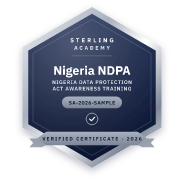
Verifiable certificate with a QR code anyone can scan, plus a digital badge to add to your LinkedIn profile.
See how verification works →Save when you take more than one course
The discount is added automatically in your basket.
Standard and editionNigeria Data Protection Act, 2023
Last updated10 November 2026
Preview this course
Watch a sample from Nigeria Data Protection Act Awareness Training before you enrol.
What learners say
Every course is built by the experts behind 8,100+ client engagements in 60+ countries, so you learn what auditors and regulators actually expect. Here is what professionals said after finishing their course.
Informative
10/10 for Philippines Data Privacy Act and DPO Training
Best value
All-Access Pass
A pharma and life sciences professional from the USA started with one course, then upgraded to the All-Access Pass.
Every Sterling Academy course for 12 months.
US$499
See the passA selection of comments from learners who finished a course and answered our feedback request, shortened from their own words. Client names available on request.
Learning outcomes
Connect the subject to the responsibilities and decisions people encounter in their roles.
Part of: Privacy and Data Protection Training
Inside the course
10 modules, 10 practice checkpoints and a final exam. Video runtimes are approximate; allow additional time for the practice questions and the final exam. Modules marked optional can be skipped; the others are studied in any order.
Introduces the Nigeria Data Protection Act 2023, the 2025 GAID directive and the Nigeria Data Protection Commission's enforcement focus.
Opens the Nigeria Data Protection Act Awareness training course with accounts opened without consent, the first trend in the Commission's 2025 annual report. Gives the report's figures, including 38,661 registered organisations of major importance, and its problem areas, from copied privacy notices to profiling and data loss. Introduces the Nigeria Data Protection Act, 2023, the General Application and Implementation Directive of 20 March 2025, the Act's objectives and the penalties. Presents OTV Pay Ltd, the Lagos digital wallet company the course follows, the four everyday moments, and notes the course is not legal advice.
What you will be able to do
Why it matters
The Commission is moving to full enforcement, and its problem areas come from ordinary work at every desk.
Practice: Practice: Why the NDPA matters · 3 questions
Explains where the Nigeria Data Protection Act applies, its exemptions, key terms such as personal data, and the Commission's role.
Starts with a London savings app that believes Nigerian law does not concern it. Explains when the Act applies under section 2, including to controllers abroad processing the data of people in Nigeria, and the narrow exemptions in section 3. Defines personal data, processing, data controller, data processor, personal data breach and pseudonymisation, and the Nigerian term data controller or processor of major importance. Describes the Commission's functions and the GAID, maps the roles around OTV, and adds examples from a school in Ibadan and a call centre in Accra. These terms run through the whole training course.
What you will be able to do
Why it matters
The Act follows the data of people in Nigeria, so knowing what you hold and who decides about it underpins every duty.
Practice: Practice: Scope, terms and the Commission · 3 questions
Covers the six principles of processing in section 24 of the Nigeria Data Protection Act, the duty of care and accountability.
Opens with OTV's marketing team planning to profile customers' payments to guess income and religion and sell targeted adverts. Sets out the six principles: fair, lawful and transparent processing, purpose limitation, data minimisation, storage limitation, accuracy and security. Explains the compatibility factors for a new use, the duty of care and accountability, and OTV's four kinds of records. Links transparency to the Commission's finding on copied privacy notices, and shows why the DPO rejects selling profiles but allows a narrower, consent-based idea, with examples from a hospital in Abuja and a logistics firm in Kano.
What you will be able to do
Why it matters
Holding data is not permission to use it for anything, so testing new uses against the principles avoids problem areas.
Practice: Practice: The principles of processing · 3 questions
Explains the six lawful bases in section 25 of the Nigeria Data Protection Act, valid consent, withdrawal and consent for cookies.
Begins with an OTV agent who opens wallets using ID copies left by earlier customers, with no lawful basis at all. Sets out the six lawful bases, the three limits on legitimate interests, and the narrower vital interest and public task bases, then matches OTV's purposes to bases. Explains the section 26 rules for consent, including that silence and pre-ticked boxes are not consent, records of consent and easy withdrawal. Covers the GAID's cookie rules and how OTV closed the agent's shortcut and changed agents' targets, with examples from Port Harcourt and Abuja.
What you will be able to do
Why it matters
Silence is never consent, and a lawful basis must exist before processing starts, whatever the target.
Practice: Practice: Lawful bases and consent · 3 questions
Covers privacy notices under section 27 of the Nigeria Data Protection Act and data privacy impact assessments for high-risk processing.
Starts with OTV's first privacy notice, copied from another company's website and silent on face matching and the cloud provider abroad. Lists the seven things people must be told before collection, the rule for data not collected directly, and how the privacy policy must be written. Shows how OTV's DPO rebuilt the notice and gave it in two layers, including scripts for walk-in customers. Explains when a DPIA is needed, what it contains and when the Commission must be consulted, with OTV's face matching DPIA and examples from Ibadan and Abuja.
What you will be able to do
Why it matters
A copied notice is the easiest failing to spot, so a notice written from real processing protects people and the organisation.
Practice: Practice: Privacy notices and DPIAs · 3 questions
Explains processors under section 29 of the Nigeria Data Protection Act, Data Protection Officers, registration and GAID compliance duties.
Opens with a bulk SMS firm asking OTV for customers' phone numbers to start campaigns the next day. Explains the section 29 duties when engaging a processor and OTV's written agreement. Covers the Data Protection Officer's role and the semi-annual report under the GAID, registration with the Commission under section 44 and the three levels in the GAID's guidance notice, which has since been amended. Explains annual compliance audit returns by 31 March, the training schedule, Data Protection Compliance Organisations and OTV's level, with examples from Ibadan and a cloud provider in Dublin.
What you will be able to do
Why it matters
Outsourcing the work does not outsource the duty, and registration and returns reach schools, hotels and small firms.
Practice: Practice: Processors, DPOs and registration · 3 questions
Covers data subjects' rights under Part Six of the Nigeria Data Protection Act, including access, erasure, objection and automated decisions.
Starts with a market trader in Kano whose OTV wallet is frozen by the automated fraud tool. Explains the rights to confirmation and access, a copy, correction, erasure and restriction, withdrawal of consent and objection, including to direct marketing. Covers the right not to be subject to solely automated decisions and the safeguards of human intervention, a point of view and contest. Shows how OTV handled the trader's case, then covers data portability, complaints to the Commission, civil claims and the GAID's Data Subject's Standard Notice to Address Grievance, with examples from Abuja and Port Harcourt.
What you will be able to do
Why it matters
Behind every automated decision a person must be reachable, and handling requests well stops most complaints starting.
Practice: Practice: Data subjects' rights · 3 questions
Explains sensitive personal data under section 30 of the Nigeria Data Protection Act, its grounds for processing, and children's data.
Begins with OTV's marketing team planning to tag customers' religion from payments to churches and mosques for festive offers. Defines sensitive personal data and sets out the nine grounds in section 30, and the Commission's power to add more. Shows OTV's face matching, relying on consent with an alternative check, and why the faith campaign stopped. Explains parental or guardian consent for children and people lacking legal capacity, age verification, the exceptions, and OTV's process for minors, with examples from a hospital in Abuja and a church charity in Enugu.
What you will be able to do
Why it matters
An inference about religion or health is sensitive data, so finding a clear ground first prevents serious mistakes.
Practice: Practice: Sensitive data and children · 3 questions
Covers security under section 39 of the Nigeria Data Protection Act, the seventy-two hour breach rules and transfers outside Nigeria.
Opens with OTV's agent-network manager reporting on a Friday evening that her unencrypted laptop was stolen from a car in Abuja. Explains the security duty and the measures the Act lists, processors' duty to notify the controller, notice to the Commission within seventy-two hours, telling people immediately when risk is high, and keeping a breach record. Shows OTV's response, from a remote wipe to telling agents and customers with advice on fraud. Explains the rules for transfers abroad, adequate protection and the section 43 conditions, applied to OTV's cloud provider in Dublin, with examples from Kano and Accra.
What you will be able to do
Why it matters
The seventy-two hours run over the weekend, so reporting first and letting the experts decide protects people in time.
Practice: Practice: Security, breaches and transfers · 3 questions
Explains enforcement under the Nigeria Data Protection Act: investigations, compliance and enforcement orders, penalties and your role.
Starts with an imagined complaint to the Commission about an account opened in a customer's name without her knowledge. Explains investigations under section 46, compliance orders, enforcement orders and sanctions, and penalties up to the greater of N10 million or two per cent of annual gross revenue for organisations of major importance. Covers the factors the Commission weighs, the offence of ignoring a compliance order, judicial review within thirty days and civil claims. Describes the Commission's restorative approach and move to full enforcement, then closes the training course with eight everyday habits.
What you will be able to do
Why it matters
Compliance is a habit, not a reaction, and cooperation and quick mitigation are factors the Commission weighs.
Practice: Practice: Enforcement and your role · 3 questions
About this course
The Nigeria Data Protection Act 2023 has applied since 12 June 2023, and the Nigeria Data Protection Commission is moving from a restorative approach to what it calls full enforcement of the Act and its 2025 implementation directive. Its 2025 annual report records 38,661 organisations registered as data controllers and processors of major importance, and 146 investigations in the year; it says its investigations cover sectors such as health, telecommunications, banking, fintech and hospitality. The problem areas it lists come from everyday work: accounts opened without the customer's consent, privacy notices copied from elsewhere, behavioural profiling that goes beyond data minimisation, unauthorised access, and lost personal data. Penalties or remedial fees for organisations of major importance can reach the greater of N10 million or two percent of annual gross revenue, and ignoring a compliance order is an offence.
The course is taught from the official gazetted text of the Nigeria Data Protection Act 2023, the Commission's General Application and Implementation Directive issued in March 2025, and the Commission's own 2025 annual report. Every rule is cited, and the Act and the directive are kept distinct. It covers where the Act applies, the six principles and the duty of care, the six lawful bases and valid consent, cookie consent, privacy notices and data privacy impact assessments, processors, Data Protection Officers, registration levels and annual compliance audit returns, people's rights including human review of automated decisions, sensitive data and children, security, the seventy-two-hour breach rule, transfers abroad, and the Commission's orders and sanctions. One payments and digital wallet company with its head office in Lagos runs through every module.
The course is written for everyone who handles personal data in Nigeria, or the data of people in Nigeria: front-line, agent and customer support staff who collect details and receive requests; marketing teams who run SMS, e-mail and cookie consent; HR, finance and IT teams; processors and outsourcing providers serving Nigerian clients, at home or abroad; and team leaders, managers and Data Protection Officers who set the habits others follow. No legal background is needed. It covers Nigerian law only; for the EU General Data Protection Regulation, Sterling Academy's GDPR Awareness course is separate. It is awareness training, not legal advice: decisions about your own organisation belong with your Data Protection Officer or a qualified adviser.
After the course, you can tell when the Act applies, recognise personal and sensitive personal data, and tell controllers from processors. You can apply the principles, choose the right lawful basis, recognise valid consent and make withdrawal easy, and check that people receive the right information before collection. You can spot processing that needs an impact assessment, support registration, compliance audit returns and your Data Protection Officer's reports, and make sure processors work under written agreements. You can recognise requests for access, erasure, objection and human review and route them the same day, protect data, report a suspected breach at once so the seventy-two hours can be met, and check the basis before any transfer abroad. The scenario-based final exam leads to the Sterling Academy Certificate of Completion for those who reach the final exam's pass mark, with one retake included.
Module 1: introduces the Nigeria Data Protection Act 2023, the 2025 GAID directive and the Nigeria Data Protection Commission's enforcement focus. Module 2: explains where the Nigeria Data Protection Act applies, its exemptions, key terms such as personal data, and the Commission's role. Module 3: covers the six principles of processing in section 24 of the Nigeria Data Protection Act, the duty of care and accountability. Module 4: explains the six lawful bases in section 25 of the Nigeria Data Protection Act, valid consent, withdrawal and consent for cookies. Module 5: covers privacy notices under section 27 of the Nigeria Data Protection Act and data privacy impact assessments for high-risk processing. Module 6: explains processors under section 29 of the Nigeria Data Protection Act, Data Protection Officers, registration and GAID compliance duties. Module 7: covers data subjects' rights under Part Six of the Nigeria Data Protection Act, including access, erasure, objection and automated decisions. Module 8: explains sensitive personal data under section 30 of the Nigeria Data Protection Act, its grounds for processing, and children's data. Module 9: covers security under section 39 of the Nigeria Data Protection Act, the seventy-two hour breach rules and transfers outside Nigeria. Module 10: explains enforcement under the Nigeria Data Protection Act: investigations, compliance and enforcement orders, penalties and your role.
Frequently asked questions
About Nigeria Data Protection Act Awareness Training, its certificate and enrolment.
Ask SterlingYes. Sterling Academy's Nigeria Data Protection Act Awareness training is built by the Sterling consulting group, which has taken organisations to certification across 8,100+ client engagements in 60+ countries over 20+ years. It comes with practice questions that show the right answer. Each course ends with a final exam and a verifiable certificate that anyone can check online, plus a LinkedIn badge, and client administrators can show an auditor exactly who has been trained. You will be able to apply Nigeria Data Protection Act Awareness at work and show your competence with confidence. Sterling Academy courses carry the same content as Sterling's classroom training, whose certificates are trusted and accepted by all major certification bodies, as evidence of training at client audits for over 20 years.
It is for employees, team leaders and managers who process personal data in Nigeria or of people in Nigeria, including banks, fintechs, telecoms operators, retailers, hospitals, public institutions and outsourcing providers. No legal background is needed. The course explains the Act and the GAID in plain words, with one Lagos payments company as the example throughout.
Yes. It teaches the Nigeria Data Protection Commission's General Application and Implementation Directive, issued in March 2025, alongside the Act: how organisations of major importance are designated, compliance audit returns, data protection officers, consent and cookies, impact assessments and breach notification. Every point is taken from the official texts published by the Commission.
Short practice questions after each module help you check your understanding; they do not count toward the result. The course ends with a scenario-based multiple-choice final exam. Learners who reach the final exam's pass mark receive a Sterling Academy Certificate of Completion, and one retake is included. Each certificate carries a unique number and a QR code for online checking.
No. It is awareness training that explains the Act and the Commission's directive in plain words, so that staff know what to do and when to ask. Every rule is taught from the official Gazette text of the Act and the Commission's own publications. For decisions about your own organisation, speak to your data protection officer or a qualified adviser.
The course is in preparation. Register on this page with “Notify me when it opens” and we will send you one e-mail when it opens for enrolment, with the price per learner and the details for team enrolment. The course page will then show the full module list and the video runtime.
Sources
Your certificate
You will be able to apply Nigeria Data Protection Act Awareness at work and show your competence with confidence. Your certificate can be verified online in seconds, so certification body auditors, employers and clients can confirm your training instantly.
Complete the course and its final exam and you receive a Sterling Academy Certificate of Completion, verifiable online by QR code, with a LinkedIn badge to share.
Sterling Academy courses carry the same content as Sterling's classroom training, whose certificates are trusted and accepted by all major certification bodies, as evidence of training at client audits for over 20 years.
Ask about course requirementsYour next step
Not sure which course?