Get consulting from Sterling
Expert and experienced consultants, 8,100+ client engagements in 60+ countries, from gap assessment to a system ready for its certification audit.
Talk to a Sterling consultantAwareness training · Regional laws and regulations
Online training course to help every employee handle personal information the way the Australian Privacy Act expects.
This awareness training course explains the Privacy Act 1988 as it stands today: who it covers, personal and sensitive information, the 13 Australian Privacy Principles, overseas disclosure, security, access and correction, and the Notifiable Data Breaches scheme. It covers the 2024 reforms, including the new penalty tiers, the statutory tort for serious invasions of privacy, the automated decision rules and the Children's Online Privacy Code. A group of medical and dental clinics in Melbourne runs through the course.
Secure payment by Stripe · for yourself or for your team
Add another course and save 15%, up to 25%
What you get
About 111 minutes, with captions. Watch at your own pace on any device.
Short questions check your understanding before you move on.
Multiple choice, with one retake if you need it.
Industry experts, domain specialist trainers and globally renowned auditors with 30+ years in ISO and GRC.
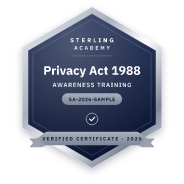
Verifiable certificate with a QR code anyone can scan, plus a digital badge to add to your LinkedIn profile.
See how verification works →Save when you take more than one course
The discount is added automatically in your basket.
Standard and editionPrivacy Act 1988 (Cth) and the Australian Privacy Principles
Last updated10 November 2026
Preview this course
Watch a sample from Australian Privacy Act Awareness Training before you enrol.
What learners say
Every course is built by the experts behind 8,100+ client engagements in 60+ countries, so you learn what auditors and regulators actually expect. Here is what professionals said after finishing their course.
Informative
10/10 for Philippines Data Privacy Act and DPO Training
Best value
All-Access Pass
A pharma and life sciences professional from the USA started with one course, then upgraded to the All-Access Pass.
Every Sterling Academy course for 12 months.
US$499
See the passA selection of comments from learners who finished a course and answered our feedback request, shortened from their own words. Client names available on request.
Learning outcomes
Connect the subject to the responsibilities and decisions people encounter in their roles.
Part of: Privacy and Data Protection Training
Inside the course
10 modules, 10 practice checkpoints and a final exam. Video runtimes are approximate; allow additional time for the practice questions and the final exam. Modules marked optional can be skipped; the others are studied in any order.
Introduces Australia's Privacy Act 1988 and the thirteen Australian Privacy Principles, the 2024 amendments and recent enforcement.
Opens the Australian Privacy Act Awareness training course with a question: could your organisation say what it holds about a customer? Shows the OAIC's breach statistics for January to June 2026 and the first civil penalties under the Act, ordered against Australian Clinical Labs in October 2025. Explains the Privacy Act 1988, the thirteen APPs in five parts, and the staged start of the 2024 amendments, noting that the Children's Online Privacy Code is still an exposure draft. Introduces BLV Health Group, the Melbourne clinic group the course follows, the four everyday moments, and makes clear the course is not legal advice.
What you will be able to do
Why it matters
Breaches and penalties are real, and how people respond is part of compliance, so everyone needs to know the basics and ask early.
Practice: Practice: Why the Privacy Act matters · 3 questions
Explains who the Australian Privacy Act covers: APP entities, the small business test and its exceptions, overseas reach and exemptions.
Starts with BLV buying a small family dental clinic whose owner believed small businesses were exempt. Explains APP entities, agencies and organisations, and the three million dollar small business test, including the rule that a business that ever exceeded it stays covered. Lists businesses never treated as small, such as health service providers and those trading in personal information, with a Brisbane physiotherapy practice and a Singapore online retailer. Covers the Australian link, the narrow employee records exemption, other limits, Part IIIA credit reporting and tax file number rules, and the OAIC's role. Later modules of the training course assume these coverage rules.
What you will be able to do
Why it matters
A small turnover does not always mean the Act does not apply, so checking the exceptions avoids a costly wrong assumption.
Practice: Practice: Who the Act covers · 3 questions
Covers personal information, sensitive and health information, de-identification and valid consent under the Australian Privacy Act.
Opens with a BLV nurse's note that a patient seemed anxious and was late twice. Explains the definition of personal information, true or not and recorded or not, the difference between identified and reasonably identifiable, and properly de-identified data. Lists the kinds of sensitive information, including health and biometric information, and where they hide in ordinary paperwork. Covers why the label matters at each stage, the Bunnings facial recognition determination and the OAIC's updated retail guidance, the four elements of consent and capacity, with examples from a Sydney law firm and a Perth mining services company.
What you will be able to do
Why it matters
Notes and opinions count too, so knowing the label before handling data stops careless records and unexpected breaches.
Practice: Practice: Personal and sensitive information · 3 questions
Explains privacy policies under APP 1, anonymity under APP 2, collection notices under APP 5 and the new automated decision rule.
Starts with a new BLV patient who stops filling in a registration form to ask why her address is needed. Covers APP 1 practices and systems, the required contents of a privacy policy and making it available at no cost. Explains the APP 2 option to stay anonymous or use a pseudonym, and the APP 5 collection notice with its timing. Sets the policy and the notice side by side, then explains the APP 1.7 to 1.9 duty on automated decisions from the tenth of December 2026, and infringement notices for listed principles. Shows BLV's notices across channels and examples from Auckland and Hong Kong.
What you will be able to do
Why it matters
Surprise is where complaints begin, so a current policy and short notices tell people what happens to their details.
Practice: Practice: Policies, notices and anonymity · 3 questions
Covers collecting personal information under APP 3, the extra rules for sensitive information, fair collection and APP 4 unsolicited data.
Begins with BLV's marketing team proposing occupation, household income and religion fields on the patient registration form. Explains the APP 3 test of reasonably necessary, foreseeable versus speculative need, and the higher bar for sensitive information, with consent and the APP 3.4 exceptions. Covers lawful and fair means, collecting from the person, and the APP 4 decision on unsolicited information such as CVs. Applies the rules field by field to BLV's form, links data minimisation to the OAIC's breach statistics, and adds examples from a Sydney recruitment firm and a London online shop.
What you will be able to do
Why it matters
Organisations cannot lose information they do not hold, so collecting only what is needed is one of the strongest protections.
Practice: Practice: Collecting personal information · 3 questions
Explains use and disclosure under APP 6 and direct marketing under APP 7 of the Australian Privacy Act, with opt-out rights.
Follows BLV's plan to e-mail patients who saw a doctor about their skin to promote a new skin clinic. Explains the primary purpose, use versus disclosure, and the APP 6 exceptions, especially the reasonable expectation test and its stricter form for sensitive information. Covers written notes for enforcement disclosures and related companies. Sets out APP 7: the two routes for marketing with non-sensitive information, consent for sensitive information, the link with the Spam Act and the Do Not Call Register Act, and people's rights to stop marketing. Shows the revised skin clinic plan and examples from Brisbane and Singapore.
What you will be able to do
Why it matters
Holding information is not permission to use it, so checking the purpose and expectations protects trust and avoids complaints.
Practice: Practice: Use, disclosure and direct marketing · 3 questions
Covers cross-border disclosure under APP 8, accountability under section 16C and government related identifiers under APP 9.
Starts with BLV's after-hours booking line, run by an outsourcing partner in Manila. Explains APP 8.1 reasonable steps, section 16C accountability for an overseas recipient's acts, and the OAIC's expectation of an enforceable contract. Covers when giving data to an overseas contractor is a disclosure, the APP 8.2 exceptions and why the consent route should be used rarely, then BLV's contract terms. Explains government related identifiers such as Medicare numbers, the APP 9.1 ban on adopting them and the APP 9.2 limits on use, with a Perth car rental company and a Sydney insurer.
What you will be able to do
Why it matters
You can send information overseas but not the accountability, so contracts and checks must be in place before data moves.
Practice: Practice: Overseas disclosure and identifiers · 3 questions
Explains data quality under APP 10, security under APP 11, and the rights of access and correction under APPs 12 and 13.
Opens with a BLV patient's out-of-date mobile number that sent a text about her test results to a stranger. Covers APP 10 quality, APP 11.1 security and the APP 11.3 wording on technical and organisational measures, four everyday security habits, and destruction or de-identification under APP 11.2. Explains APP 12 access, the exceptions, charges and refusals, the risk of impostors, and APP 13 correction with attached statements. Follows a BLV access request from day one to day fourteen, under BLV's own procedure, with examples from a London bank and a Toronto university.
What you will be able to do
Why it matters
Many breaches start with an out-of-date detail or a wrong recipient, so people's habits are part of security.
Practice: Practice: Quality, security, access, correction · 3 questions
Covers the Notifiable Data Breaches scheme: eligible data breaches, assessing a suspected breach and notifying the OAIC and individuals.
Begins with a BLV practice manager whose unencrypted laptop, holding about two thousand patients' details, is stolen from her car on a Friday. Explains the three parts of an eligible data breach, the matters for judging serious harm and how remedial action can prevent a breach becoming notifiable. Covers assessing a suspected breach within thirty days, the statement to the Commissioner, notifying affected people, and breaches shared with suppliers. Revisits the Australian Clinical Labs penalties, the OAIC's 2026 statistics, BLV's four-step plan for staff and how it handled the laptop, with examples from Sydney and Singapore.
What you will be able to do
Why it matters
A suspicion is enough to report, and fast reporting can contain harm and keep the organisation within the scheme.
Practice: Practice: Data breaches: the NDB scheme · 3 questions
Explains enforcement under the Australian Privacy Act, the three penalty tiers, the statutory tort for privacy, doxxing and your role.
Covers the OAIC's tools, from complaints and determinations to infringement and compliance notices and civil penalties in three tiers, and the matters that make an interference serious. Brings together the enforcement cases in the course. Explains the right since the tenth of June 2025 to sue for a serious invasion of privacy, its elements and defences, and the doxxing offences added to the Criminal Code. Covers the automated decision rule and the Children's Online Privacy Code, still a draft. Closes the training course with six everyday habits and a look back at BLV Health Group a year on.
What you will be able to do
Why it matters
Small failures now have quick consequences and deliberate misuse can reach the courts, so good habits protect people and the organisation.
Practice: Practice: Enforcement, new rules, your role · 3 questions
About this course
Organisations covered by the Privacy Act 1988 notified the Office of the Australian Information Commissioner of 667 data breaches in the first half of 2026 alone, with malicious or criminal attacks the most common cause and health service providers reporting more than any other sector. In October 2025, the Federal Court ordered the first civil penalties ever made under the Act: $5.8 million against a pathology company, and $1.6 million of that was for assessing a suspected breach too slowly and telling the regulator too late. The Act itself changed significantly in December 2024: higher penalty tiers, infringement and compliance notices, clearer security duties, a right to sue for serious invasions of privacy from June 2025, and new rules on explaining automated decisions from December 2026. Most of what the Act requires is done, or not done, by ordinary staff at ordinary desks.
The course is taught from the official text of the Privacy Act on the Federal Register of Legislation, Compilation No. 104 dated 4 June 2026, the 2024 amendment Act and the OAIC's own guidelines and publications, with every rule cited by section or principle and every change shown with the date it starts. It covers all thirteen Australian Privacy Principles in plain words, the small business test and its exceptions, sensitive and health information, overseas disclosure and the accountability that stays with the Australian organisation, government identifiers, and the Notifiable Data Breaches scheme step by step. Real enforcement is taken only from the regulator's own releases, and drafts such as the Children's Online Privacy Code are named as drafts. One group of medical and dental clinics in Melbourne runs through every module, from its registration form to a stolen laptop.
The course is written for everyone who handles personal information in an organisation covered by the Act: reception, customer service and sales staff who collect details every day; HR, finance and marketing teams who use and share them; IT and security staff and suppliers who store and protect them; and team leaders and managers who set the habits others follow. It suits health, finance, retail, education, technology and outsourcing organisations, including teams overseas who work on Australian customers' data for an Australian client. No legal background is needed. It is awareness training, not legal advice: decisions about your own organisation belong with your privacy officer or a qualified adviser. For the European regulation, Sterling Academy's GDPR Awareness course is separate.
After the course, you can tell whether the Act covers a business, recognise personal, sensitive and health information, and judge whether a detail is reasonably necessary before you ask for it. You can check that people are told what they need to know when their information is collected, use information only for its purpose or an allowed exception, and follow the direct marketing rules, including opt-outs and consent for sensitive information. You can spot what must happen before information goes overseas, keep information accurate and secure, and handle access and correction requests. And you can recognise a possible eligible data breach and report it at once. The scenario-based final exam leads to the Sterling Academy Certificate of Completion for those who reach the final exam's pass mark, with one retake included.
Module 1: introduces Australia's Privacy Act 1988 and the thirteen Australian Privacy Principles, the 2024 amendments and recent enforcement. Module 2: explains who the Australian Privacy Act covers: APP entities, the small business test and its exceptions, overseas reach and exemptions. Module 3: covers personal information, sensitive and health information, de-identification and valid consent under the Australian Privacy Act. Module 4: explains privacy policies under APP 1, anonymity under APP 2, collection notices under APP 5 and the new automated decision rule. Module 5: covers collecting personal information under APP 3, the extra rules for sensitive information, fair collection and APP 4 unsolicited data. Module 6: explains use and disclosure under APP 6 and direct marketing under APP 7 of the Australian Privacy Act, with opt-out rights. Module 7: covers cross-border disclosure under APP 8, accountability under section 16C and government related identifiers under APP 9. Module 8: explains data quality under APP 10, security under APP 11, and the rights of access and correction under APPs 12 and 13. Module 9: covers the Notifiable Data Breaches scheme: eligible data breaches, assessing a suspected breach and notifying the OAIC and individuals. Module 10: explains enforcement under the Australian Privacy Act, the three penalty tiers, the statutory tort for privacy, doxxing and your role.
Frequently asked questions
About Australian Privacy Act Awareness Training, its certificate and enrolment.
Ask SterlingYes. Sterling Academy's Australian Privacy Act Awareness training is built by the Sterling consulting group, which has taken organisations to certification across 8,100+ client engagements in 60+ countries over 20+ years. It comes with practice questions that show the right answer. Each course ends with a final exam and a verifiable certificate that anyone can check online, plus a LinkedIn badge, and client administrators can show an auditor exactly who has been trained. You will be able to apply Australian Privacy Act Awareness at work and show your competence with confidence. Sterling Academy courses carry the same content as Sterling's classroom training, whose certificates are trusted and accepted by all major certification bodies, as evidence of training at client audits for over 20 years.
It is for employees, team leaders and managers who handle personal information in organisations covered by the Privacy Act 1988, including health providers, banks, insurers, retailers, technology firms and outsourcing providers serving Australian clients. No legal background is needed. The course explains the Australian Privacy Principles in plain words, with one clinic group as the example throughout.
Yes. It is based on the current compilation of the Privacy Act on the Federal Register of Legislation and explains the Privacy and Other Legislation Amendment Act 2024: the new penalty tiers and infringement notices, the statutory tort for serious invasions of privacy from June 2025, the automated decision rules from December 2026 and the Children's Online Privacy Code, which is shown as a draft while it is a draft.
Short practice questions after each module help you check your understanding; they do not count toward the result. The course ends with a scenario-based multiple-choice final exam. Learners who reach the final exam's pass mark receive a Sterling Academy Certificate of Completion, and one retake is included. Each certificate carries a unique number and a QR code for online checking.
No. It is awareness training that explains the law and the OAIC's guidance in plain words so that staff know what to do and when to ask. Every rule is taught from the official text of the Act and the regulator's own publications. For decisions about your own organisation, speak to your privacy officer or a qualified adviser.
The course is in preparation. Register on this page with “Notify me when it opens” and we will send you one e-mail when it opens for enrolment, with the price per learner and the details for team enrolment. The course page will then show the full module list and the video runtime.
Sources
Your certificate
You will be able to apply Australian Privacy Act Awareness at work and show your competence with confidence. Your certificate can be verified online in seconds, so certification body auditors, employers and clients can confirm your training instantly.
Complete the course and its final exam and you receive a Sterling Academy Certificate of Completion, verifiable online by QR code, with a LinkedIn badge to share.
Sterling Academy courses carry the same content as Sterling's classroom training, whose certificates are trusted and accepted by all major certification bodies, as evidence of training at client audits for over 20 years.
Ask about course requirementsYour next step
Not sure which course?