Get consulting from Sterling
Expert and experienced consultants, 8,100+ client engagements in 60+ countries, from gap assessment to a system ready for its certification audit.
Talk to a Sterling consultantPractitioner training · Environmental management
Part of the ISO 14001:2026 learning path → Step 2
Online training course to build an aspects and impacts register that drives your ISO 14001 system.
This practitioner training course teaches clause 6.1.2 of ISO 14001:2026 in depth: identifying environmental aspects and impacts under normal, abnormal and emergency conditions, the life cycle perspective, control and influence, significance criteria, and the documented information. It links significant aspects to compliance obligations, risks and opportunities, objectives and operational control. Recent Environment Agency cases show how unseen aspects become pollution. A packaging printer in Mumbai runs through the course, from process map to a full aspects register.
Secure payment by Stripe · for yourself or for your team
Add another course and save 15%, up to 25%
What you get
About 3 hours, with captions. Watch at your own pace on any device.
Short questions check your understanding before you move on.
Score at least 60% to receive the Certificate of Competence.
Industry experts, domain specialist trainers and globally renowned auditors with 30+ years in ISO and GRC.
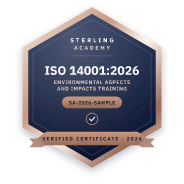
Verifiable certificate with a QR code anyone can scan, plus a digital badge to add to your LinkedIn profile.
See how verification works →Save when you take more than one course
The discount is added automatically in your basket.
Standard and editionISO 14001:2026
Last updated9 November 2026
Preview this course
Watch a sample from Environmental Aspects and Impacts Training before you enrol.
What learners say
Every course is built by the experts behind 8,100+ client engagements in 60+ countries, so you learn what auditors and regulators actually expect. Here is what professionals said after finishing their course.
Informative
10/10 for Philippines Data Privacy Act and DPO Training
Best value
All-Access Pass
A pharma and life sciences professional from the USA started with one course, then upgraded to the All-Access Pass.
Every Sterling Academy course for 12 months.
US$499
See the passA selection of comments from learners who finished a course and answered our feedback request, shortened from their own words. Client names available on request.
Learning outcomes
Connect the subject to the responsibilities and decisions people encounter in their roles.
Inside the course
12 modules, 12 practice checkpoints, 4 practice exercises and a final exam. Video runtimes are approximate; allow additional time for the practice questions and the final exam. Modules marked optional can be skipped; the others are studied in any order.
Explains why environmental aspects and impacts sit at the centre of ISO 14001:2026, starting from a diesel spill into the River Test.
Opens the Environmental Aspects and Impacts training course with a 2026 Environment Agency case: a failed underground valve at a fuel distributor's site in Southampton leaked diesel that heavy rain later carried into the River Test. Shows the controls the company changed afterwards, then defines an environmental aspect and an environmental impact in ISO 14001:2026 as cause and effect. Explains why managing aspects comes first in an environmental management system, and where aspects are used across the standard, from clause 6.1.5 to 9.1.1. Introduces KMN Packaging Pvt. Ltd., a built example printer in Mumbai, a café chain in Melbourne, the edition's transition and the course's four parts.
What you will be able to do
Why it matters
An aspect you do not watch can still cause an impact, and almost everything in the system is built on getting the aspects right.
Practice: Practice: Why aspects matter · 3 questions
Reads the five ISO 14001:2026 definitions behind environmental aspects and impacts, and shows how to write each register line clearly.
Starts with the 2026 release of plastic pellets, known as nurdles, after two vessels collided at the Port of Tyne. Reads five definitions: environment, environmental aspect, environmental impact, environmental condition and prevention of pollution. Explains aspects and impacts as cause and effect, with four pairs from KMN, and describes impacts by scale, local, regional or global, and by nature, direct, indirect or cumulative. Shows that aspects come from activities, products and services, with a private hospital in Johannesburg as a service example. Sets out the wording Sterling recommends for each line, and how an aspect differs from an occupational health and safety hazard.
What you will be able to do
Why it matters
When aspects and impacts are mixed up, controls are aimed at the wrong thing, so clear lines tell each owner what to control.
Practice: Practice: Aspects and impacts · 3 questions
Reads clause 6.1.2 of ISO 14001:2026 line by line: the aspects process, conditions, significance, communication and documented information.
Begins with a 2026 Environment Agency case at a waste site in Little Hulton, where 52 complaints about odour led to a partial permit suspension. Covers clause 6.1.1 on a documented process and KMN's one-page description of who, when, how and with which criteria. Reads clause 6.1.2 line by line: scope, control and influence, the life cycle perspective, normal and abnormal conditions, change and potential emergency situations, significance using established criteria, communication and the three items of documented information. Compares the 2026 text with the 2015 edition, follows four chains to clauses 6.1.3, 6.1.4, 7.2 and 8.2, and lists the four gaps KMN's audit found. Adds a data centre operator in Singapore.
What you will be able to do
Why it matters
Without written criteria nobody can check why a line was rated significant, and an auditor often starts with the register.
Practice: Practice: What ISO 14001 requires · 3 questions
Covers environmental conditions in clause 4.1, the scope in clause 4.3 and the life cycle perspective, using a snack pouch as the example.
Opens with the Environment Agency declaring half of England in drought on 29 July 2026, which turned water use into a different aspect overnight. Explains the environmental conditions clause 4.1 now names, looking both ways: those your aspects affect and those that can affect you, with four conditions KMN recorded. Covers the scope under clause 4.3 and a brewery in Dublin that left its yard out. Defines life cycle and walks the seven stages for KMN's multilayer snack pouch, with life cycle prompts from Annex A.6.1.2. Explains that a life cycle perspective does not require a detailed life cycle assessment, and shows four lines KMN added, each marked control or influence.
What you will be able to do
Why it matters
Conditions around you change how much your aspects matter, and the biggest impact of a product may happen long after it leaves the gate.
Practice: Practice: Context and life cycle · 3 questions
Builds a method for identifying environmental aspects: process maps, inputs and outputs, the nine categories, grouping and the walk-through.
Starts with a 2026 case where a contractor jet-washing land drainage sent silt into two streams in Yate, near Bristol. Sets out the five-step approach Sterling recommends: map the processes, list inputs and outputs, walk the site, read the records and ask the people. Uses the nine categories in Annex A.6.1.2 as a checklist, then applies the steps to KMN's process map and its printing presses. Explains grouping lines with common characteristics, what KMN's walk-through, records and night operators revealed, and beneficial aspects such as solvent recovery. Adds a dairy plant in Auckland where a night walk found tanker bay wash water running to a storm drain.
What you will be able to do
Why it matters
Every task can have an aspect, even a short one done by a contractor, and only looking at the real work finds it.
Practice: Practice: Identifying aspects · 3 questions
Covers abnormal conditions, potential emergency situations and change, and adds the missing lines for a site's worst days to the register.
Opens with a 2026 case of clay pollution in Cornwall, where an underground pipeline weakened by machinery failed and clay entered a stream that leads to the River Fal. Explains normal, abnormal and emergency conditions from Annex A.6.1.2, with four abnormal conditions KMN added, such as oxidiser maintenance, and how it now plans that work. Covers finding potential emergency situations, the four KMN determined, and how firewater runoff became a new significant aspect. Links emergency lines to clause 8.2, then covers change under clause 6.3, the kinds of change in Annex A.6.3, past incidents as evidence, and a hotel in Cape Town.
What you will be able to do
Why it matters
Many of the worst impacts happen on days that are not normal, and planning for those days lets you control what would otherwise surprise you.
Practice: Practice: Abnormal, emergency and change · 3 questions
Separates the environmental aspects you control from those you can influence, and applies clause 8.1 to external providers along the chain.
Begins with a 2026 report of payments under enforcement undertakings in Lincolnshire, after construction and demolition waste was deposited on a farm without authorisation. Explains control and influence under clause 6.1.2 and Annex A.6.1.2, and the column KMN added to rate its influence as strong, some or limited. Covers clause 8.1 on controlling or influencing externally provided processes, products or services, its four life cycle duties, and the factors in Annex A.8.1. Shows KMN's controls on its hazardous waste contractor, contractors working on site, and its actions on the pouch at end of life. Adds a chain of forty food stores in London and the four columns Sterling recommends.
What you will be able to do
Why it matters
Waste, suppliers and products after sale are often your largest impacts, and you can shape them even where you do not control them.
Practice: Practice: Control and influence · 3 questions
Sets significance criteria for environmental aspects that give consistent results, and rates a printer's main aspects with them.
Starts with a test where KMN's production manager and environmental officer rated solvent vapour differently without written criteria. Explains what Annex A.6.1.2 says about significance: no single method, consistent results, environmental criteria first, and other criteria that can raise a line but never lower it. Builds KMN's criteria as Sterling's recommended approach: a severity scale and a frequency or likelihood scale from 1 to 5, a threshold of 10, a severity rule and a stressed-condition rule. Rates eight of KMN's normal, abnormal and emergency lines, including firewater, and shows how to test consistency. Adds a university campus in Vancouver that uses five yes or no questions.
What you will be able to do
Why it matters
A significant line gets objectives, controls and monitoring, so criteria anyone can repeat decide where your effort goes.
Practice: Practice: Significance criteria · 3 questions
Sets out an aspects register line by line: the columns, four filled-in lines, the significant aspects summary, communication and control.
Opens with KMN's internal audit, where the old line air emissions, significant, could not answer the auditor's questions. Explains that clause 6.1.2 requires three items but no format, then sets out the twelve columns Sterling recommends in three groups: identify, evaluate and act. Fills in four KMN lines: solvent vapour from presses 1 to 3, a tank overfill emergency, the pouch at end of life, and film offcuts raised by customer requests. Covers the one-page summary of ten significant aspects, communicating each team's lines under clause 7.3 b), line numbers as the thread through the system, and control under clauses 7.5.2 and 7.5.3. Adds a container terminal in Rotterdam.
What you will be able to do
Why it matters
A line that only its author can explain leaves when that person does, while a complete line can be read and acted on by anyone.
Practice: Practice: The aspects register · 3 questions
Follows significant environmental aspects to compliance obligations, risks and opportunities, planned actions and environmental objectives.
Starts with a 2026 sentencing in Gloucestershire after fuel was deliberately emptied onto the ground during an unannounced visit. Traces the chain from clause 6.1.2 to compliance obligations under 6.1.3, risks and opportunities under 6.1.4, planning action under 6.1.5 and objectives under 6.2.1. Shows how KMN linked significant lines to its air permit, discharge consent, waste rules and customer requests, and the risks and opportunities it found, such as rooftop solar panels. Covers placing actions into processes and setting objectives that give significant aspects high priority, with four KMN objectives. Adds a car-parts plant in Monterrey that improves one aspect and holds another.
What you will be able to do
Why it matters
A significant aspect needs an obligation, an action and an owner, and the chain lets you show that each one is managed.
Practice: Practice: From aspects to action · 3 questions
Covers operational control, monitoring, competence and the review triggers that keep an environmental aspects register alive.
Opens with a 2026 case where a water company was fined after a broken valve and ignored alarms let sludge pollute the River Brain in Essex. Covers operating criteria and controls under clause 8.1, the methods in Annex A.8.1, and monitoring under clause 9.1.1, with KMN's plan sending each result to a named person. Shows how monitoring results changed KMN's register, and its response when the oxidiser alarm sounds. Links people to the register through clauses 7.2, 7.3 and 7.4.2, sets out the review triggers Sterling recommends and the corrective action steps of clause 10.2. Adds an airline catering kitchen in Doha where a grease trap alarm worked.
What you will be able to do
Why it matters
A control works only if someone acts on its warning, and a register is only as good as its last review.
Practice: Practice: Controls and review · 3 questions
Takes a new press line through every step of the aspects method, then gives a road map, an auditor's checklist and the takeaways.
Closes the training course with KMN's planned fifth press, using water-based inks for a recyclable mono-material pouch, assessed three months before it arrives. Applies the seven steps: scope and flows, normal, abnormal and emergency conditions, control, influence and the life cycle, ratings with KMN's criteria, links to actions and clauses, and communication and review. Shows how an improvement shrinks some aspects, such as solvent vapour, and grows others, such as wash water. Gives an auditor's checklist, an office in Bengaluru with 400 staff, a six-week road map for a single site, five takeaways and the final exam.
What you will be able to do
Why it matters
A change assessed before it happens means problems are solved on paper, not found later as a complaint, a spill or a failed sample.
Practice: Practice: Putting it together · 3 questions
About this course
Most pollution starts with something ordinary that nobody wrote down or watched closely enough. In 2026, the Environment Agency in England reported a diesel leak from a failed underground valve that went unnoticed because stock losses stayed below the company's investigation threshold, until rain carried the fuel into the River Test; six clay pipeline failures in Cornwall; silt from a contractor's drain cleaning in two streams; and a water company fined £1.6 million after alarms at a treatment works were ignored. Each case is an environmental aspect that was not identified, not rated or not controlled. Clause 6.1.2 of ISO 14001:2026 is where an environmental management system finds these aspects and decides which are significant. Compliance obligations, risks and opportunities, objectives, training, controls and monitoring all build on it.
The course goes deep on one clause instead of covering the whole standard, and it is built on the 2026 edition's own words, with the clause number on screen. It covers environmental conditions in clause 4.1, the life cycle perspective, what you control and what you can influence, normal, abnormal and emergency conditions, and change. One built company, a flexible packaging printer in Mumbai, is taken from process map to a complete aspects register: its presses, solvent tanks, effluent plant, waste contractor, monsoon flooding and the snack pouch its customers throw away. Written significance criteria are applied line by line, presented as the company's own criteria and Sterling's recommended approach, because the standard sets no method. Nine Environment Agency cases from 2026 open the modules, and examples from other cities show the same method in a café chain, a hospital, a data centre, a brewery, a port terminal and a software office.
The course is for environmental managers and officers, EHS coordinators, sustainability staff, and the operations, facilities and engineering leads who own aspects in their areas. It suits internal auditors who test the aspects register, and consultants who help organisations build or rebuild one, including for the move to ISO 14001:2026. Learners who need every clause of the standard can take our ISO 14001:2026 Implementation Training as well.
After the course, you can identify aspects and impacts process by process, using maps, inputs and outputs, a walk-through, records and the people who do the work. You can cover abnormal and emergency conditions and planned changes, walk the life cycle of your main products, and decide what you control and what you can influence. You can write significance criteria that give consistent results, rate every line, and link each significant aspect to its compliance obligations, risks and opportunities, objectives, controls and monitoring, with an owner and a review date. Twelve video modules take about three hours. Three practice questions follow each module, and four practice exercises with model answers let you build register lines yourself; none of these count toward the result. A scenario-based multiple-choice exam closes the course: score 60% or more for a Sterling Academy Certificate of Competence, with one retake included. The course does not certify a management system; only an accredited certification body can do that.
Module 1, Why aspects matter: explains why environmental aspects and impacts sit at the centre of ISO 14001:2026, starting from a diesel spill into the River Test. Module 2, Aspects and impacts: reads the five ISO 14001:2026 definitions behind environmental aspects and impacts, and shows how to write each register line clearly. Module 3, What ISO 14001 requires: reads clause 6.1.2 of ISO 14001:2026 line by line: the aspects process, conditions, significance, communication and documented information. Module 4, Context and life cycle: covers environmental conditions in clause 4.1, the scope in clause 4.3 and the life cycle perspective, using a snack pouch as the example. Module 5, Identifying aspects: builds a method for identifying environmental aspects: process maps, inputs and outputs, the nine categories, grouping and the walk-through. Module 6, Abnormal, emergency and change: covers abnormal conditions, potential emergency situations and change, and adds the missing lines for a site's worst days to the register. Module 7, Control and influence: separates the environmental aspects you control from those you can influence, and applies clause 8.1 to external providers along the chain. Module 8, Significance criteria: sets significance criteria for environmental aspects that give consistent results, and rates a printer's main aspects with them. Module 9, The aspects register: sets out an aspects register line by line: the columns, four filled-in lines, the significant aspects summary, communication and control. Module 10, From aspects to action: follows significant environmental aspects to compliance obligations, risks and opportunities, planned actions and environmental objectives. Module 11, Controls and review: covers operational control, monitoring, competence and the review triggers that keep an environmental aspects register alive. Module 12, Putting it together: takes a new press line through every step of the aspects method, then gives a road map, an auditor's checklist and the takeaways.
Frequently asked questions
About Environmental Aspects and Impacts Training, its certificate and enrolment.
Ask SterlingYes. Sterling Academy's ISO 14001 courses are built by the Sterling consulting group, which has taken organisations to certification across 8,100+ client engagements in 60+ countries over 20+ years. They cover the awareness, implementation, internal auditor and specialist levels, always on the current edition, with practice questions that show the right answer. Each course ends with a final exam and a verifiable certificate that anyone can check online, plus a LinkedIn badge, and client administrators can show an auditor exactly who has been trained. You will be able to apply Environmental Aspects and Impacts at work and show your competence with confidence. Sterling Academy courses carry the same content as Sterling's classroom training, whose certificates are trusted and accepted by all major certification bodies, as evidence of training at client audits for over 20 years.
Awareness: ISO 14001:2026 Awareness · Implementation: ISO 14001:2026 Implementation Training · Internal auditor: ISO 14001:2026 Internal Auditor Training · Specialist: Environmental Aspects and Impacts Training
It is for environmental managers and officers, EHS coordinators, operations, facilities and engineering leads, sustainability staff and internal auditors. It suits anyone who builds, reviews or audits an aspects register, in manufacturing or services, and teams moving their system to ISO 14001:2026.
Our ISO 14001:2026 Implementation Training covers every clause of the standard. This course goes deep on clause 6.1.2 and the life cycle perspective, with significance criteria, the links to compliance obligations and objectives, and a complete aspects register. It includes four practice exercises with model answers.
Practice exercises after key modules let you apply each topic to your own organisation and get feedback; they do not count toward the result. The course ends with a scenario-based multiple-choice final exam. Learners who score 60% or more receive a Sterling Academy Certificate of Competence, and one retake is included. Each certificate carries a unique number and a QR code for online checking.
No. ISO 14001:2026 asks for a life cycle perspective, and its guidance says this does not require a detailed life cycle assessment. The organisation sets its own criteria for significance. The scoring shown in the course is a recommended approach for the example company, not the standard's method.
The course is in preparation. Register on this page with “Notify me when it opens” and we will send you one e-mail when it opens for enrolment, with the price per learner and the details for team enrolment. The course page will then show the full module list and the video runtime.
Sources
Your certificate
You will be able to apply Environmental Aspects and Impacts at work and show your competence with confidence. Your certificate can be verified online in seconds, so certification body auditors, employers and clients can confirm your training instantly.
Reach the pass mark in the final exam and you receive a Sterling Academy Certificate of Competence, verifiable online by QR code, with a LinkedIn badge to share. Employers, clients and auditors can check it in seconds. Every learner who finishes the course receives a certificate: a Certificate of Completion when the retake does not reach the pass mark.
Sterling Academy courses carry the same content as Sterling's classroom training, whose certificates are trusted and accepted by all major certification bodies, as evidence of training at client audits for over 20 years.
Ask about course requirementsYour next step
Not sure which course?