Ready to put ISO 37001 Anti-Bribery Management into practice?
Expert and experienced consultants, 8,100+ client engagements in 60+ countries, from gap assessment to a system ready for its certification audit.
Talk to a Sterling consultantAwareness training · Anti-bribery
Online training to help every employee recognise bribery and know how to say no and speak up.
Built by industry experts, domain specialist trainers and globally renowned auditors with 30+ years in ISO and GRC. 8,100+ client engagements in 60+ countries.
What you will be able to do
ISO 37001:2025 Anti-Bribery Management Awareness is for top management, compliance staff, managers, people in higher-risk roles and all employees. Learners will recognise bribery and its red flags, understand the anti-bribery compliance function and culture, declare conflicts of interest and raise concerns in good faith. Learners work online and self-paced towards a final exam and a verifiable certificate.
The training is a practical introduction to ISO 37001:2025, the second edition of the international standard for anti-bribery management systems: bribery risk, the anti-bribery policy and function, due diligence, controls, conflicts of interest and raising concerns.
Part of: Ethics Compliance and Social Accountability Training
How the course works
Every Sterling Academy course takes you through the same stages, so you leave with a skill, not just a summary.
What you get
About 110 minutes, with captions. Watch at your own pace on any device.
Short questions check your understanding before you move on.
Multiple choice; retakes are unlimited and included in the price.
Industry experts, domain specialist trainers and globally renowned auditors with 30+ years in ISO and GRC.
Preview this course
Watch a sample from ISO 37001:2025 Anti-Bribery Management Awareness before you enrol.
Inside the course
12 modules, 12 practice checkpoints and a final exam. Video runtimes are approximate; allow additional time for the practice questions and the final exam.
Shows what one bribe can cost a business, why the law alone is not enough, and how an anti-bribery management system helps prevent, detect and respond.
Starts with a Jakarta contractor offered a cash processing fee by a permit agent, and counts the cost in contracts, law, people and reputation. It explains why a management system acts before the payment is made while the law acts afterwards, and introduces prevent, detect and respond. Six reasons to choose ISO 37001:2025 and three common beliefs are included, with a Bangkok hotel example.
What you will be able to do
Why it matters
Anti-bribery management protects contracts, people and reputation, and a clear first step is to know your policy and who to ask.
Practice: Practice: Why anti-bribery management matters · 3 questions
Defines bribery as the standard does, shows who counts as a public official, and separates facilitation payments from extortion.
Uses a Manila freight forwarder asked for tea money to release a container. It sets out bribery, as ISO 37001 defines it, as an undue advantage of any value, covering offering, promising, giving, accepting and soliciting, in every sector and direction, directly or through others. It explains public officials, why a facilitation payment is treated as a bribe under ISO 37001, and how extortion differs, with examples from Dubai, Riyadh and Melbourne.
What you will be able to do
Why it matters
Staff who recognise a small request for what it is can stop it before it puts the whole organisation at risk.
Practice: Practice: What bribery is, and what it is not · 3 questions
Explains what ISO 37001:2025 is and is not, how it is built, the five main changes in the 2025 edition, and four common myths.
Opens with a Johannesburg distributor asked by a hospital group whether it holds ISO 37001 certification. It covers what ISO 37001:2025 requires, its plan, do, check, act structure, the five changes in the second edition including climate change and conflicts of interest, and the end-of-February 2027 expiry of 2016 certificates. The shared structure lets it fit alongside ISO 9001, ISO 14001 or ISO/IEC 27001 in one integrated system. Four myths are corrected, including that it means bribery never happens.
What you will be able to do
Why it matters
A right idea of what the standard means stops claims that overstate it and could cost credibility with clients and tender buyers.
Practice: Practice: ISO 37001: what it is, what changed, four myths · 3 questions
Shows how the organisation's context, its interested parties and climate change shape the scope of the anti-bribery system.
Uses a Riyadh construction company bidding in two new countries on an old picture of its business. It lists the context factors to review, internal and external issues, and the 2025 requirement to decide whether climate change is relevant. It then covers interested parties and what they expect, the documented scope, and mistakes auditors often find, with examples from Chennai and London.
What you will be able to do
Why it matters
Context and scope kept up to date mean controls protect against today's risks, not those of the business as it was.
Practice: Practice: Context, interested parties and scope · 3 questions
Explains the bribery risk assessment: what it must cover, where risks hide, how to rate them, and when to review it.
Contrasts a Mumbai distributor's copied register, rated low everywhere, with a real assessment. It uses a bicycle lock to explain reasonable and proportionate controls, sets out what the standard asks of the assessment, and gives five places to look for risk. Sterling's three-by-three approach to likelihood and impact is applied, with three common mistakes and review after a significant change.
What you will be able to do
Why it matters
Every control, check and budget depends on the assessment, so a real one puts effort where the risk is.
Practice: Practice: The bribery risk assessment · 3 questions
Explains what the board and top management must do, and what an anti-bribery culture looks like in daily practice.
Uses a Nairobi water utility whose board approved a policy and never asked for a report. It separates the duties of the governing body from those of top management, grouped as set direction, provide, speak and protect, and report. It covers the 2025 requirement for an anti-bribery culture, active, visible, consistent and sustained, and organisations with no separate board.
What you will be able to do
Why it matters
Staff watch what leaders do, not what they sign, so visible leadership decides whether the system works.
Practice: Practice: Leadership and an anti-bribery culture · 3 questions
Covers the anti-bribery policy, who does what, the anti-bribery function, delegated decisions, and how conflicts of interest are declared.
Opens with a Manila BPO team leader who scored her cousin's catering firm highest in silence. It sets out what the policy must do, the responsibilities of top management, managers and staff, and the role, resources and independence of the anti-bribery function. It adds guard rails on delegated decisions, the 2025 definition of conflict of interest, and Sterling's simple register of declarations.
What you will be able to do
Why it matters
Having a conflict is human; declaring it early stops a hidden one from cancelling a contract.
Practice: Practice: Policy, roles and conflicts of interest · 3 questions
Covers planning, objectives, resources and competence, and the controls the standard places on hiring, promotion, incentives and declarations.
Starts with a Singapore telecom operator whose bonus scheme rewarded only signed government deals. It covers planning from risks and opportunities, objectives with owners and dates, resources and competence, and controls on the employment process for all staff. For higher-risk roles it adds due diligence before a move, review of bonuses and targets, and signed declarations, with examples from Kuala Lumpur and Hyderabad.
What you will be able to do
Why it matters
People and pay drive behaviour, so checking both stops a bonus from buying a bribe you never wanted.
Practice: Practice: Planning, resources and people controls · 3 questions
Covers awareness, role-based training for staff and business associates, communication in the right language, and the records that prove it.
Uses a Durban shipping agent whose English-only policy never reached its port runners. It sets out the four things every member of staff must know, training sized to risk, including for business associates, and when it happens. It covers communication in languages people understand, and the six kinds of record an anti-bribery system keeps, with examples from Toronto, Doha and Cebu.
What you will be able to do
Why it matters
When something goes wrong, evidence that people were told, trained and understood is the first defence.
Practice: Practice: Awareness, training, communication, records · 3 questions
Explains due diligence, financial and non-financial controls, and how the standard deals with business associates and controlled organisations.
Opens with a Perth mining company offered quick permits by a local businessman on a very large success fee. It covers due diligence where risk is more than low, examples of financial controls such as separating duties and approval levels, and non-financial controls such as fair tenders. It then sets out controls in organisations you control, and commitments from associates, with the right to end the relationship.
What you will be able to do
Why it matters
Many bribes are paid through third parties, so knowing who acts for you and what you pay for protects the organisation.
Practice: Practice: Due diligence, controls and partners · 3 questions
Covers controls on gifts and hospitality, what to do when controls are not enough, raising concerns safely, and how investigations are run.
Uses a Cairo sales team that added family flights and a beach resort for a hospital doctor. A gift to a teacher explains value, timing and the decision involved. It lists the benefits to control and ways to control them, then ending or declining a relationship when risk cannot be managed. It sets out reporting procedures, protection from retaliation, and independent investigation.
What you will be able to do
Why it matters
Clear gift limits and a protected route for speaking up stop well-meant generosity from costing a contract or a reputation.
Practice: Practice: Gifts, concerns and investigations · 3 questions
Covers monitoring, internal audit, reviews and corrective action, a five-step way to get started, and each person's part every day.
Opens with a Bengaluru firm whose internal audit found entertainment claims over the limit during a tender. It covers monitoring, risk-based and impartial internal audit, and reviews by top management, the anti-bribery function and the governing body. It sets out the steps for a nonconformity, Sterling's five steps to get started and six things that make a system work, and closes with the course recap.
What you will be able to do
Why it matters
A system that is never checked drifts, so testing real transactions finds a weak control before a regulator does.
Practice: Practice: Checking, improving, and your part · 3 questions
Your certificates
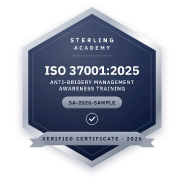
Verifiable certificate with a QR code anyone can scan, plus a digital badge to add to your LinkedIn profile.
See how verification works →You will understand what ISO 37001 asks of you, contribute to your organisation's implementation and audit readiness, and play your part with confidence when the auditor visits. Your certificate can be verified online in seconds, so certification body auditors, employers and clients can confirm your training instantly.
Complete the course and its final exam and you receive a Sterling Academy Certificate of Completion, verifiable online by QR code, with a LinkedIn badge to share.
Who built this course
Sterling has 20+ years and 8,100+ client engagements in 60+ countries. The course is built by industry experts, domain specialist trainers and globally renowned auditors with 30+ years in ISO and GRC, on the current edition of the standard. Online and self-paced, built the way we build our classroom training: the same content and format as Sterling’s classroom courses, whose certificates are trusted and accepted by all major certification bodies.
Prepared by the Sterling expert panel · Last updated 3 October 2026 · How our courses are made
Sterling Academy courses carry the same content as Sterling's classroom training, whose certificates are trusted and accepted by all major certification bodies, as evidence of training at client audits for over 20 years.
Who it is for
Top management, the anti-bribery compliance function, managers, staff in higher-risk roles and all employees in organisations using or planning ISO 37001.
Training a team? Every learner gets their own access and certificate, and the client administrator sees each person’s progress and result in one place.
About this course
Bribery at work is offering, giving, requesting or accepting any undue advantage, directly or through someone else, to influence how a person performs their role. It is not limited to cash handed to a government official. A supplier paying for a buyer's family holiday, a sales agent handing part of a success fee to a customer's procurement manager, a donation requested by an inspector before a permit is signed, or a job offered to a regulator's relative can all be bribery. It can happen in the public, private and not-for-profit sectors. Small facilitation payments to speed up routine paperwork are a common grey area that many organisations prohibit outright. The course draws the line between ordinary courtesy and improper advantage with realistic examples, so employees can tell a modest business lunch from hospitality designed to influence a decision.
Employees should watch for anything unusual in value, timing, route or secrecy. Gifts or invitations arriving during a tender, hospitality that includes partners or side trips, and requests to keep an arrangement off the record are warning signs. With third parties, red flags include an agent recommended by the official who will make the decision, fees out of proportion to the work, requests to pay a different company or an account in another country, vague invoices for "consulting" or "logistics", and refusal to sign anti-bribery commitments. Charitable donations and sponsorships requested by people who influence a contract need the same scrutiny. The right response is not to investigate personally, but to pause, record what happened and raise it with the compliance function. The course trains learners to notice these signals in their own roles in sales, procurement, finance and operations.
An anti-bribery management system protects staff and the organisation by giving clear rules, checks before risky commitments and a safe route to raise concerns. ISO 37001 sets requirements and guidance for establishing, implementing, maintaining and improving such a system so an organisation can prevent, detect and respond to bribery and meet anti-bribery laws and voluntary commitments. Its elements include a policy, a compliance function with authority and independence, a bribery risk assessment, due diligence on transactions and business associates, financial and non-financial controls, and training. The second edition was published in February 2025 and can be used alone or integrated with other management systems. For an employee, the system means knowing which approvals a gift or a new agent needs, and having a documented answer when someone applies pressure. The course explains how the 2025 edition is organised.
You declare a conflict of interest by telling your manager or the compliance function, through the organisation's form or register, before you take part in the related decision. Typical conflicts include owning shares in a supplier, a relative working for a bidder, or a second job with a competitor. Declaring does not mean wrongdoing; it lets the organisation manage the risk, perhaps by removing you from one evaluation. Concerns about suspected bribery are raised in good faith through the reporting channels the policy names, which may include an anonymous line. The organisation should protect people who report from retaliation and handle the report confidentially, then investigate and act on what it finds. The course explains what happens after a report is made, which helps employees trust the process enough to use it when they see something wrong.
All employees should take ISO 37001 Awareness, with particular priority for managers, top management and staff in higher-risk roles such as sales, procurement, finance and government liaison. People appointed to check the system should continue with ISO 37001:2025 Internal Auditor Training, which follows risks and transactions through the system clause by clause. Compliance teams responsible for wider legal and regulatory obligations can add ISO 37301:2021 Compliance Management Awareness, and procurement staff vetting business associates can take Supplier Evaluation & Second-Party Audits. Staff in remote branches can study it online whenever convenient and still receive the same content and format as Sterling's classroom training, refined across 20+ years and 8,100+ client engagements in 60+ countries. Assessments are designed on the principles of ISO/IEC 17024:2026, and the certificate is verifiable through a QR code, which helps when a certification auditor samples training records.
Save when you learn more
Course passes
Also in the Awareness Pass: all 110 awareness courses for US$99, about the price of 5 courses.
Or every course except Lead Auditor courses with the All-Access Pass: 210 courses for US$499.
Compare the passesFor teams
From US$13 per learnerEach learner gets their own access and certificate; you see progress in one place.
Price your team →Save when you take more than one course
The discount is added automatically in your basket.
What learners say
Every course is built by the experts behind 8,100+ client engagements in 60+ countries, so you learn what auditors and regulators actually expect. Here is what professionals said after finishing their course.
Informative
10/10 for Philippines Data Privacy Act and DPO Training
Better value
All-Access Pass
A pharma and life sciences professional from the USA started with one course, then upgraded to the All-Access Pass.
Every Sterling Academy course except Lead Auditor courses, for 12 months.
US$499
See the passA selection of comments from learners who finished a course and answered our feedback request, shortened from their own words. Client names available on request.
Frequently asked questions
About ISO 37001:2025 Anti-Bribery Management Awareness, its certificate and enrolment.
Ask SterlingYes. Sterling Academy's ISO 37001 courses are built by the Sterling consulting group, which has taken organisations to certification across 8,100+ client engagements in 60+ countries over 20+ years. They cover the awareness and internal auditor levels, always on the current edition, with practice questions that show the right answer. Each course ends with a final exam and a certificate that anyone can verify online, plus a LinkedIn badge, and client administrators can show an auditor exactly who has been trained. You will understand what ISO 37001 asks of you, contribute to your organisation's implementation and audit readiness, and play your part with confidence when the auditor visits. Sterling Academy courses carry the same content as Sterling's classroom training, whose certificates are trusted and accepted by all major certification bodies, as evidence of training at client audits for over 20 years.
Awareness: ISO 37001:2025 Anti-Bribery Management Awareness · Internal auditor: ISO 37001:2025 Internal Auditor Training
It is for top management, the anti-bribery compliance function, managers, staff in higher-risk roles such as sales, procurement and finance, and all employees in organisations using or planning ISO 37001. It helps every person recognise bribery, respond correctly and know how to raise a concern. No prior knowledge of ISO 37001 is needed, so it suits new starters as well as managers.
It covers what bribery is and its impact; how ISO 37001:2025 is organised and what the second edition changed; leadership, the anti-bribery policy, the compliance function and culture; bribery risk assessment and due diligence; financial and non-financial controls; gifts, hospitality and donations; conflicts of interest; raising concerns and investigating bribery; and monitoring, internal audit, management review and continual improvement.
It is a set of short video modules, each followed by practice questions, and a final exam. The course page shows the number of modules and the approximate video runtime; allow additional time for the practice questions and the exam. With 12 months of access, learners can complete it in one sitting or spread it over several sessions.
Yes. Learners who reach the 70% pass mark in the final exam receive a Sterling Academy Certificate of Completion for ISO 37001 Anti-Bribery Management Awareness. Each certificate carries a unique number and a QR code, and anyone can verify it online using the certificate number and the holder's surname. It is a training certificate for the individual learner.
Yes. ISO 37001 Anti-Bribery Management Awareness is a self-paced online course made of short video modules, in English with captions. You study at your own pace during 12 months of access, and practice questions after modules help you check your understanding before the final exam. If a point is unclear, questions are answered by a Sterling consultant.
ISO 37001 Anti-Bribery Management Awareness is US$19 per learner. Teams save 20% for 11 to 50 learners and 30% for 51 to 200 learners; 201 or more learners are priced on request. Client administrators can track their team's progress. Prices are in US dollars, excluding taxes, and Sterling confirms final pricing and enrolment.
It gives your people the knowledge ISO 37001 asks of them, and each learner's verifiable certificate is evidence of that training when the auditor asks. The Certificate of Completion is a training certificate: it shows that one person completed ISO 37001 Anti-Bribery Management Awareness and reached the pass mark in its final exam. An organisation is certified by an independent certification body after that body's own audit.
Your next step
Not sure which course?