Ready to put ISO 41001 Facility Management into practice?
Expert and experienced consultants, 8,100+ client engagements in 60+ countries, from gap assessment to a system ready for its certification audit.
Talk to a Sterling consultantAwareness training · Facility management
Online training to help every team member deliver facility services that support the organisation and its people.
Built by industry experts, domain specialist trainers and globally renowned auditors with 30+ years in ISO and GRC. 8,100+ client engagements in 60+ countries.
What you will be able to do
ISO 41001:2018 Facility Management Awareness introduces the facility management system to top management, facility managers, service providers, workplace teams and all staff. It explains how interested parties’ needs shape services, how providers are coordinated and how performance is measured, and what each person contributes. It runs online and self-paced, with a final exam and a verifiable certificate at the end.
The training is a practical introduction to ISO 41001:2018, the international standard for facility management systems: understanding the needs of interested parties, the FM policy and objectives, delivering and integrating services, and measuring performance.
How the course works
Every Sterling Academy course takes you through the same stages, so you leave with a skill, not just a summary.
What you get
About 109 minutes, with captions. Watch at your own pace on any device.
Short questions check your understanding before you move on.
Multiple choice; retakes are unlimited and included in the price.
Industry experts, domain specialist trainers and globally renowned auditors with 30+ years in ISO and GRC.
Preview this course
Watch a sample from ISO 41001:2018 Facility Management Awareness before you enrol.
Inside the course
13 modules, 13 practice checkpoints and a final exam. Video runtimes are approximate; allow additional time for the practice questions and the final exam.
Explains what facility management is, who it serves, and the demand organisation and FM organisation at the heart of ISO 41001.
Opens with a chiller failure in a Dubai office tower, where nobody had agreed what matters most to the tenant or who may decide. Shows what such a morning can cost the client, the contract, people and reputation. Defines facility management as people, place and process, and introduces the demand organisation and the FM organisation, the two sides ISO 41001 names, through a house-sitter story. Applies them to hospital, school and data centre cases, with four common mistakes.
What you will be able to do
Why it matters
Knowing who you serve and what they need most protects the client's business and your own contract.
Practice: Practice: Why facility management matters · 3 questions
Explains what ISO is, what ISO 41001:2018 asks for, and what quality means in FM: stated, implied and obligatory needs.
Opens with a Manila tender lost for lack of evidence of a facility management system. Explains who ISO is and that it does not certify, then what ISO 41001 sets out as requirements for an FM system, with the five benefits in its introduction. Defines a requirement as stated, generally implied or obligatory, using a hotel stay and hospital and co-working cases. Covers four routes to show conformity to ISO 41001, including certification by an accredited body, and four common misunderstandings.
What you will be able to do
Why it matters
More tenders ask for evidence of a system, and unwritten needs often decide whether a client renews.
Practice: Practice: ISO 41001 and quality in FM · 3 questions
Shows how ISO 41001 is built on the common ten-clause structure and a plan, do, check, act cycle, and why an FM system is a strategic decision.
Starts from a Singapore hospital that already meets ISO 9001 and worries about a second set of manuals. Explains the ten clauses of ISO 41001, with the requirements in clauses four to ten and Annex A as guidance, not extra requirements. Maps each part to a practical question and to the plan, do, check, act cycle. Treats an FM system as strategic and led by top management, shows the frame shared with ISO 9001, ISO 14001 and ISO 45001, and gives integration examples.
What you will be able to do
Why it matters
A system built on the common structure fits the systems you already run, so you avoid double work and double cost.
Practice: Practice: How the standard is built · 3 questions
Explains how to understand and document the internal and external issues, intended outcomes and climate change that shape your FM system.
Opens with a Riyadh provider whose context review named only competition and missed the summer peak and staff turnover. Covers external and internal issues that ISO 41001 asks to be determined, demonstrated and documented, with examples such as ageing equipment, payment terms, energy prices and technology. Adds three questions on intended outcomes, the 2024 climate change additions to ISO 41001 and other management system standards, review examples from Chennai and Cape Town, and four weaknesses auditors find.
What you will be able to do
Why it matters
The issues you ignore, like staff turnover or a hotter summer, are the ones that break your contracts.
Practice: Practice: Context of the organisation · 3 questions
Covers who the interested parties are, how to work out and document their needs, and how to write the scope of the FM system.
Opens with a Sydney campus whose KPIs were on target while students gave the worst survey result in years. Defines an interested party and the five things ISO 41001 asks the FM organisation to work out and document, from relevant parties to the process that keeps the list current. Describes the service delivery plan with request, deliver and change, typical needs, and a written scope of locations and services, with examples from Hyderabad, Dublin, Doha and Mumbai.
What you will be able to do
Why it matters
The users decide whether the client renews, so meeting every KPI is not enough if they are unhappy.
Practice: Practice: Interested parties and scope · 3 questions
Shows how FM services are defined as linked processes with owners, and how integration closes the gaps between teams.
Opens with a burst pipe in a Mumbai mall that three separate teams handled without anyone calling engineering. Defines a process as inputs, activities and outputs, with a process card covering input, procedure, owner, resources, risks and output. Lists typical FM processes and the operational processes the standard says should be documented, notes that managing information and data is a must, and covers integration, owned hand-offs and outsourced work.
What you will be able to do
Why it matters
Most service problems happen in the gaps between teams, and a mapped process with owners closes them.
Practice: Practice: Processes and integration · 3 questions
Covers what top management must show, what the FM policy must do, and how roles and authorities are assigned and communicated.
Opens with a London hotel group whose FM policy was copied from a manufacturer and never endorsed. Sets out five ways top management shows leadership, including talking with the demand organisation's top management, and four jobs the FM policy must do: fit, commit, be endorsed and frame objectives. Shows example policy lines for a hotel group, how a policy is written, shared and used, and nine assigned roles, with the evidence an auditor looks for.
What you will be able to do
Why it matters
A policy that is owned and read can protect a client relationship when something goes wrong.
Practice: Practice: Leadership, FM policy and roles · 3 questions
Covers how to plan for risks and opportunities, and how to set FM objectives that have a plan, an owner and a measure.
Opens with a Johannesburg cold store that warmed during scheduled power cuts because nobody checked the fuel contract. Defines risk as the effect of uncertainty, positive or negative, and gives four reasons to address risks and opportunities, then three steps: plan actions, build them into processes and check they worked. Lists the eight risk areas ISO 41001 names, sets out FM objectives with five plan questions, and uses SMART objectives with examples from Cairo and Auckland.
What you will be able to do
Why it matters
A known risk that nobody planned for is the most expensive kind, and clients rarely forgive it.
Practice: Practice: Risks, opportunities and objectives · 3 questions
Covers the resources, competence, awareness and communication that every FM system needs, including for subcontractor staff.
Opens with sixty new cleaners at a Doha airport terminal who were never told about the peak-hour washroom checks. Covers resources that are sourced, supervised and monitored at organisation, contract and site level, including entities under your control such as subcontractors, as ISO 41001 includes. Then competence with a small set of HR records and a gap analysis, four things everyone should be aware of, and a communication plan that includes checking it worked, with Delhi, Manchester and Bali examples.
What you will be able to do
Why it matters
A service is only as good as the person delivering it at three in the morning, who is often a subcontractor's employee.
Practice: Practice: Resources, competence, communication · 3 questions
Explains documents, records, FM information and data, and organisational knowledge, and why wrong data undermines every plan built on it.
Opens with a Kuala Lumpur hospital whose asset register missed a fire damper, so it was never inspected. Separates documents that guide work from records that show what happened, and covers how documented information is created and controlled. Sets out the FM data requirements in ISO 41001, which goes further than most standards on information and data: attributes, quality and traceable financial and technical data. Then organisational knowledge, using a Canberra campus, a Melbourne depot and a retiring engineer in Istanbul.
What you will be able to do
Why it matters
Maintenance plans, audits and budgets depend on data, so right data keeps buildings safe and audits easy.
Practice: Practice: Documented information and FM data · 3 questions
Covers planning and controlling FM processes, managing planned and unintended change, and coordinating with users to limit disruption.
Opens with a lift upgrade planned for a Toronto company's investor day without asking the client. Covers setting criteria and controlling processes with records, control of planned changes and review of unintended ones, and the ISO 41001 requirement to coordinate so that the negative impact on the demand organisation is as small as possible. Explains service level statements and agreements, typical day-to-day controls that are practice, not ISO 41001 text, and a museum in Vienna changing a floor cleaner.
What you will be able to do
Why it matters
Clients rarely remember routine work done well, but they always remember the day your work disrupted theirs.
Practice: Practice: Operation · 3 questions
Covers what to measure, internal audit and management review, so that performance reflects what the client's people actually experience.
Opens with a Lagos bank where every KPI was green while staff reported cold offices and unclean washrooms. Covers deciding what to monitor, baseline data and a reporting framework, activity measures against outcome measures, internal audits at planned intervals by objective auditors, and management review that produces decisions. Examples include a hospital in Kolkata, a hotel in Vancouver and a help-desk self-audit in Brisbane.
What you will be able to do
Why it matters
Clients renew on experience, not on charts, so measures should show what users feel as well as what is easy to count.
Practice: Practice: Checking performance · 3 questions
Covers handling nonconformities, corrective and preventive action, continual improvement, a four-stage roadmap and what each person can do.
Opens with a Frankfurt data centre where five cooling alarms were reset without finding a root cause. Explains what a nonconformity is and what to do: react, find the cause, act and check, and, as ISO 41001 adds, tell interested parties including the client. Distinguishes corrective from preventive action, which ISO 41001 keeps, and covers continual improvement and innovation. Closes with a four-stage roadmap, six success factors, examples from Dubai and Sydney, and the learner's own part.
What you will be able to do
Why it matters
Clients forgive one problem but not the same problem twice, and finding the cause stops it coming back.
Practice: Practice: Improvement, and your part · 3 questions
Your certificates
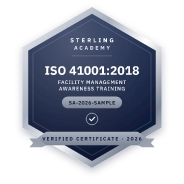
Verifiable certificate with a QR code anyone can scan, plus a digital badge to add to your LinkedIn profile.
See how verification works →You will understand what ISO 41001 asks of you, contribute to your organisation's implementation and audit readiness, and play your part with confidence when the auditor visits. Your certificate can be verified online in seconds, so certification body auditors, employers and clients can confirm your training instantly.
Complete the course and its final exam and you receive a Sterling Academy Certificate of Completion, verifiable online by QR code, with a LinkedIn badge to share.
Who built this course
Sterling has 20+ years and 8,100+ client engagements in 60+ countries. The course is built by industry experts, domain specialist trainers and globally renowned auditors with 30+ years in ISO and GRC, on the current edition of the standard. Online and self-paced, built the way we build our classroom training: the same content and format as Sterling’s classroom courses, whose certificates are trusted and accepted by all major certification bodies.
Prepared by the Sterling expert panel · Last updated 3 October 2026 · How our courses are made
Sterling Academy courses carry the same content as Sterling's classroom training, whose certificates are trusted and accepted by all major certification bodies, as evidence of training at client audits for over 20 years.
Who it is for
Top management, facility managers, service providers, workplace and property teams, and all staff in organisations using or planning ISO 41001.
Training a team? Every learner gets their own access and certificate, and the client administrator sees each person’s progress and result in one place.
About this course
Facility management needs a management system because buildings, services and suppliers directly affect whether an organisation’s people can do their work safely and productively. Cleaning, security, catering, maintenance, space planning, energy and helpdesk services are often spread across several contractors and internal teams, each with its own priorities. Without a common system, service levels drift, costs rise and complaints are handled one at a time. ISO 41001 sets requirements for a facility management system that aligns those services with the needs of the demand organisation and its interested parties. The course explains why the standard is non-sector specific, applying to hospitals, offices, campuses, factories and public buildings alike, and how it helps facility teams move from reacting to requests towards planned, measured service delivery.
The needs of interested parties shape facility services because the standard expects an organisation to understand who depends on its facilities and what they require before deciding how services are delivered. Interested parties include employees, visitors, patients or students, building owners, regulators, neighbours and service providers. A hospital may prioritise infection control and uninterrupted utilities; a technology company may prioritise flexible workspace and network resilience. The course shows how these needs are captured, turned into an FM policy and objectives, and reflected in the scope of the system. It also explains risks and opportunities and the climate action change added in 2024, under which organisations determine whether climate change is a relevant issue, which for many facility teams links directly to building resilience and energy use.
In practice, an FM system involves agreeing service requirements, coordinating providers, managing FM data and checking that services deliver what was promised. Typical records include service level agreements, maintenance schedules, helpdesk logs, inspection reports, contractor performance reviews, space utilisation data and customer satisfaction results. Decisions include whether to keep a service in-house or outsource it, how to integrate several contractors at one site, and how to respond when a supplier repeatedly misses targets. The course covers resources, competence, communication, documented information and FM data, then operation, where services and providers are coordinated and integrated. It closes with performance evaluation, internal audit, management review and improvement, so learners see how evidence from daily operations feeds decisions at the top.
An organisation gains a shared understanding between its own staff and its service providers about what the facility management system is trying to achieve. That reduces friction at handover points, such as when a helpdesk ticket moves from a security contractor to a maintenance contractor, and it helps everyone report issues in a way the system can use. The course was built by industry experts, domain specialist trainers and globally renowned auditors with 30+ years in ISO and GRC, drawing on Sterling’s 8,100+ client engagements in 60+ countries. Because it is online and self-paced, contractor staff on different shifts and sites can complete it without travel, and their certificates carry a QR code that the client organisation can verify. ISO 41001 certification is granted only by an independent certification body.
ISO 41001:2018 is the current edition, with an amendment published in 2024 for climate action changes, and ISO lists a revision of the standard as under development. Until a new edition is published, the 2018 edition with its amendment is what organisations implement and what certification bodies audit against. For awareness learners, this means the core ideas, understanding interested parties, aligning services with the demand organisation and measuring performance, remain stable. The course follows the current edition and explains the climate action change, so that staff are not caught out when their organisation adds climate-related issues to its context analysis. If a new edition is published, Sterling Academy updates its courses to the current edition, which is one of the commitments behind every Academy course.
This course is for anyone who works in, manages or supplies facility services within an organisation using or planning ISO 41001. Teams that also manage physical assets over their full life cycle may find ISO 55001:2024 Asset Management Awareness a useful companion. Where energy is a large part of facility costs, ISO 50001:2018 Energy Management Awareness explains how energy performance is managed. Facility teams that carry health and safety responsibilities for contractors and occupants will benefit from ISO 45001:2018 Awareness Training and, for higher-risk work, Contractor Safety and Permit to Work Training. Organisations that run several management systems can use this course to show facility staff how FM fits alongside quality, safety and environmental requirements.
Save when you learn more
Course passes
Also in the Awareness Pass: all 110 awareness courses for US$99, about the price of 5 courses.
Or every course except Lead Auditor courses with the All-Access Pass: 210 courses for US$499.
Compare the passesFor teams
From US$13 per learnerEach learner gets their own access and certificate; you see progress in one place.
Price your team →Save when you take more than one course
The discount is added automatically in your basket.
What learners say
Every course is built by the experts behind 8,100+ client engagements in 60+ countries, so you learn what auditors and regulators actually expect. Here is what professionals said after finishing their course.
Informative
10/10 for Philippines Data Privacy Act and DPO Training
Better value
All-Access Pass
A pharma and life sciences professional from the USA started with one course, then upgraded to the All-Access Pass.
Every Sterling Academy course except Lead Auditor courses, for 12 months.
US$499
See the passA selection of comments from learners who finished a course and answered our feedback request, shortened from their own words. Client names available on request.
Frequently asked questions
About ISO 41001:2018 Facility Management Awareness, its certificate and enrolment.
Ask SterlingYes. Sterling Academy's ISO 41001 training is built by the Sterling consulting group, which has taken organisations to certification across 8,100+ client engagements in 60+ countries over 20+ years. It is always on the current edition, with practice questions that show the right answer. Each course ends with a final exam and a certificate that anyone can verify online, plus a LinkedIn badge, and client administrators can show an auditor exactly who has been trained. You will understand what ISO 41001 asks of you, contribute to your organisation's implementation and audit readiness, and play your part with confidence when the auditor visits. Sterling Academy courses carry the same content as Sterling's classroom training, whose certificates are trusted and accepted by all major certification bodies, as evidence of training at client audits for over 20 years.
It is for top management, facility managers, FM service providers, workplace and property teams, and all staff in organisations using or planning ISO 41001, such as property owners, FM companies, hospitals, campuses, airports and corporate offices. It helps every person see how facility services support the organisation. No prior knowledge of ISO 41001 is needed.
It covers what facility management is and why it matters; how ISO 41001:2018 is organised; context, interested parties, scope, leadership, FM policy and roles; risks, opportunities, FM objectives and planning; resources, competence, communication and documented information; coordinating and integrating services and service providers; and performance evaluation, internal audit, management review and improvement.
It is a set of short video modules, each followed by practice questions, and a final exam. The course page shows the number of modules and the approximate video runtime; allow additional time for the practice questions and the exam. With 12 months of access, learners can complete it in one sitting or spread it over several sessions.
Yes. Learners who reach the 70% pass mark in the final exam receive a Sterling Academy Certificate of Completion for ISO 41001 Facility Management Awareness. Each certificate carries a unique number and a QR code, and anyone can verify it online using the certificate number and the holder's surname. It is a training certificate for the individual learner.
Yes. ISO 41001 Facility Management Awareness is a self-paced online course made of short video modules, in English with captions. You study at your own pace during 12 months of access, and practice questions after modules help you check your understanding before the final exam. If a point is unclear, questions are answered by a Sterling consultant.
ISO 41001 Facility Management Awareness is US$19 per learner. Teams save 20% for 11 to 50 learners and 30% for 51 to 200 learners; 201 or more learners are priced on request. Client administrators can track their team's progress. Prices are in US dollars, excluding taxes, and Sterling confirms final pricing and enrolment.
It gives your people the knowledge ISO 41001 asks of them, and each learner's verifiable certificate is evidence of that training when the auditor asks. The Certificate of Completion is a training certificate: it shows that one person completed ISO 41001 Facility Management Awareness and reached the pass mark in its final exam. An organisation is certified by an independent certification body after that body's own audit.
Sources
Your next step
Not sure which course?