Get consulting from Sterling
Expert and experienced consultants, 8,100+ client engagements in 60+ countries, from gap assessment to a system ready for its certification audit.
Talk to a Sterling consultantAwareness training · Regional laws and regulations
Online training course to help every employee play their part in meeting the SAMA Cyber Security Framework.
This awareness training course explains the SAMA Cyber Security Framework, version 1.0, issued by the Saudi Central Bank in May 2017 and in force in the SAMA Rulebook: who it applies to, how its four domains and the maturity model work, and what cyber security governance, risk management and compliance, everyday operations and technology, and third-party security mean in daily work. A consumer finance company in Riyadh runs through the course.
Secure payment by Stripe · for yourself or for your team
Add another course and save 15%, up to 25%
What you get
About 117 minutes, with captions. Watch at your own pace on any device.
Short questions check your understanding before you move on.
Multiple choice, with one retake if you need it.
Industry experts, domain specialist trainers and globally renowned auditors with 30+ years in ISO and GRC.
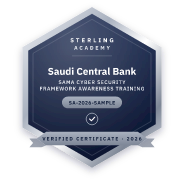
Verifiable certificate with a QR code anyone can scan, plus a digital badge to add to your LinkedIn profile.
See how verification works →Save when you take more than one course
The discount is added automatically in your basket.
Standard and editionSAMA Cyber Security Framework, version 1.0 (May 2017)
Last updated10 November 2026
Preview this course
Watch a sample from SAMA Cyber Security Framework Awareness Training before you enrol.
What learners say
Every course is built by the experts behind 8,100+ client engagements in 60+ countries, so you learn what auditors and regulators actually expect. Here is what professionals said after finishing their course.
Informative
10/10 for Philippines Data Privacy Act and DPO Training
Best value
All-Access Pass
A pharma and life sciences professional from the USA started with one course, then upgraded to the All-Access Pass.
Every Sterling Academy course for 12 months.
US$499
See the passA selection of comments from learners who finished a course and answered our feedback request, shortened from their own words. Client names available on request.
Learning outcomes
Connect the subject to the responsibilities and decisions people encounter in their roles.
Inside the course
10 modules, 10 practice checkpoints and a final exam. Video runtimes are approximate; allow additional time for the practice questions and the final exam. Modules marked optional can be skipped; the others are studied in any order.
Introduces the SAMA Cyber Security Framework, version 1.0 of May 2017: why the Saudi Central Bank issued it, its aims and who must follow it.
Opens the SAMA Cyber Security Framework Awareness training course by asking who decides how well a finance app's customers must be protected. Introduces version 1.0 of May 2017, listed in SAMA's Rulebook as in force, the reasons in section 1.1 and the three objectives. Explains confidentiality, integrity and availability, the member organisations in section 1.4, the broad scope of information assets, SAMA's role and each organisation's, and how the framework relates to other rules. Introduces HZM Finance, the Riyadh consumer finance company the course follows, and what the framework asks of all staff.
What you will be able to do
Why it matters
The framework reaches every desk, branch and supplier, so everyone who uses the organisation's systems has a part in it.
Practice: Practice: Why the framework exists · 3 questions
Explains how the SAMA Cyber Security Framework is built: four domains, principles and control considerations, waivers and self-assessment.
Starts by asking whether a company can simply skip a control it cannot apply. Sets out the four domains and thirty-two subdomains, each with a principle, an objective and control considerations, and explains why should means expected. Reads subdomain 3.1.6 as an example, then covers the principle-based approach: compensating controls, internal risk acceptance and a formal waiver under Appendix D. Explains the four exceptions for organisations other than banks and what they mean for HZM Finance, self-assessment with evidence, one project touching all four domains, update requests, and examples from Dubai and London. From Module 4 the training course follows the subdomains in order.
What you will be able to do
Why it matters
A hidden gap becomes a SAMA finding, while a gap handled openly gives SAMA a decision to make.
Practice: Practice: How the framework works · 3 questions
Covers the six cyber security maturity levels in the SAMA framework, why level three is the minimum, and what levels four and five add.
Starts with a team that runs the same checks every week without ever writing them down. Explains the six maturity levels in section 2.4, from non-existent to adaptive, and the rule that organisations should operate at least at level three. Covers what level three requires, the documentation pyramid of policy, standards and procedures, the meaning of a process, KPIs at level three and KRIs at level four, and continuous improvement at level five. Shows how HZM Finance scored access reviews, awareness and phishing resistance, with examples from Cairo and Singapore and Sterling's recommended practice.
What you will be able to do
Why it matters
Under the maturity model what cannot be shown does not count, so writing down and approving existing practice moves teams up.
Practice: Practice: The maturity levels · 3 questions
Explains the leadership and governance domain of the SAMA framework: the board, the committee, the independent CISO, policy and awareness.
Starts by asking who holds ultimate responsibility for cyber security. Covers the board's role, the cyber security committee and its charter under section 3.1.1, the function's independence from IT, and the full-time CISO. Explains the strategy in section 3.1.2, the policy in section 3.1.3, the roles in section 3.1.4 from the board to all staff, security in projects under section 3.1.5, awareness for staff, third parties and customers under section 3.1.6, and training under section 3.1.7. Shows HZM Finance moving its CISO to report to the chief executive, with examples from Manama and Mumbai.
What you will be able to do
Why it matters
Responsibility starts at the top and reaches everyone, so knowing the policy and reporting weaknesses supports the whole programme.
Practice: Practice: Leadership and governance · 3 questions
Covers the risk management and compliance domain of the SAMA framework: the risk process, treatment, regulation, reviews and audits.
Starts by asking what must happen before a business manager's acceptance of a cyber risk counts. Explains the four-step risk management process in section 3.2.1, when it starts, and the business owner as risk owner. Covers identification, analysis, the four treatments and their conditions, and monitoring. Explains regulatory compliance under section 3.2.2, industry standards such as PCI DSS and the SWIFT framework under section 3.2.3, annual reviews and penetration tests under section 3.2.4, and independent audits under section 3.2.5. Follows HZM Finance treating an old branch system's risk, with examples from Dubai and Kuala Lumpur.
What you will be able to do
Why it matters
An unowned open risk is simply untreated, so logging risks and following treatments through leaves evidence for SAMA.
Practice: Practice: Risk and compliance · 3 questions
Opens the operations and technology domain of the SAMA framework: HR security, physical security, asset management and secure disposal.
Starts with an employee who resigns on a Thursday. Explains cyber security in human resources under section 3.3.1, from staff agreements and screening to revoking access and returning assets, following a leaver at HZM Finance. Covers physical security under section 3.3.2 and the habit of badging in for yourself. Explains the unified asset register under section 3.3.3, owners and custodians, classification and handling, security architecture under section 3.3.4, and secure disposal under section 3.3.11. Shows the four gaps HZM Finance found, from former staff with active accounts to unwiped servers, with examples from Istanbul and Cairo.
What you will be able to do
Why it matters
You cannot protect what you do not know you have, and many gaps need only a moment of inattention, not a hacker.
Practice: Practice: People, places and assets · 3 questions
Covers identity and access, application security, change control, infrastructure, cryptography and BYOD in the SAMA framework.
Starts with a colleague moving from credit to marketing who wants to keep her old access. Explains identity and access management under section 3.3.5, need-to-have and need-to-know, joiners, movers and leavers, and multi-factor authentication for remote, sensitive and privileged access. Covers application security and segregation of duties under section 3.3.6, strict change control under section 3.3.7, infrastructure standards under section 3.3.8, cryptography under section 3.3.9 and personal devices under section 3.3.10. Shows HZM Finance's first access review, which removed thirty-seven rights and replaced a shared administrator account, and examples from London and Singapore.
What you will be able to do
Why it matters
Every extra access right and every uncontrolled change is a way in, so small habits prevent big incidents.
Practice: Practice: Access and systems · 3 questions
Explains security monitoring, incident management, reporting incidents to SAMA, threat intelligence and vulnerability management.
Starts with a serious incident at a financing company late on a Thursday. Covers payment systems and electronic banking standards in sections 3.3.12 and 3.3.13, including multi-factor authentication. Explains security event management and the SOC under section 3.3.14, and incident management under section 3.3.15, including informing SAMA's IT Risk Supervision immediately of medium or high incidents, its no objection before media contact and the formal report. Covers threat management and vulnerability management with fix timelines. Follows HZM Finance's phishing incident, from locked accounts to the formal report and lessons for the committee, with examples from Dubai and Mumbai.
What you will be able to do
Why it matters
The first notice to SAMA does not wait for the full picture, so quick reporting by staff makes timely notice possible.
Practice: Practice: Monitoring and incidents · 3 questions
Covers the third party domain of the SAMA framework: contract and vendor management, outsourcing approval and cloud computing rules.
Starts with a team wanting to move customer files to a cheap cloud service abroad next week. Explains the principle that third parties must give the same level of protection, and contract and vendor management under section 3.4.1, from tenders to escalation, exit and escrow. Covers material outsourcing under section 3.4.2, which needs SAMA's approval first, and cloud computing under section 3.4.3: risk assessment, SAMA's approval, data in Saudi Arabia in principle, provider commitments and return and deletion on exit. Shows HZM Finance's cloud move and call centre partner, with examples from Dubai and London.
What you will be able to do
Why it matters
Outsourcing a task never outsources the responsibility, so assessing, approving and contracting first protects customers' data.
Practice: Practice: Third parties and cloud · 3 questions
Explains how SAMA reviews compliance and maturity under its Cyber Security Framework, how to prepare, and your daily role.
Starts by asking whether SAMA looks at policies on the shelf or at what people do every day. Explains periodic self-assessments that SAMA reviews and audits, what evidence to keep ready in each domain, and the key numbers in the framework. Covers waivers and update requests, how SAMA keeps the framework current, and the Rulebook listing version 1.0 as in force. Gives six daily habits, Sterling's recommended practice for answering a self-assessment, a look back at HZM Finance, and examples from Manama and Singapore. Closes the training course with a review of all four domains.
What you will be able to do
Why it matters
Maturity is a habit, not an event, and evidence built in daily work is what SAMA's reviews rely on.
Practice: Practice: Reviews and your role · 3 questions
About this course
Banks, insurers, financing companies, credit bureaus and the financial market infrastructure in Saudi Arabia must adopt the Cyber Security Framework issued by the Saudi Central Bank, SAMA. Version 1.0, issued in May 2017 under Circular 381000091275, is listed as in force in the SAMA Rulebook. It replaced earlier SAMA cyber security circulars with one framework of four domains and thirty-two subdomains, and SAMA reviews and audits each organisation's self-assessment to set its maturity level, with level 3 as the minimum. Its controls reach every member of staff, third parties and customers, from awareness and access to incident reporting.
The course teaches from the framework itself, with section numbers on screen, and explains it for everyone who uses the organisation's systems, not only for security specialists. It shows how the maturity model works, what level 3 needs in documents and evidence, and which subdomains change for organisations other than banks. It keeps the framework's own numbers exact, such as the quarterly committee meetings, the annual review and penetration test of internet-facing services, and immediate notice to SAMA of medium and high incidents. One consumer finance company in Riyadh, HZM Finance, runs through all ten modules, from its CISO's reporting line to a phishing incident and a move to the cloud.
The course is written for staff, team leaders and managers in organisations regulated by SAMA: banks, insurers and reinsurers, financing companies, credit bureaus and payment providers, and the suppliers, outsourcing partners and cloud teams that serve them. It suits business owners of systems, IT and development teams, HR, procurement, branch and operations staff, and anyone who answers part of a SAMA self-assessment. No technical background is needed. A separate Sterling Academy course covers the National Cybersecurity Authority's Essential Cybersecurity Controls.
After the course, a learner can explain why SAMA issued the framework, which organisations it applies to, and how its domains, principles and control considerations fit together. They can describe the maturity levels and the evidence each one needs, and the roles of the board, the cyber security committee and the CISO. They can follow the risk, access and change processes in their own work, report a suspected incident at once and protect the evidence, and recognise when a supplier, outsourcing arrangement or cloud service needs an assessment and SAMA's approval first.
Module 1: introduces the SAMA Cyber Security Framework, version 1.0 of May 2017: why the Saudi Central Bank issued it, its aims and who must follow it. Module 2: explains how the SAMA Cyber Security Framework is built: four domains, principles and control considerations, waivers and self-assessment. Module 3: covers the six cyber security maturity levels in the SAMA framework, why level three is the minimum, and what levels four and five add. Module 4: explains the leadership and governance domain of the SAMA framework: the board, the committee, the independent CISO, policy and awareness. Module 5: covers the risk management and compliance domain of the SAMA framework: the risk process, treatment, regulation, reviews and audits. Module 6: opens the operations and technology domain of the SAMA framework: HR security, physical security, asset management and secure disposal. Module 7: covers identity and access, application security, change control, infrastructure, cryptography and BYOD in the SAMA framework. Module 8: explains security monitoring, incident management, reporting incidents to SAMA, threat intelligence and vulnerability management. Module 9: covers the third party domain of the SAMA framework: contract and vendor management, outsourcing approval and cloud computing rules. Module 10: explains how SAMA reviews compliance and maturity under its Cyber Security Framework, how to prepare, and your daily role.
Frequently asked questions
About SAMA Cyber Security Framework Awareness Training, its certificate and enrolment.
Ask SterlingYes. Sterling Academy's SAMA Cyber Security Framework Awareness training is built by the Sterling consulting group, which has taken organisations to certification across 8,100+ client engagements in 60+ countries over 20+ years. It comes with practice questions that show the right answer. Each course ends with a final exam and a verifiable certificate that anyone can check online, plus a LinkedIn badge, and client administrators can show an auditor exactly who has been trained. You will be able to apply SAMA Cyber Security Framework Awareness at work and show your competence with confidence. Sterling Academy courses carry the same content as Sterling's classroom training, whose certificates are trusted and accepted by all major certification bodies, as evidence of training at client audits for over 20 years.
It is for employees, team leaders and managers in banks, insurers, financing companies, credit bureaus and payment providers regulated by the Saudi Central Bank, and for suppliers that serve them. No technical background is needed. The course explains the framework in plain words, with one consumer finance company in Riyadh as the example throughout.
The NCA Essential Cybersecurity Controls are the national baseline set by the National Cybersecurity Authority. This course covers the sector framework that the Saudi Central Bank issued for the organisations it regulates, with its own domains, maturity levels and expectations. Many financial institutions need both, so the course points to the NCA ECC course where the two meet.
Short practice questions after each module help you check your understanding; they do not count toward the result. The course ends with a scenario-based multiple-choice final exam. Learners who reach the final exam's pass mark receive a Sterling Academy Certificate of Completion, and one retake is included. Each certificate carries a unique number and a QR code for online checking.
Yes. It is based on version 1.0 of the SAMA Cyber Security Framework, which the SAMA Rulebook lists as in force, issued under a circular dated 24 May 2017. Related SAMA documents in the Rulebook, such as the Cyber Resilience Fundamental Requirements, are named where they apply, and the course does not teach drafts as requirements.
The course is in preparation. Register on this page with “Notify me when it opens” and we will send you one e-mail when it opens for enrolment, with the price per learner and the details for team enrolment. The course page will then show the full module list and the video runtime.
Your certificate
You will be able to apply SAMA Cyber Security Framework Awareness at work and show your competence with confidence. Your certificate can be verified online in seconds, so certification body auditors, employers and clients can confirm your training instantly.
Complete the course and its final exam and you receive a Sterling Academy Certificate of Completion, verifiable online by QR code, with a LinkedIn badge to share.
Sterling Academy courses carry the same content as Sterling's classroom training, whose certificates are trusted and accepted by all major certification bodies, as evidence of training at client audits for over 20 years.
Ask about course requirementsYour next step
Not sure which course?