Get ISO 45001 consulting from Sterling
Expert and experienced consultants, 8,100+ client engagements in 60+ countries, from gap assessment to a system ready for its certification audit.
Talk to a Sterling consultantAwareness training · Health & safety
Part of the ISO 45001:2018 learning path → Step 1
Online training to help every employee play their part in a safe, healthy workplace.
The training is a practical introduction to ISO 45001 for staff at every level: what an occupational health and safety management system is, how hazards and risks are managed, why worker participation matters, and what each person does to prevent injury and ill health.
Secure payment by Stripe · for yourself or for your team
Add another course and save 15%, up to 25%
What you get
About 99 minutes, with captions. Watch at your own pace on any device.
Short questions check your understanding before you move on.
Multiple choice, with one retake if you need it.
Industry experts, domain specialist trainers and globally renowned auditors with 30+ years in ISO and GRC.
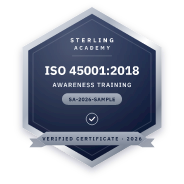
Verifiable certificate with a QR code anyone can scan, plus a digital badge to add to your LinkedIn profile.
See how verification works →Save when you take more than one course
The discount is added automatically in your basket.
Standard and editionISO 45001:2018, including Amendment 1:2024 (climate action changes)
Last updated1 October 2026
Preview this course
Watch a sample from ISO 45001:2018 Awareness Training before you enrol.
What learners say
Every course is built by the experts behind 8,100+ client engagements in 60+ countries, so you learn what auditors and regulators actually expect. Here is what professionals said after finishing their course.
Informative
10/10 for Philippines Data Privacy Act and DPO Training
Best value
All-Access Pass
A pharma and life sciences professional from the USA started with one course, then upgraded to the All-Access Pass.
Every Sterling Academy course for 12 months.
US$499
See the passA selection of comments from learners who finished a course and answered our feedback request, shortened from their own words. Client names available on request.
Learning outcomes
Connect the subject to the responsibilities and decisions people encounter in their roles.
Inside the course
15 modules, 15 practice checkpoints and a final exam. Video runtimes are approximate; allow additional time for the practice questions and the final exam.
Introduces ISO 45001 as the international standard for occupational health and safety management, who stands behind it and what the system should deliver.
Opens with a Dubai contractor facing a hospital tender and a scaffolder's fall on another site. Counts what one serious incident can cost, then explains who stands behind the standard: ISO writes it, certification bodies certify, and accreditation bodies check them. Covers its purpose, the edition in force, ISO 45001:2018 with its 2024 amendment, its place beside ISO 9001 and ISO 14001, why protective equipment is the last of five levels of control, and the three intended outcomes.
What you will be able to do
Why it matters
Safe work keeps people well and keeps the business working, and clients increasingly ask how you manage health and safety before awarding work.
Practice: Practice: Welcome, and what ISO 45001 is · 3 questions
Traces the standard from OHSAS 18001 to ISO 45001, lists the business benefits, and explains the ten clauses and the plan, do, check, act cycle.
Starts with a Manchester warehouse operator whose supplier form still names OHSAS 18001. Explains where ISO 45001 came from, the March 2018 publication of ISO 45001 and the 2024 climate change amendment, and why the old standard is not the same. Lists six benefits, defines a health and safety management system, describes the ten clauses with shall and should, the seven requirement clauses in order, the structure shared with ISO 9001 and ISO 14001, and the cycle applied to a packaging plant.
What you will be able to do
Why it matters
Sharing one structure with ISO 9001 and ISO 14001 means one integrated system and one set of audits.
Practice: Practice: From OHSAS 18001 to ISO 45001: benefits and structure · 3 questions
Takes seven common myths about ISO 45001 and sets out the reality, including that it fits small organisations and offices and is not a finish line.
Opens with a Nairobi software company that believes safety is for factories until a developer nearly falls asleep driving home after a sixteen-hour release night. Works through seven myths about ISO 45001: only for big companies, just paperwork, a marketing badge, too bureaucratic, too expensive, only for factories and building sites, and finished once certified. Shows the reality of a strategic decision led from the top, with examples from a bakery, an accounting office, a school and a logistics start-up.
What you will be able to do
Why it matters
Myths stop organisations from starting or make them stop once the certificate is on the wall.
Practice: Practice: Myths and reality · 3 questions
Covers the organisation's context, including climate change, who counts as a worker, other interested parties and how the scope is set.
Opens with a Riyadh hospital where agency nurses, cleaners, contractors and visiting families raise the question of who counts as a worker. Defines context under ISO 45001 with internal and external issues, gives Sterling's five steps, and explains the 2024 climate change points. Describes workers as anyone under the organisation's control, how to identify other interested parties and their needs, and a credible scope compared with one that hides.
What you will be able to do
Why it matters
The issues and people you miss today become the incidents and complaints you did not plan for.
Practice: Practice: Context, workers and interested parties, and scope · 3 questions
Explains top management's responsibilities, the difference between consulting workers and having them take part, and the six commitments of the policy.
Starts with a mining contractor near Perth that announced twelve-hour shifts by e-mail, followed by two near misses. Sets out what leadership means in ISO 45001, then separates telling, consultation and participation, and lists the topics workers should help decide. Covers how to make participation possible, the usual barriers, and the six commitments the health and safety policy must hold, with a sample policy and examples from Cairo and London.
What you will be able to do
Why it matters
Workers know where the hazards are, so asking them prevents incidents and ignoring them loses their trust.
Practice: Practice: Leadership, worker participation and the OH&S policy · 3 questions
Separates hazard from risk and shows where to look for hazards in routine and non-routine work, people, the workplace and how work is organised.
Opens with a Singapore restaurant kitchen where cleaning a plugged-in slicer had never been listed as a job with hazards. Uses a wet floor and a road to show hazard versus risk, then lists families of hazard, which in ISO 45001 means harm to people, not damage to property: mechanical, electrical, chemical, biological, physical, movement and energy, and psychosocial. Covers the four places to look, the extra places to check, and examples from an office, a factory, a construction site and a warehouse.
What you will be able to do
Why it matters
A hazard nobody finds is a hazard nobody controls, and confusing hazard with risk leads to fixing the wrong thing.
Practice: Practice: Hazards: what they are, and where to look · 3 questions
Shows how to assess likelihood and severity, look for opportunities, and choose controls in the right order using the five levels of the hierarchy.
Starts with a Mumbai chemical plant that must have a contractor's crew clean a confined-space storage tank within a week. Explains risk as likelihood combined with severity, Sterling's one to five scoring, and opportunities that remove a hazard. Walks down the five levels of control in the fixed order ISO 45001 sets, from eliminate to protective equipment, applies them to the tank, covers cost, why contracting out is not elimination, and scoring again.
What you will be able to do
Why it matters
Assessing well puts money on the controls that matter, so you do not buy gloves for a problem a guard should solve.
Practice: Practice: Risks and opportunities, and the hierarchy of controls · 3 questions
Looks at risks and opportunities to the management system itself, beyond hazards to people, and how to plan and check actions for them.
Opens with a Houston logistics company that awarded a loading contract on price alone, so every task was assessed but the system had a weak point. Explains risk as the effect of uncertainty and the two uses in ISO 45001. Lists five common risks to the system, where they come from, and opportunities for people and for the system. Gives Sterling's five steps for managing them, with a three-risk exercise.
What you will be able to do
Why it matters
A system can fail even when every task is assessed, for lack of budget, competent contractors or records.
Practice: Practice: The other risks and opportunities · 3 questions
Covers legal and other requirements, how to keep them current in one register, and how to write health and safety objectives with leading measures.
Starts with a Lagos food plant whose only objective was zero accidents and whose legal register was three years old. Defines the legal requirements and other requirements ISO 45001 speaks of, with examples, the four-part process to find, apply, communicate and update them, and Sterling's single register with an owner and review date. Explains objectives and their levels, the smart test, why zero accidents is a weak objective alone, and the plan behind each one.
What you will be able to do
Why it matters
Breaking the law brings prosecution, stop-work orders and lost contracts, and the wrong goals hide the warnings.
Practice: Practice: Legal requirements and OH&S objectives · 3 questions
Covers competence, awareness, communication and documented information, and why training held and e-mail sent do not mean people are competent or informed.
Opens with a Cebu BPO whose training ran at two in the afternoon and whose new evacuation route went by e-mail, missing the night shift. Defines competence, including, in ISO 45001:2018, the ability to identify hazards, and Sterling's records. Lists six things every worker must be aware of, the four questions communication settles with diversity in mind, and documents versus records, with a document life cycle and a master list.
What you will be able to do
Why it matters
A control is only as good as the person applying it and the instruction they were given.
Practice: Practice: Support: competence, communication and documented information · 3 questions
Covers operational control: procedures people know, management of change, choosing and coordinating contractors, and calibrated, maintained equipment.
Starts with an Abu Dhabi oil and gas services company where a pump was swapped without review and a welder reached a tank hatch without an entry permit. Explains what operational control means and examples of procedures. Describes how to spot and assess a change, buying safe and choosing contractors on safety criteria, and why responsibility stays with you. Ends with calibration of monitoring equipment and preventive maintenance.
What you will be able to do
Why it matters
Changes and contractors sit behind many serious incidents, and a control that lives only on paper stops nothing.
Practice: Practice: Operational control: procedures, change, contractors and equipment · 3 questions
Covers emergency preparedness and response: identifying emergencies, planning, training, testing with drills and reviewing, and who needs to know.
Opens with a Sydney hotel where a fryer fire led to a chaotic evacuation to an assembly point closed after the car park was rebuilt. Describes the cycle of identify, plan, train, test and review, on-site and off-site emergencies, and the people who must know, including contractors, visitors, emergency services and the community. Includes examples from a Jeddah depot and an Auckland school, and the three fixes for the hotel.
What you will be able to do
Why it matters
In an emergency people do what they have practised, so a written plan alone does not make a site prepared.
Practice: Practice: Emergency preparedness and response · 3 questions
Covers monitoring and measurement, internal audit and management review, and why a low injury count alone does not show the system is working.
Starts with a Chennai car-parts plant whose safety board counts injuries while near-miss reports stopped and half the guard inspections were skipped. Lists four things to monitor, a balanced board of leading and lagging indicators, and the check of legal compliance. Explains internal audits at planned intervals by impartial auditors and the inputs and decisions of management review, including trends in worker consultation and participation, an input of ISO 45001's own.
What you will be able to do
Why it matters
Counting accidents tells you what already went wrong, while good indicators warn you before anyone is hurt.
Practice: Practice: Monitoring, internal audit and management review · 3 questions
Explains incidents, near misses and nonconformities, the process of report, investigate and act, and the difference between correction and corrective action.
Opens with a Johannesburg warehouse where a forklift missed a picker by about a metre and nobody reported it. Defines incident, accident and near miss, and nonconformity with examples, in ISO 45001's terms. Sets out reacting, investigating with workers, finding the root cause, acting through the hierarchy of controls and checking it worked. Separates correction from corrective action and introduces five whys, fishbone and Pareto analysis, with a worked five whys.
What you will be able to do
Why it matters
The near miss you do not report today is the injury you investigate tomorrow, with the cost and downtime that follow.
Practice: Practice: Incidents, nonconformity and corrective action · 3 questions
Covers the documented information ISO 45001 needs, a ten-step route to implement it, what makes a system last, and what each person does.
Opens with four workplace moments, including a skipped harness and a blocked fire exit, and what each worker does. Lists the documented information ISO 45001 needs, kept up to date and kept as evidence, and four short procedures Sterling recommends. Sets out ten steps from setting up to certification audit, eight things that make a system last, and closes the course by returning to the improvement question from module one and a recap for each role.
What you will be able to do
Why it matters
A simple system that people use lasts, while a bureaucratic one dies the week after the audit.
Practice: Practice: Documentation, implementation and your part · 3 questions
Frequently asked questions
About ISO 45001:2018 Awareness Training, its certificate and enrolment.
Ask SterlingYes. Sterling Academy's ISO 45001 courses are built by the Sterling consulting group, which has taken organisations to certification across 8,100+ client engagements in 60+ countries over 20+ years. They cover the awareness, implementation, internal auditor and specialist levels, always on the current edition, with practice questions that show the right answer. Each course ends with a final exam and a verifiable certificate that anyone can check online, plus a LinkedIn badge, and client administrators can show an auditor exactly who has been trained. You will understand what ISO 45001 asks of you, contribute to your organisation's implementation and audit readiness, and play your part with confidence when the auditor visits. Sterling Academy courses carry the same content as Sterling's classroom training, whose certificates are trusted and accepted by all major certification bodies, as evidence of training at client audits for over 20 years.
Awareness: ISO 45001:2018 Awareness Training · Implementation: ISO 45001:2018 Implementation Training · Internal auditor: ISO 45001:2018 Internal Auditor Training · Specialist: Hazard Identification and Risk Assessment (HIRA) Training
It is for all employees, supervisors and managers in an organisation using or planning ISO 45001, including contractors. A suggested staff path of seven modules covers hazards and risks, emergencies, reporting incidents and each person's part; managers, supervisors, OH&S committee members and the core team take the full course. No prior knowledge is needed.
It covers why OH&S management matters; context, interested parties and scope, including climate change; leadership, the OH&S policy and worker consultation and participation; hazard identification and risk assessment; the hierarchy of controls; legal and other requirements and OH&S objectives; operational control and emergency preparedness; incidents, nonconformity and corrective action; and monitoring, internal audit and management review.
The course is planned as 15 video modules and about 120 minutes of video, with practice questions after each module and a 30-question final exam: about 2 hours 40 minutes in all. A suggested staff path of seven modules takes about 55 minutes of video. With 12 months of access, learners go at their own pace.
Yes. Learners who reach the 70% pass mark in the final exam receive a Sterling Academy Certificate of Completion for ISO 45001 Awareness. Each certificate carries a unique number and a QR code, and anyone can check it online using the certificate number and the holder's surname. It is a training certificate for the individual learner.
Yes. ISO 45001 Awareness is a self-paced online course made of short video modules, in English with captions. You study at your own pace during 12 months of access, and practice questions after modules help you check your understanding before the final exam. If a point is unclear, questions are answered by a Sterling consultant.
ISO 45001 Awareness is US$19 per learner. Teams save 20% for 11 to 50 learners and 30% for 51 to 200 learners; 201 or more learners are priced on request. Client administrators can track their team's progress. Prices are in US dollars, excluding taxes, and Sterling confirms final pricing and enrolment.
It gives your people the knowledge ISO 45001 asks of them, and each learner's verifiable certificate is evidence of that training when the auditor asks. The Certificate of Completion is a training certificate: it shows that one person completed ISO 45001 Awareness and reached the pass mark in its final exam. An organisation is certified by an independent certification body after that body's own audit.
Consultation and participation of workers is one of the features that most sets ISO 45001 apart from ISO 9001 and ISO 14001. Workers face the hazards, so they are best placed to spot them and to help decide on controls. The course gives it particular attention and reminds every learner to speak up when they have not been consulted.
Learning path
This course
Understand occupational health and safety management, the importance of recognising hazards and the part everyone plays in prevention and participation.
Next step
Put every ISO 45001:2018 requirement in place with the workers who face the hazards, from hazard identification and risk assessment to operational control, incidents and certification readiness.
View courseYour certificate
You will understand what ISO 45001 asks of you, contribute to your organisation's implementation and audit readiness, and play your part with confidence when the auditor visits. Your certificate can be verified online in seconds, so certification body auditors, employers and clients can confirm your training instantly.
Complete the course and its final exam and you receive a Sterling Academy Certificate of Completion, verifiable online by QR code, with a LinkedIn badge to share.
Sterling Academy courses carry the same content as Sterling's classroom training, whose certificates are trusted and accepted by all major certification bodies, as evidence of training at client audits for over 20 years.
Ask about course requirementsYour next step
Not sure which course?