Ready to strengthen your ISMS internal audits?
Expert and experienced consultants, 8,100+ client engagements in 60+ countries, from gap assessment to a system ready for its certification audit.
Talk to a Sterling consultantPractitioner training · Auditing
Online training to audit your ISMS with evidence, not assumptions.
Exemplar Global certified certificate available
ISO/IEC 27001:2022 and ISO 19011:2026Built by industry experts, domain specialist trainers and globally renowned auditors with 30+ years in ISO and GRC. 8,100+ client engagements in 60+ countries.
What you will be able to do
ISO/IEC 27001:2022 Internal Auditor Training is for ISMS, IT and security staff, control owners and compliance officers appointed as internal auditors. Learners will plan audits using ISO 19011:2026, sample Annex A controls, test the risk assessment and Statement of Applicability and write clear findings. Online and self-paced, the course ends in a final exam and a verifiable certificate.
The training is a practitioner course for internal auditors of information security management systems: what ISO/IEC 27001:2022 clause 9.2 requires of internal audits, and how to plan, conduct, report and follow up an ISMS audit using ISO 19011:2026 guidance, including auditing the risk assessment, the Statement of Applicability and Annex A controls.
Part of: Information Security and ISO 27001 Training
Part of: Information Security & Privacy
How the course works
Every Sterling Academy course takes you through the same stages, so you leave with a skill, not just a summary.
What you get
About 7½ hours, with captions. Watch at your own pace on any device.
Short questions check your understanding before you move on.
Score at least 60% to receive the Certificate of Competence.
Industry experts, domain specialist trainers and globally renowned auditors with 30+ years in ISO and GRC.
Preview this course
Watch a sample from ISO/IEC 27001:2022 Internal Auditor Training before you enrol.
Inside the course
26 modules, 26 practice checkpoints, 7 practice exercises and a final exam. Video runtimes are approximate; allow additional time for the practice questions and the final exam. Modules marked optional can be skipped; the others are studied in any order.
Introduces this training course on auditing an information security management system (ISMS), using four recent incidents to show why internal audit matters.
Opens with a self-rating and four incidents: Coinbase, Qantas, Snowflake and CrowdStrike, each with the questions an auditor would ask. Introduces ABC BPO & IT Services Inc., a company of about 2,500 staff with centres in New York, Manila and Mumbai. Shows two auditors checking the same leaver control, links this to clause 9.2, and outlines this training course in four parts, its limits as a course for auditing within your own organisation, and four myths.
What you will be able to do
Why it matters
An audit that reads policies finds nothing; one that asks for evidence finds accounts still active after people have left.
Practice: Practice: Welcome, and why ISMS internal audit matters · 3 questions
Explains information, C-I-A (confidentiality, integrity and availability), information assets and the threats to them, as an auditor sees them.
Starts at ABC in Manila, where payroll data sits on screens, paper, a whiteboard and in conversation. Covers what information is, the areas of the business where it lives, its forms and its life-cycle, then the three parts of C-I-A with the Jack and Jill story and a payments fintech in Singapore. Moves on to information assets, controls A.5.9, A.5.10, A.5.12 and A.5.13, threats to assets, and a finding on laptops missing from the Mumbai inventory.
What you will be able to do
Why it matters
An auditor who looks only at systems misses most of the risk, because the same data also sits on paper, whiteboards and in conversation.
Practice: Practice: Information, C-I-A, assets and threats · 3 questions
Explains what an ISMS is, how ISO/IEC 27001:2022 is built, the four themes of Annex A and what the Statement of Applicability contains.
Begins with an online retailer in London claiming that internal audit does not apply and that all 93 controls are implemented. Covers management systems and the ISMS, ISO and certification bodies, the ISO/IEC 27000 family, other frameworks, the standard's history and structure, and Plan, Do, Check, Act. Annex A is split into 37 organisational, 8 people, 14 physical and 34 technological controls, and four Statement of Applicability lines at ABC are tested.
What you will be able to do
Why it matters
Knowing that only ISO/IEC 27001 holds the requirements stops you raising nonconformities against guidance, or accepting a clause being left out.
Practice: Practice: The ISMS and ISO/IEC 27001:2022 · 3 questions
Clause 4.1, the context of the organisation, from an auditor's view: intended outcomes, internal and external issues, and the climate change decision.
Starts with ABC in Mumbai, where managers name three issues that the risk register leaves out. Explains intended outcomes with an airline, a bank, a BPO and a retail store, then internal and external issues, six areas to look in, and a five-step trail from issue to review. Covers the 2024 climate change addition, with typhoons in Manila, a telecom operator in Dubai and an insurer in Toronto, the evidence to expect, and findings under clauses 6.1.1 and 9.3.2.
What you will be able to do
Why it matters
A list of issues tells little on its own; what matters is whether the issues reach risks, treatments and management review.
Practice: Practice: Context: issues and climate change · 3 questions
Shows how to audit interested parties (clause 4.2), the ISMS scope (clause 4.3) and the ISMS and its processes (clause 4.4).
Opens with a UK client contract at ABC in Manila whose breach reporting time the register, account manager and incident procedure all miss. Covers who an interested party is, eight example parties, where requirements come from, and the 2024 climate note. Then the scope: what a good statement names, interfaces and dependencies, and three traps, the convenient, vague and out-of-date scope. Ends with processes and their hand-overs, using joiner to leaver access at ABC.
What you will be able to do
Why it matters
Failures often happen at the hand-over between processes and at the edge of the scope, so that is where an auditor should look.
Practice: Practice: Interested parties, scope and processes · 3 questions
Leadership and commitment (clause 5.1), the information security policy (clause 5.2) and roles and responsibilities (clause 5.3), and how to audit each.
Begins at ABC headquarters in New York, where the chief operating officer says security is a matter for the IT team. Covers the eight ways top management shows leadership, the evidence of commitment, integrating the ISMS into sales, HR, purchasing and IT change, and culture. Then reads a policy against clause 5.2, control A.5.1 and a policy register, lists information security roles, and writes a finding under clause 5.3 on reporting ISMS performance.
What you will be able to do
Why it matters
Leadership shows in decisions, budgets and reports, so interviewing only the ISMS manager leaves clause 5 untested.
Practice: Practice: Leadership, the policy and roles · 3 questions
Explains how to audit risks and opportunities (clause 6.1.1) and the information security risk assessment (clause 6.1.2), including criteria and risk owners.
Starts at the Manila centre of ABC, where two team leads score the same download risk twenty and four. Explains strategic and operational risks, what clause 6.1.2 requires, risk criteria and acceptance criteria, identification by C-I-A, risk owners, analysis and evaluation. Follows one staff turnover risk from issue to decision, reviews three register rows, and writes findings on missing owners at an online retailer in London and on inconsistent scoring.
What you will be able to do
Why it matters
If two people score the same risk differently, the register cannot be trusted to set priorities for treatment.
Practice: Practice: Risks and the risk assessment · 3 questions
Risk treatment under clause 6.1.3 from an auditor's view: treatment options, the Statement of Applicability, the treatment plan and residual risk.
Starts at Mumbai, where backup is marked implemented in the Statement of Applicability but no restore test has been made. Walks through the six parts of clause 6.1.3, four treatment options, the comparison with Annex A, and Statement of Applicability rows, statuses and exclusions, using an insurer in Toronto. Covers the treatment plan, residual risk accepted by risk owners, re-assessment, opportunities, and a university in Sydney with eleven unjustified exclusions.
What you will be able to do
Why it matters
A status of implemented is only a claim until you have seen the control working, and that is how gaps like untested backups surface.
Practice: Practice: Risk treatment and the Statement of Applicability · 3 questions
Shows how to audit information security objectives and planning to achieve them (clause 6.2), and planning of changes (clause 6.3).
Starts at ABC headquarters in New York with an objective that says improve availability, with no measure, owner or plan. Covers the content of clause 6.2, five planning questions, where objectives come from, SMART as a memory aid and not wording from the standard, and examples at company and function level. Follows an uptime objective through a year, then clause 6.3 with a call recording move in Mumbai, the change request to check, and a finding at a cloud hosting provider in Hong Kong.
What you will be able to do
Why it matters
An objective with no measure cannot be shown to be monitored, and an unplanned change can undo existing controls overnight.
Practice: Practice: Objectives and planning of changes · 3 questions
Resources, competence, awareness and communication, clauses 7.1 to 7.4, and how to audit each one.
Opens at the Manila centre of ABC, where training records look complete but agents cannot say how to report a suspect request. Covers determining and providing resources, defined competence for a role, evaluating whether training worked by checking recorded calls, a training calendar, awareness of the policy, and a communication matrix for internal and external audiences. Findings include a contracted engineer with no competence evidence, and a client told of an incident a week late.
What you will be able to do
Why it matters
Training records show attendance only; what people say on the floor shows whether awareness and communication really work.
Practice: Practice: Resources, competence, awareness, communication · 3 questions
Documented information under clause 7.5, from an auditor's view: documents and records, creating and updating, and control of documented information.
Opens at Mumbai, where a superseded version 2 of the incident response procedure sits on the night shift desk. Separates documents from records, then covers clause 7.5.1 on what the ISMS includes, clause 7.5.2 on identification, format and approval, and clause 7.5.3 on distribution, storage, change control and retention, including documents of external origin. Uses a master list, a backup procedure change, access review records anyone could edit, and a university in Sydney.
What you will be able to do
Why it matters
Comparing the copy in someone's hand with the master list is one check that shows how well the whole documentation system is controlled.
Practice: Practice: Documented information · 3 questions
Clause 8, operation, audited: operational planning and control, outsourced processes, and risk assessment and treatment in practice.
Starts at Manila, where the latest risk assessment is fourteen months old, a new chat service and its provider are missing from the register and five treatment actions are overdue. Covers clause 8.1 criteria, planned and unintended changes, and outsourcing with a screening agency in Mumbai and an online retailer in London. Then clause 8.2 intervals and triggers, clause 8.3 following one risk from plan to residual risk, the evidence to expect, and the findings.
What you will be able to do
Why it matters
A treatment plan that has not been carried out leaves the risk where it was, so the audit must check practice, not paper.
Practice: Practice: Operation: control, risk and treatment · 3 questions
Shows how to audit clause 9: monitoring and measurement (9.1), the internal audit programme (9.2) and management review (9.3).
Begins at the New York headquarters of ABC, where a report has forty numbers and no targets, an auditor audited his own area, and review minutes say noted. Covers what clause 9.1 requires and four example indicators, internal audit under clause 9.2 with importance, past results and impartiality, and the seven inputs and the results of clause 9.3. Also covers audits by clients and the certification body, and three findings written from the opening case.
What you will be able to do
Why it matters
A review that only notes reports decides nothing, so top management never learns whether the ISMS is working.
Practice: Practice: Measurement, audit and management review · 3 questions
Clause 10 audited: continual improvement, events and incidents, and nonconformity and corrective action, including root cause analysis.
Opens with an incident log at the Manila centre where three agents gave passwords to fake sign-in pages and each incident was closed after a reset. Separates an event from an incident, lists common incidents, and covers clause 10.1 and the requirements of clause 10.2. Explains correction against corrective action, the six stages of the life cycle, root cause analysis, and a Pareto view of twenty-four incidents. Includes a full record from Mumbai and an exit case in New York.
What you will be able to do
Why it matters
Closing an incident quickly is not the same as solving it; an unaddressed cause brings the same incident back.
Practice: Practice: Improvement, incidents and corrective action · 3 questions
Audits the first eighteen organisational controls in Annex A: policies, roles, threat intelligence, assets, classification, transfer and access.
Starts at Manila, where an access review signed all OK on a UK client's system misses six people who moved teams. Sets out the five steps used for every control. Covers policies, roles and segregation of duties, contact with authorities and special interest groups, threat intelligence, project management, asset inventory, acceptable use, return of assets, classification, labelling and information transfer, then the access life cycle for joiners, movers, exits and reviews.
What you will be able to do
Why it matters
A signed review is only a record; checking the accounts on the system itself finds access that should have been removed.
Practice: Practice: Organisational controls, part one · 3 questions
Audits the nineteen remaining organisational controls: suppliers and cloud, incidents, continuity, legal and privacy, and independent review.
Starts at the Mumbai help desk, where a cloud ticketing tool holds client customer names under a contract with no security terms. Covers supplier agreements and monitoring, following a speech analytics provider through its life cycle, the ICT supply chain and cloud services with a table of responsibilities. Then incident management, ICT readiness for continuity, the legal register, records and PII, independent review, and four further controls, with findings from New York and Manila.
What you will be able to do
Why it matters
When a supplier holds client data, the organisation stays accountable, so supplier controls need records of review and not only a contract.
Practice: Practice: Organisational controls, part two · 3 questions
Audits the eight people controls and fourteen physical controls in Annex A, from screening and remote working to secure areas and disposal.
Starts at the Manila floor door, where a second person follows a badge holder in and unattended screens show client records. Explains how exclusions are tested, using A.6.7 remote working. Covers screening, employment terms, confidentiality agreements, awareness, discipline, leaving, reporting events and remote working, then a walk from street to server room through A.7.1 to A.7.7, followed by equipment, media and reuse of laptops, with findings on screening and disposal.
What you will be able to do
Why it matters
Training completion shows who attended, but asking people on the floor and walking the site shows whether the controls work.
Practice: Practice: People and physical controls · 3 questions
Audits the first seventeen technological controls in Annex A: access, operations, data protection and backup, and logging and monitoring.
Starts in the Mumbai server room, where every backup job shows success but nobody can show a restore test. Explains how someone who is not an engineer audits technology by watching the auditee drive the system. Covers A.8.1 to A.8.5 on devices, privileged access and secure authentication, A.8.6 to A.8.9 on capacity, malware, vulnerabilities and configuration, A.8.10 to A.8.14 on deletion, masking, leakage prevention, backup and redundancy, and A.8.15 to A.8.17 on logs, monitoring and clocks.
What you will be able to do
Why it matters
A green backup dashboard shows that copies were made, not that they can be restored, which is why tested restores matter.
Practice: Practice: Technological controls, part one · 3 questions
Audits the last seventeen technological controls in Annex A: networks, tools and cryptography, secure development, change and audit testing.
Starts with an emergency Friday night fix deployed to a client's production system by the software support team in Mumbai. Covers network security, segregation and web filtering, privileged utility programs, software installation and cryptography with key management, then the development controls A.8.25 to A.8.31, including outsourced development and test information. Ends with A.8.32 change management, how it differs from clauses 6.3 and 8.1, A.8.34 audit testing, and a recap of all four themes.
What you will be able to do
Why it matters
Starting from what was really deployed, and not from the change system, shows whether an approval exists behind every change.
Practice: Practice: Technological controls, part two · 3 questions
Which documented information to ask for in an ISMS audit: the sixteen items the clauses require, Annex A controls that say documented, and a request list.
Opens with an auditor at the Manila centre who requests sixty documents and calls every missing one a nonconformity. Separates documents from records by the verb the clause uses, then lists the sixteen items the clauses require, following ISO/IEC 27007. Covers the seven Annex A controls that say documented, documents that are kept but not required, building a five-step request list, auditing clause 7.5 on every document, and a finding on a superseded escalation procedure in Mumbai.
What you will be able to do
Why it matters
Asking for too little misses evidence, and demanding too much raises findings the standard does not support.
Practice: Practice: The documented information to ask for · 3 questions
Explains audit concepts and principles from ISO 19011:2026: audit, objective evidence, criteria, findings, types of audit and the seven principles.
Opens Part D of the training course with ISO 19011:2026 and ISO/IEC 27007, then the definition of an audit and objective evidence with its three sources, using an interview, a record and a system report in Manila. Covers the chain of audit criteria, evidence, finding and conclusion, and the roles of audit client, auditee, auditor, technical expert, observer and guide. Also explains programme, scope and plan, combined and joint audits, remote auditing, first, second and third party audits, the seven principles and independence.
What you will be able to do
Why it matters
A finding with no criterion and no verifiable evidence will not survive the closing meeting.
Practice: Practice: Audit concepts and principles · 3 questions
Covers planning an ISMS audit: the audit programme, the objectives, scope and criteria of one audit, the audit plan and the checklist.
Starts with a one-line audit plan at the Mumbai delivery centre that never reached incident management. Places planning in the ISO 19011:2026 audit flow, then covers clause 9.2.2, a programme grid for ABC, changes during the year and selecting impartial auditors. Defines objectives, scope and criteria with a Mumbai help desk and an insurer in Toronto, builds a day plan with the riskiest process first, and shows three checklist types, a four-column format and four planning mistakes.
What you will be able to do
Why it matters
Poor planning, not poor auditing, is what leaves the riskiest process unexamined when the time runs out.
Practice: Practice: Planning the audit programme, plan, checklist · 3 questions
Covers conducting an ISMS audit: the opening meeting, on-site and remote methods, human aspects, verifying evidence, sampling, questions and note taking.
Opens with an unprepared audit at the Manila centre, with no opening meeting and a photo of a client's customer data. Covers the purposes and eight points of the opening meeting, on-site conduct and guides, remote auditing with a cloud hosting provider in Hong Kong, and the qualities of good and bad auditors. Then turns information into evidence using four checks, judgement-based and statistical sampling, open, closed, leading and appreciative questions, and notes that anyone can trace.
What you will be able to do
Why it matters
People tell more to an auditor they trust, and only verified information can support a finding you can defend.
Practice: Practice: Conducting the audit people, questions, notes · 3 questions
Covers turning verified evidence into findings: grading nonconformities, opportunities for improvement and writing the nonconformity statement.
Explains reviewing findings with the auditee so that facts are acknowledged, not accepted, and the 2026 change from the older acceptance rule. Covers three questions that decide whether a finding exists, major and minor grading with ABC examples, the link to clause 10.2, opportunities for improvement and good practice, and four nonconformities that will not stand. Shows the four-part statement with awareness, risk treatment plan and backup examples, weak against strong wording, and five checks.
What you will be able to do
Why it matters
A finding that names its criterion and verifiable evidence lets the process owner act, and cannot be argued away.
Practice: Practice: Findings and nonconformities · 3 questions
Covers the closing meeting, the audit report, follow-up of corrective action and an effective ISO/IEC 27001 internal audit, step by step.
Covers who attends the closing meeting, six points to explain, a Mumbai example, and why an audit is a sampling exercise. Lists what the audit report includes and how a conclusion answers clause 9.2.1. Then follows up corrective action at Manila, separating correction from corrective action, sends trends to management review, and lists four ways a finding dies. Ends with a seven-step method running from the standard through risks, objectives, controls, people, assets, documents and change.
What you will be able to do
Why it matters
A nonconformity is closed when the action works, not when the form is filled in, so the same finding does not return next year.
Practice: Practice: Closing, reporting, follow-up, step by step · 3 questions
Walks through a mock ISMS audit of access management at the Manila centre, from plan to follow-up, then recaps the training course and the final exam.
Follows one audit from objective, scope and criteria through the checklist, opening meeting, risk and objective checks, and a thread from joiner to mover. Four claims are tested on the floor with show me, giving two minor nonconformities, an improvement and a good practice, then the closing meeting, report, conclusion and follow-up. Also covers five habits, common mistakes, the four incidents of Module 1, five takeaways, the exam structure and the scope of the course.
What you will be able to do
Why it matters
Seeing the whole method in one audit shows how a plan, a checklist and discipline turn answers into findings management can act on.
Practice: Practice: A mock audit, end to end · 3 questions
How certification works
After the training, learners who choose the certified option and pass the exam receive an Exemplar Global certified certificate. Every learner receives the Sterling Academy Certificate of Competence.
Choose the certified option at checkout, or upgrade later within your 12 months.
26 video modules with practice after every module, at your own pace.
The same final exam as the course. Its rules are shown before you start.
The Sterling Academy Certificate of Competence and, with the certified option, an Exemplar Global certified certificate. Exemplar Global is accredited by IAS under ISO/IEC 17024.
Any employer or auditor can verify it on our certificate verification page and with Exemplar Global.
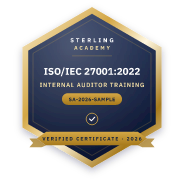
A certificate you can verify, and share Verifiable certificate with a QR code anyone can scan, plus a digital badge to add to your LinkedIn profile. See how verification works →
The certificate is issued by our certification partner, an Exemplar Global certified training provider.
Your certificate
You will be able to plan and conduct internal audits of your ISO/IEC 27001 management system, and face the certification audit with confidence. Your certificate can be verified online in seconds, so certification body auditors, employers and clients can confirm your training instantly.
Reach the pass mark in the final exam and you receive a Sterling Academy Certificate of Competence, verifiable online by QR code, with a LinkedIn badge to share. Employers, clients and auditors can verify it in seconds. Every learner who finishes the course receives a certificate: a Certificate of Completion when the retake does not reach the pass mark.
Who built this course
Sterling has 20+ years and 8,100+ client engagements in 60+ countries. The course is built by industry experts, domain specialist trainers and globally renowned auditors with 30+ years in ISO and GRC, on the current edition of the standard. Online and self-paced, built the way we build our classroom training: the same content and format as Sterling’s classroom courses, whose certificates are trusted and accepted by all major certification bodies.
Prepared by the Sterling expert panel · Last updated 27 October 2026 · How our courses are made
Sterling Academy courses carry the same content as Sterling's classroom training, whose certificates are trusted and accepted by all major certification bodies, as evidence of training at client audits for over 20 years.
Who it is for
ISMS team members, IT and security staff, control owners, compliance officers and anyone appointed to carry out internal audits of an ISO/IEC 27001 ISMS.
Training a team? Every learner gets their own access and certificate, and the client administrator sees each person’s progress and result in one place.
Part of the ISO/IEC 27001:2022 learning path → Step 5
Is security awareness training mandatory for ISO/IEC 27001?
Terms in this course: Audit evidence · Audit programme · Internal audit · Major nonconformity
About this course
ISO/IEC 27001:2022 expects internal audits at planned intervals that show whether the ISMS meets the organisation's own requirements and the standard, and whether it is effectively implemented and maintained. That needs a programme, not a single annual event: one that sets frequency, methods, responsibilities and reporting, and that gives more attention to processes with higher risk or recent problems. Auditors must be objective and impartial, which in practice means they do not audit their own work, and results go to the relevant management so action follows. ISO 19011:2026, the fourth edition of the auditing guidance, published in May 2026, supports this with principles of auditing and a risk-based approach to managing a programme. The course turns these expectations into a working programme, an audit plan and checklists that cover both the management system requirements and the Annex A controls.
You audit Annex A controls by collecting evidence that each control works in practice, not just that a policy describes it. For access control, compare a list of leavers from HR with active accounts in the directory and the VPN. For change management, pick changes from the ticketing system and check approval, testing and rollback plans. For backups, ask for the last restore test, not the backup schedule. For vulnerability management, follow a critical finding from scan to fix and check the date. Physical controls call for observation: visitor logs, clear desks, secure areas. People controls call for interviews with staff about reporting incidents or handling classified information. Each sample needs a clear basis and size. The course covers the organisational, people, physical and technological control themes and lists the documented information an auditor should ask to see.
An auditor tests the risk assessment and Statement of Applicability by tracing a sample of risks from identification to treatment and checking that the documents agree with each other and with reality. Start with the method: are criteria for acceptance and for performing assessments defined, and do repeated assessments give consistent results? Pick a few risks and confirm they have owners, ratings and treatment decisions. Follow a treatment to the controls chosen, then to the Statement of Applicability, which should list each control, whether it is included and why, and its implementation status. Excluded controls need a justification that holds up; excluding mobile device controls in a company that issues phones to every manager will not. Finally, check that risk owners approved the treatment plan and accepted residual risks. The course includes a mock audit that follows this trail end to end.
An ISMS nonconformity is clear when it states the requirement, the objective evidence and what was found, in words the auditee cannot misread. "Access control weak" is an opinion. "Three of ten leavers sampled from HR records for August still had active VPN accounts on the audit date, contrary to the access removal procedure" is a finding that the control owner can investigate and fix. Good findings are traceable to a requirement of the standard, a control in the Statement of Applicability or the organisation's own policy. They are graded consistently, discussed at the closing meeting so facts are agreed, and recorded in a report that management can use. The auditor then follows up to check that corrective action addressed the cause. The course gives learners practice in writing findings, separating them from opportunities for improvement and running the closing meeting.
Anyone appointed to audit their own organisation's ISMS should take this course. Staff new to the standard may start with ISO/IEC 27001:2022 Awareness, while the team building the system should take ISO/IEC 27001:2022 Implementation Training. Auditors who want depth on risk methods can add ISO/IEC 27001:2022 Risk Assessment and Statement of Applicability Training, and those auditing several management systems will benefit from ISO 19011:2026 Auditing Management Systems. Auditors study online and self-paced, with the same content and format as Sterling's classroom training, whose certificates are trusted and accepted by all major certification bodies. A QR code on the certificate lets the certification body confirm the internal auditor's training on the spot.
Save when you learn more
Add the next step
ISO/IEC 27001:2022 Implementation Training + ISO/IEC 27001:2022 Internal Auditor Training: US$198 → US$168
Course passes
Also in the Internal Auditor Pass: all 17 internal auditor courses for US$399, about the price of 4 courses.
Or every course except Lead Auditor courses with the All-Access Pass: 210 courses for US$499.
Compare the passesFor teams
From US$69 per learnerEach learner gets their own access and certificate; you see progress in one place.
Price your team →Save when you take more than one course
The discount is added automatically in your basket.
What learners say
Every course is built by the experts behind 8,100+ client engagements in 60+ countries, so you learn what auditors and regulators actually expect. Here is what professionals said after finishing their course.
Informative
10/10 for Philippines Data Privacy Act and DPO Training
Better value
All-Access Pass
A pharma and life sciences professional from the USA started with one course, then upgraded to the All-Access Pass.
Every Sterling Academy course except Lead Auditor courses, for 12 months.
US$499
See the passA selection of comments from learners who finished a course and answered our feedback request, shortened from their own words. Client names available on request.
Frequently asked questions
About ISO/IEC 27001:2022 Internal Auditor Training, its certificate and enrolment.
Ask SterlingYes. Choose the certified option when you enrol, or upgrade later within your 12 months of access. After the training, learners who choose the certified option and pass the exam receive an Exemplar Global certified certificate, issued by our certification partner and carrying the Sterling Academy logo. You also keep the Sterling Academy Certificate of Competence.
Two ways. On our certificate verification page, with the certificate's reference and the holder's surname: it shows the issuer printed on the certificate, the issuer's reference and the scheme reference. And with Exemplar Global, through the verification link printed in the certificate's record.
Yes. Sterling Academy's ISO/IEC 27001 courses are built by the Sterling consulting group, which has taken organisations to certification across 8,100+ client engagements in 60+ countries over 20+ years. They cover the awareness, implementation, internal auditor, lead auditor and specialist levels, always on the current edition, with practice questions that show the right answer. Each course ends with a final exam and a certificate that anyone can verify online, plus a LinkedIn badge, and client administrators can show an auditor exactly who has been trained. You will be able to plan and conduct internal audits of your ISO/IEC 27001 management system, and face the certification audit with confidence. Sterling Academy courses carry the same content as Sterling's classroom training, whose certificates are trusted and accepted by all major certification bodies, as evidence of training at client audits for over 20 years.
Awareness: ISO/IEC 27001:2022 Awareness · Implementation: ISO/IEC 27001:2022 Implementation Training · Internal auditor: ISO/IEC 27001:2022 Internal Auditor Training · Lead auditor: ISO/IEC 27001:2022 Lead Auditor Training · Specialist: ISO/IEC 27002:2022 Information Security Controls
It is for people who carry out or support internal audits of an ISO/IEC 27001 information security management system: ISMS team members, IT and security staff, control owners, compliance officers and staff appointed as internal auditors. It suits organisations preparing for certification and those strengthening an existing ISMS audit programme. A working knowledge of ISO/IEC 27001 helps; learners new to it may start with Sterling Academy's ISO/IEC 27001 awareness training.
It covers what ISO/IEC 27001:2022 clause 9.2 requires of internal audits, and the ISO 19011:2026 guidance on how to audit. You learn the work an internal auditor does: plan the audit, prepare checklists, interview control owners, sample and verify evidence, write nonconformities, report the results and follow up corrective action. It also shows how to audit the risk assessment, the Statement of Applicability and Annex A controls.
ISO/IEC 27001 Internal Auditor Training is a set of short video modules with practice questions, audit exercises and a final exam; the course page shows the number of modules and the approximate video runtime. Allow additional time for the exercises and the exam. With 12 months of access, you can complete it in one sitting or spread it over several sessions.
Yes. Learners who score at least 60% in the multiple-choice sections of the final exam receive a Sterling Academy Certificate of Competence for ISO/IEC 27001 Internal Auditor Training. The audit exercises are practice with feedback and do not count toward the result. A learner who does not reach the pass mark has one retake, which opens 24 hours after the result; a learner who finishes the course but does not reach it on the retake receives a Certificate of Completion. Each certificate carries a unique number and a QR code, and anyone can verify it online.
Yes. ISO/IEC 27001 Internal Auditor Training is a self-paced online course made of short video modules, in English with captions. You study at your own pace during 12 months of access, and practice questions after modules help you check your understanding before the final exam. If a point is unclear, questions are answered by a Sterling consultant.
ISO/IEC 27001 Internal Auditor Training has a list price of US$149 per learner, with a limited-time offer of US$99 per learner until 31 December 2026. Teams save 20% for 11 to 50 learners and 30% for 51 to 200; 201 or more learners are priced on request. Client administrators can track their team's progress. Prices are in US dollars, excluding taxes, and Sterling confirms final pricing and enrolment.
Sources
Your next step
Not sure which course?