Get PCI DSS consulting from Sterling
Expert and experienced consultants, 8,100+ client engagements in 60+ countries, from gap assessment to a system ready for its certification audit.
Talk to a Sterling consultantAwareness training · Payment security
Online training to help everyone who touches card payments keep card data safe.
Built by industry experts, domain specialist trainers and globally renowned auditors with 30+ years in ISO and GRC. 8,100+ client engagements in 60+ countries.
What you will be able to do
PCI DSS v4.0.1 Awareness is an introductory course for staff, team leaders, IT and managers who handle or can affect card payments. It explains card data, scope, the twelve requirements, who is who and the everyday controls each person applies, including reporting a suspected compromise. Delivered online and self-paced, it closes with a final exam and verifiable certificate.
The training is a practical introduction to PCI DSS v4.0.1 for everyone who handles, supports or can affect card payments: what card data is, what scope means, the 12 requirements, who is who, your everyday controls and what to do when something goes wrong.
Part of: PCI DSS Awareness and Implementation Training
Part of: Information Security & Privacy
How the course works
Every Sterling Academy course takes you through the same stages, so you leave with a skill, not just a summary.
What you get
About 105 minutes, with captions. Watch at your own pace on any device.
Short questions check your understanding before you move on.
Multiple choice; retakes are unlimited and included in the price.
Industry experts, domain specialist trainers and globally renowned auditors with 30+ years in ISO and GRC.
Preview this course
Watch a sample from PCI DSS v4.0.1 Awareness before you enrol.
Inside the course
13 modules, 13 practice checkpoints and a final exam. Video runtimes are approximate; allow additional time for the practice questions and the final exam.
Introduces PCI DSS as the card industry's security standard, who writes and enforces it, and which businesses it applies to.
Opens PCI DSS Awareness Training with a Toronto online retailer whose payment page was copying card numbers for months. Covers what a card breach can cost: a forensic investigation, penalties passed on by the bank, loss of card payments and lost clients. Explains that the PCI Security Standards Council writes PCI DSS while the payment brands and acquiring banks enforce it, that version 4.0.1 from June 2024 is the only active version, and that it applies to merchants and service providers in almost every sector.
What you will be able to do
Why it matters
You can outsource the work but never the responsibility, so knowing that PCI DSS applies protects your revenue and your right to take cards.
Practice: Practice: What PCI DSS is, why it exists, who it applies to · 3 questions
Explains account data, the difference between cardholder data and sensitive authentication data, and what may never be stored after authorisation.
Uses a Kuala Lumpur booking contact centre whose call recordings held card numbers and codes. Defines the PAN, wherever stored, processed or transmitted PCI DSS applies, then the two kinds of account data: cardholder data, which may be kept with care, and sensitive authentication data, which must not be kept after authorisation, even encrypted. Explains why full track data, the verification code and PINs are dangerous, and where card data hides: recordings, logs, paper, e-mail and chat.
What you will be able to do
Why it matters
Keep a card's security code after the payment, and one breach hands criminals what they need to spend your customers' money.
Practice: Practice: Account data: cardholder data and sensitive authentication data · 3 questions
Covers the cardholder data environment, what is in scope for PCI DSS, and how segmentation and regular checks keep scope small and true.
Starts with a Hong Kong hotel group getting ready for its first PCI DSS assessment, whose terminals, booking system, guest Wi-Fi and laptops share one flat network. Defines the cardholder data environment and three circles of scope, then explains segmentation, which is optional but strongly recommended, and its strict test. Gives Sterling's four steps: follow the data, draw it, list it and confirm it. Notes easily missed items such as backups, laptops, paper and home agents.
What you will be able to do
Why it matters
Every system in scope must meet the requirements and be assessed, so letting card data spread spreads cost and risk with it.
Practice: Practice: The cardholder data environment (CDE), scope and segmentation · 3 questions
Presents the twelve PCI DSS requirements in their six goals as one picture, and shows who in the business touches which.
Begins with a London restaurant group breached through a till supplier's remote access with a default password. Walks through the twelve principal requirements of PCI DSS version 4.0.1 in six goals: networks and secure configurations, protecting stored and sent account data, vulnerabilities, access control, monitoring and testing, and policy. Explains security as business as usual. Shows which teams own which requirements, and that a gap in one lets an attacker past the others.
What you will be able to do
Why it matters
One weak requirement can let a breach in, so seeing all twelve together shows where your daily work fits.
Practice: Practice: The 12 requirements in six goals, in one picture · 3 questions
Sets out who is who around PCI DSS, from the Council and payment brands to acquirers and assessors, and where Sterling fits.
Opens with a Philippine mobile wallet that gets a PCI DSS validation request from its bank and an offer of PCI certification in ten days. Describes eight roles: the Council, the payment brands, the acquirer, the issuer, your company, the QSA, the ISA and the ASV. Explains who enforces PCI DSS, what external scans involve, and how to check the Council's lists. Sterling prepares companies but never signs a Report on Compliance.
What you will be able to do
Why it matters
A firm that cannot sign, or the wrong document, can mean a missed acquirer deadline, penalties or lost card payments.
Practice: Practice: Who is who, and Sterling's role · 3 questions
Explains merchants and service providers, the choice between self-assessment and a Report on Compliance, and the Attestation of Compliance.
Uses a Warsaw SaaS billing platform that is both a merchant and a service provider, and a Manila BPO handling refunds for a US marketplace. Covers the extra PCI DSS requirements for service providers, SAQ and ROC, levels set by the payment brands and confirmed by the acquirer, and four SAQ types such as SAQ A. Gives the six high-level validation steps and explains that every route ends in the AOC.
What you will be able to do
Why it matters
Take the wrong route and a year of work may not be accepted, so confirming your role and level first saves effort.
Practice: Practice: Merchant or service provider; SAQ or ROC; the AOC · 3 questions
Shows how to protect stored card data in plain words: keep less, protect what stays, and mask what people see.
Uses a Dubai hotel group that keeps card numbers in a spreadsheet, in plain text and in call recordings. Repeats the two rules for sensitive authentication data and cardholder data, then covers retention. Explains five protections: masking, truncation, hashing, tokenisation and encryption, with the key protected. Lists four common mistakes and suggests a simple card data map. Practice case: a Delhi BPO whose agent screens show full numbers.
What you will be able to do
Why it matters
Readable card numbers in the wrong hands can mean a forensic investigation, recovered costs and the loss of card payments.
Practice: Practice: Protecting stored card data · 3 questions
Covers the everyday controls every employee uses: spotting phishing, logging in safely, keeping a clear desk and checking card readers.
Follows a Johannesburg BPO agent who receives an urgent e-mail apparently from IT. Gives four signs of phishing, which PCI DSS has expected defences and training against since March 2025, and the password rules, at least twelve characters with letters and numbers, plus multi-factor authentication for the card data environment. Covers a fifteen-minute idle sign-in, checking card readers for tampering, a clear desk, badges and visitors, and what to do after clicking.
What you will be able to do
Why it matters
The strongest systems fail if one person hands over a password or lets in a fake technician.
Practice: Practice: Your everyday controls · 3 questions
Explains third-party service providers and why using a compliant provider does not make your own business compliant.
Uses a Toronto travel company with a cloud host, a payment gateway and an outsourced Warsaw BPO to ask whether a PCI DSS compliant payment provider makes you compliant. Defines a third-party service provider and shows what stays with you when a provider handles card payments. Lists the five things expected for every provider, from a provider list to a responsibility matrix, and four common gaps in oversight, plus the aggregator's duties.
What you will be able to do
Why it matters
If a provider fails a requirement it meets for you, that requirement is not in place for you either, and their gap becomes your finding.
Practice: Practice: Third-party service providers · 3 questions
Sets out what is new in PCI DSS version 4.0.1 and what the changes mean for everyday work, including your own timing and two ways to comply.
Gives the dates of PCI DSS: version 4.0 in March 2022 with 64 new requirements, version 3.2.1 retired in March 2024, version 4.0.1 in June 2024, and that every requirement of 4.0.1 is now in force. Explains four big ideas: security as business as usual, targeted risk analyses for your own timing, the defined and customized approaches, and named owners. Highlights duties on phishing, multi-factor authentication, passwords and payment pages.
What you will be able to do
Why it matters
Every new requirement now counts in an assessment, and one that is not in place can stop your compliance.
Practice: Practice: What is new in v4.0.1 · 3 questions
Tells you what to do when card data may be at risk: report at once, touch nothing and let the response team decide.
Opens with a New York hotel group where guests report fraud and a front-desk card reader looks different. Explains that suspected incidents count, what a suspicion looks like and why waiting is risky, and the actions to avoid: logging on, rebooting, investigating, telling customers or deleting files. Covers the incident response plan, the PCI Forensic Investigator, who does what, and a Delhi BPO finding card numbers in a spreadsheet.
What you will be able to do
Why it matters
The first hour decides a lot, because a fast, clean response limits the cards exposed, the forensic costs and the fines passed on.
Practice: Practice: When something goes wrong · 3 questions
Follows the path to PCI DSS compliance from scoping to every year after, and shows why evidence must be built all year.
Follows a Mumbai BPO that must show it is PCI DSS compliant, with an Attestation of Compliance, within a year. Gives Sterling's six steps: scope, gap assessment, remediation, readiness, assessment and the attestation. Shows four sample gap findings, why only controls in place today count, and the evidence that builds over time, such as quarterly scans and training records. Sets out an evidence calendar and how a significant change reopens scope.
What you will be able to do
Why it matters
Arrive late or unprepared for an Attestation of Compliance request and you can lose the account or the contract.
Practice: Practice: The compliance journey · 3 questions
Brings the course together into six ideas and four daily habits, and shows what PCI DSS asks of each person in their job.
Starts with a Dublin contact centre agent who jots a card number on a notepad. Recaps PCI DSS Awareness Training in six ideas and sets out four habits: no written card numbers, no kept security codes or PINs, your own login with multi-factor authentication, and checked card readers. Covers what an assessor may ask in an interview, a Bangkok payment page script, role differences, and the next course for those who lead the work, PCI DSS Requirements and Controls Implementation Training.
What you will be able to do
Why it matters
One slip, a clicked link or a card number on a notepad, can open the door to a breach and cost the right to take cards.
Practice: Practice: Your part every day · 3 questions
Your certificates
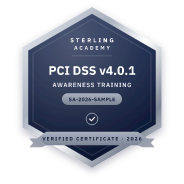
Verifiable certificate with a QR code anyone can scan, plus a digital badge to add to your LinkedIn profile.
See how verification works →You will understand what PCI DSS asks of you, contribute to your organisation's implementation and audit readiness, and play your part with confidence when the auditor visits. Your certificate can be verified online in seconds, so certification body auditors, employers and clients can confirm your training instantly.
Complete the course and its final exam and you receive a Sterling Academy Certificate of Completion, verifiable online by QR code, with a LinkedIn badge to share.
Who built this course
Sterling has 20+ years and 8,100+ client engagements in 60+ countries. The course is built by industry experts, domain specialist trainers and globally renowned auditors with 30+ years in ISO and GRC, on the current edition of the standard. Online and self-paced, built the way we build our classroom training: the same content and format as Sterling’s classroom courses, whose certificates are trusted and accepted by all major certification bodies.
Prepared by the Sterling expert panel · Last updated 1 October 2026 · How our courses are made
Sterling Academy courses carry the same content as Sterling's classroom training, whose certificates are trusted and accepted by all major certification bodies, as evidence of training at client audits for over 20 years.
Who it is for
Staff, team leaders, IT and managers who handle, support or can affect card payments.
Training a team? Every learner gets their own access and certificate, and the client administrator sees each person’s progress and result in one place.
Part of the PCI DSS learning path → Step 1
Is security awareness training mandatory under PCI DSS v4.0.1?
Terms in this course: Cardholder data · Cardholder data environment (CDE)
About this course
PCI DSS awareness matters for BPO and contact-centre teams because they often see full card numbers while processing refunds, chargebacks and orders for overseas merchants, and one careless habit can put a whole client contract at risk. An agent who writes a card number on a sticky note, pastes it into a chat window, reads it aloud on an open floor or stores a screenshot for later has created a security problem and, very likely, an assessment finding. The standard is a set of technical and operational controls, but many of them depend on people: following the approved process, keeping clean desks, locking screens and reporting anything unusual at once. The course is built around these real tasks, so that agents, team leads and support staff understand why each rule exists and what it protects.
Sensitive authentication data must never be kept after a payment is authorised. That category covers the card verification code printed on the card, full magnetic-stripe or chip data, and PINs or PIN blocks. The PCI Security Standards Council states that none of it may be stored after authorisation, even if encrypted, and that a customer's own permission to keep a card verification code does not change this. Cardholder data, such as the primary account number with the cardholder name and expiry date, may be stored where the business needs it, but the account number must be rendered unreadable wherever it is kept. The course shows the difference with screens, forms and call scenarios, so that staff can tell at a glance which data they may record in a ticketing tool and which must never leave the call.
Reducing scope makes PCI DSS easier because every system, network and person that can touch card data, or affect its security, falls inside the cardholder data environment and must be protected and evidenced. Fewer systems in scope means fewer controls to operate and less evidence to collect. Organisations reduce scope by segmenting networks, replacing card numbers with tokens, using payment pages hosted by a provider, and pausing call recordings or masking keypad entry while a customer gives card details. Staff play a part too: a workstation used to look up card numbers is in scope, so moving that task onto an unapproved laptop quietly widens it. The course explains scope with a simple picture of the environment, so that people understand why some tools are locked down and others are not.
PCI DSS v4.0.1, published by the PCI Security Standards Council in June 2024, is a limited revision that corrects formatting and typing errors and clarifies some requirements and guidance, with no requirements added or removed. PCI DSS v4.0 was retired at the end of December 2024, leaving v4.0.1 as the only supported version, and the requirements that had been future-dated became effective on 31 March 2025. For most staff the practical effect comes from the v4 family as a whole rather than from the minor revision. The course explains, in plain terms, the customized approach for meeting a requirement in a different way and the targeted risk analyses that let an organisation set how often some activities are performed, together with self-assessment questionnaires, the Report on Compliance and the Attestation of Compliance that merchants and service providers use to show their status.
Assessors expect staff to describe how they handle card data in their own job, where it must and must not appear, and what they would do if they suspected a compromise. They interview agents and team leads, watch how calls and tickets are handled, look for card numbers in notes, screenshots and shared folders, and check that security awareness training has been given and recorded. They also check that people know who to call and that nobody tries to investigate or clean up a suspected breach on their own, which can destroy evidence. The course rehearses these conversations through short scenarios, so that answers come from habit rather than a script learned the day before. A certificate with a QR code gives the organisation evidence that an assessor or client can verify for each person trained.
IT, security and compliance staff who operate or evidence the controls should move on to PCI DSS v4.0.1 Requirements & Controls Implementation Training, which works through the requirements in depth. Agents in outsourcing operations can pair this course with Information Security and Data Privacy Awareness for BPO Employees, and team leads with Information Security and Data Privacy for BPO Team Leads and Compliance Staff. Phishing and Social Engineering Awareness Training adds the attack side that many card data incidents begin with. Sterling Academy courses are online and self-paced, yet built by "industry experts, domain specialist trainers and globally renowned auditors with 30+ years in ISO and GRC", written to the current version of the standard, and their assessments are "designed on the principles of ISO/IEC 17024:2026".
Learning path
This course
Help everyone who handles card data understand what PCI DSS asks of them.
Next step
Work through the PCI DSS requirements and the controls that meet them, requirement by requirement.
View courseSave when you learn more
Course passes
Also in the Awareness Pass: all 110 awareness courses for US$99, about the price of 5 courses.
Or every course except Lead Auditor courses with the All-Access Pass: 210 courses for US$499.
Compare the passesFor teams
From US$13 per learnerEach learner gets their own access and certificate; you see progress in one place.
Price your team →Save when you take more than one course
The discount is added automatically in your basket.
What learners say
Every course is built by the experts behind 8,100+ client engagements in 60+ countries, so you learn what auditors and regulators actually expect. Here is what professionals said after finishing their course.
Informative
10/10 for Philippines Data Privacy Act and DPO Training
Better value
All-Access Pass
A pharma and life sciences professional from the USA started with one course, then upgraded to the All-Access Pass.
Every Sterling Academy course except Lead Auditor courses, for 12 months.
US$499
See the passA selection of comments from learners who finished a course and answered our feedback request, shortened from their own words. Client names available on request.
Frequently asked questions
About PCI DSS v4.0.1 Awareness, its certificate and enrolment.
Ask SterlingYes. Sterling Academy's PCI DSS courses are built by the Sterling consulting group, which has taken organisations to certification across 8,100+ client engagements in 60+ countries over 20+ years. They cover the awareness and implementation levels, always on the current edition, with practice questions that show the right answer. Each course ends with a final exam and a certificate that anyone can verify online, plus a LinkedIn badge, and client administrators can show an auditor exactly who has been trained. You will understand what PCI DSS asks of you, contribute to your organisation's implementation and audit readiness, and play your part with confidence when the auditor visits. Sterling Academy courses carry the same content as Sterling's classroom training, whose certificates are trusted and accepted by all major certification bodies, as evidence of training at client audits for over 20 years.
Awareness: PCI DSS v4.0.1 Awareness · Implementation: PCI DSS v4.0.1 Requirements & Controls Implementation Training
It is for staff, team leaders, IT and managers who handle, support or can affect card payments. That includes BPO and contact-centre teams that handle card data for overseas clients, as well as retail, e-commerce and IT support staff. No prior PCI DSS knowledge is needed.
It covers what PCI DSS is and who it applies to; cardholder data and sensitive authentication data; the cardholder data environment, scope and segmentation; the 12 requirements in six goals; who is who, from PCI SSC to assessors; self-assessment questionnaires, Reports on Compliance and Attestations of Compliance; everyday controls; what is new in v4.0.1; and responding to a suspected compromise.
The course is planned as 13 video modules and about 110 minutes of video, followed by practice questions and a final exam. Video runtimes are approximate, so allow additional time for the practice questions and the exam. With 12 months of access, learners can complete it in one sitting or over several sessions.
Yes. Learners who reach the 70% pass mark in the final exam receive a Sterling Academy Certificate of Completion for PCI DSS Awareness. Each certificate carries a unique number and a QR code, and anyone can verify it online using the certificate number and the holder's surname. It is a training certificate for the individual learner.
Yes. PCI DSS Awareness is a self-paced online course made of short video modules, in English with captions. You study at your own pace during 12 months of access, and practice questions after modules help you check your understanding before the final exam. If a point is unclear, questions are answered by a Sterling consultant.
PCI DSS Awareness is US$19 per learner. Teams save 20% for 11 to 50 learners and 30% for 51 to 200 learners; 201 or more learners are priced on request. Client administrators can track their team's progress. Prices are in US dollars, excluding taxes, and Sterling confirms final pricing and enrolment.
It gives your people the knowledge PCI DSS asks of them, and each learner's verifiable certificate is evidence of that training. The Certificate of Completion is a training certificate: it shows that one person completed PCI DSS Awareness and reached the pass mark in its final exam. An organisation's PCI DSS compliance is validated through its own assessment, such as a self-assessment questionnaire or a Report on Compliance by a qualified assessor, with an Attestation of Compliance.
The course teaches learners to recognise a suspected card data compromise and report it at once through their organisation's reporting route, and explains what not to do while waiting. Prompt reporting matters because PCI DSS depends on the organisation responding quickly. The exact contacts and steps come from each organisation's own incident response procedure.
Sources
Your next step
Not sure which course?