Get SOC 2 consulting from Sterling
Expert and experienced consultants, 8,100+ client engagements in 60+ countries, from gap assessment to a system ready for its certification audit.
Talk to a Sterling consultantAwareness training · Assurance & trust
Online training to understand the controls behind customer trust.
The training explores SOC 2, the Trust Services Criteria and how everyday responsibilities and reliable evidence support a service organisation’s assurance programme.
Secure payment by Stripe · for yourself or for your team
Add another course and save 15%, up to 25%
What you get
About 117 minutes, with captions. Watch at your own pace on any device.
Short questions check your understanding before you move on.
Multiple choice, with one retake if you need it.
Industry experts, domain specialist trainers and globally renowned auditors with 30+ years in ISO and GRC.
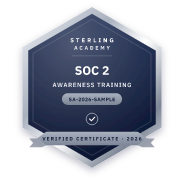
Verifiable certificate with a QR code anyone can scan, plus a digital badge to add to your LinkedIn profile.
See how verification works →Save when you take more than one course
The discount is added automatically in your basket.
Standard and editionAICPA Trust Services Criteria (2017, points of focus revised 2022)
Last updated31 October 2026
Preview this course
Watch a sample from SOC 2 Awareness before you enrol.
What learners say
Every course is built by the experts behind 8,100+ client engagements in 60+ countries, so you learn what auditors and regulators actually expect. Here is what professionals said after finishing their course.
Informative
10/10 for Philippines Data Privacy Act and DPO Training
Best value
All-Access Pass
A pharma and life sciences professional from the USA started with one course, then upgraded to the All-Access Pass.
Every Sterling Academy course for 12 months.
US$499
See the passA selection of comments from learners who finished a course and answered our feedback request, shortened from their own words. Client names available on request.
Learning outcomes
Connect the subject to the responsibilities and decisions people encounter in their roles.
Part of: SOC 2 Awareness and Controls Training
Part of: Information Security & Privacy
Inside the course
14 modules, 14 practice checkpoints and a final exam. Video runtimes are approximate; allow additional time for the practice questions and the final exam.
Explains what a SOC 2 report is, why US customers ask for one, who can issue it, why it is not a certificate, and the red flags to watch for.
Opens the SOC 2 Awareness training course, fourteen modules in four parts, with a BPO in the Philippines, a fintech in India, a US AI start-up and an IT provider in Dubai, each hearing the same request for a current SOC 2 Type 2 report. Sets out why customers ask and what a report contains: management's description and assertion, and an opinion from a US-licensed CPA firm against the Trust Services Criteria. Explains why it is an attestation, Sterling's preparation role, and four red flags.
What you will be able to do
Why it matters
A report bought the wrong way can cost you the very customers it was meant to win, so knowing who can issue one protects the contract.
Practice: Practice: What a SOC 2 report is, and what it is not · 3 questions
Compares SOC 1, SOC 2 and SOC 3 and shows how a SOC 2 report sits beside ISO/IEC 27001, so you hand each customer the right report.
A payroll provider in Singapore receives requests for a SOC 1 report and a SOC 2 report in the same renewal season, and holds ISO/IEC 27001. Describes the three SOC reports and their readers, why a SOC 3 is the one that may be published, and why the risk should be named first. Explains how ISO/IEC 27001 and SOC 2 answer different questions, and how one control set and one body of evidence can serve both.
What you will be able to do
Why it matters
Hand a customer the wrong report and its auditors cannot rely on it, so the renewal waits.
Practice: Practice: The SOC family and ISO/IEC 27001 · 3 questions
Introduces the five Trust Services Categories, how to choose which apply from your promises, and how criteria and controls relate.
A SaaS company in Mumbai promises uptime, yet its first report covers Security only. Describes the five categories: Security, always included, then Availability, Confidentiality, Processing Integrity and Privacy. Gives a quick test linking promises to categories and the reasons to include every category that applies. Explains the thirty-three common criteria in nine groups, the twenty-eight further criteria across the other four categories, and how criteria say what and controls say how.
What you will be able to do
Why it matters
A report that leaves out a promise your customers rely on invites the very question it was meant to answer.
Practice: Practice: The five Trust Services Categories, and how criteria and controls relate · 3 questions
Explains Type 1 as a date and Type 2 as a period, why neither is a better grade, and how the period of review affects your controls.
A SaaS company in Europe offers a bank a Type 2 report next month, though its controls went live only last week. Contrasts a Type 1 report, design as of one date, with a Type 2 report, which adds operation throughout a period with the auditor's tests and results. Explains why many buyers ask for a Type 2, a sensible first step with a Type 1, and what the period means day to day, with a managed-services firm in Sydney.
What you will be able to do
Why it matters
Promise the wrong Type, or a date that cannot be met, and the deal waits while a competitor's report is on the buyer's desk.
Practice: Practice: Type 1 or Type 2, and the period of review · 3 questions
Covers the system description that management writes, its nine description criteria, the five system components and four ways a description goes wrong.
A BPO in the Philippines lists three delivery sites in its draft description, though one closed in June. Explains that management writes the description and the service auditor evaluates it against the description criteria known as DC 200. Walks through the nine things it must cover, including the five components of the system, with a data centre in Singapore. Explains why the description comes first as the boundary, and four traps.
What you will be able to do
Why it matters
The description is what your customer's reviewers read first, and if it does not match reality the auditor cannot give a clean opinion on it.
Practice: Practice: The system description (the nine description criteria) · 3 questions
Covers subservice organisations, carve-out and inclusive methods, how to monitor vendors, and the controls your customers must run themselves.
A SaaS company in Sydney says its cloud provider handles security, then cannot answer who reviews that provider's report or who controls access to its cloud accounts. Defines a subservice organisation and compares the carve-out and inclusive methods. Explains what the description still says for a carved-out vendor and four ways to monitor it. Then covers complementary user entity controls, with a fintech in the US.
What you will be able to do
Why it matters
You can outsource the work, but you cannot outsource the responsibility, and customers' risk teams check which controls rely on vendors.
Practice: Practice: Subservice organisations and your customers' own controls · 3 questions
Shows Sterling's approach to scoping a SOC 2 examination, a six-question scope worksheet, seven readiness phases and how to choose a CPA firm.
A managed-services firm in London must decide whether to put the whole company in its first SOC 2 report. Explains how scope goes wrong when too wide or too narrow, and gives a scope worksheet of six questions. Sets out seven readiness phases, what a readiness assessment finds in a SaaS company in India, four checks before choosing a US-licensed CPA firm, and who does what between management, Sterling and the CPA firm.
What you will be able to do
Why it matters
Scope too wide and you pay for tests nobody asked for; too narrow and a customer's risk team can reject the report.
Practice: Practice: Scoping and readiness (Sterling's recommended approach) · 3 questions
Shows how to keep evidence through the Type 2 period with an evidence calendar, four-question controls and complete populations.
A BPO in Manila completes a quarterly access review in month four with no reason recorded, and it can become an exception. Explains why collecting evidence as you go beats a rush before the auditor arrives. Describes Sterling's evidence calendar built from a checklist of 91 evidence requests, writing a control with who, what, when and evidence, and populations taken from the system. Covers changes in the period and what to do when a control is missed.
What you will be able to do
Why it matters
In a Type 2 report a control done late or with no record can become an exception that your customers read.
Practice: Practice: Evidence through the period · 3 questions
Explains how the service auditor tests in fieldwork, how sampling works, what an exception is and how management responds to one.
An IT provider in Dubai finds two sampled background checks were completed after the person had started work. Covers the four ways the service auditor tests: inquiry, observation, inspection and re-performance, and how a sample is drawn from your population. Defines an exception, who decides what it means, and how to write a management response with facts, cause, action and date. Lists what never to do in fieldwork: alter records, guess or hide a gap.
What you will be able to do
Why it matters
Your Type 2 report describes every test and its result, and your customers read them before they renew.
Practice: Practice: Fieldwork: how the service auditor tests; exceptions and management responses · 3 questions
Shows how to read a SOC 2 report, your own or a vendor's, from the opinion to every exception, and how bridge letters cover the gap into year two.
A SaaS company in Europe sends its first Type 2 report to a US bank without reading past the opinion, and the renewal waits. Sets out the four parts of a report, unmodified and modified opinions, and three questions for each exception. Gives Sterling's four checks for a vendor's report, with a managed-services firm in Sydney, explains a bridge letter as management's word rather than the auditor's, and why the second period should start the day after the first ends.
What you will be able to do
Why it matters
Your customer's risk team reads every page, and one unexplained exception can hold up a renewal for weeks.
Practice: Practice: Reading a SOC 2 report, a vendor's report, bridge letters and year two · 3 questions
Follows four everyday moments in Manila, India, London and Singapore where one person's choice becomes a SOC 2 control and a record an auditor can see.
Four workplaces with SOC 2 Type 2 periods running: a BPO agent in Manila given a card number in a chat, an engineer in India asked to push a late-night fix without a ticket, a payroll processor in London sent a pay change from a personal e-mail address, and a technician in Singapore followed by a stranger to the server hall. Covers how to answer a service auditor truthfully, show the record and never alter one, and the habits that keep the report clean.
What you will be able to do
Why it matters
The auditor tests what you do every day through the records it leaves, so one skipped step can become the exception a customer asks about.
Practice: Practice: Your part every day · 3 questions
Covers three SOC 2 controls staff run every day, access reviews, change management and incident response, and the records an auditor will ask to see.
Takes three groups of common criteria into daily work. Follows the life of an account and a real quarterly access review at a BPO in Manila, with four higher-risk corners of access. Sets out one path for change, ticket, test, approval by someone else and record, including quiet changes at a SaaS company in India. Traces an incident at an IT provider in Dubai from report to review, and a team lead in Toronto deciding what to do with an unowned test-admin account.
What you will be able to do
Why it matters
Access, change and incidents are where customers' data is most exposed, so their risk teams read these results closely.
Practice: Practice: The controls behind daily work: access, change and incidents · 3 questions
Explains the SOC 2 confidentiality and privacy criteria in practice, following client and personal data from the day it arrives to the day it is destroyed.
Recalls the two confidentiality criteria and the eight groups of privacy criteria. Follows a client's network design through a managed-services firm in London, from identify to dispose, and four places where stray copies hide. Walks through a healthcare BPO in Manila handling US patients' details, treats the privacy notice as a promise the criteria test, and shows what a service auditor samples. Notes that a privacy section is not a statement of compliance with privacy law, and ends with test data in Sydney.
What you will be able to do
Why it matters
A leaked contract or a mishandled patient record can end a client relationship faster than any outage.
Practice: Practice: Confidentiality and privacy criteria in practice · 3 questions
Sets out what to do after a SOC 2 report: remediate exceptions at the cause, tell customers what changed, share the report correctly and stay ready all year.
Starts with two late background checks at an IT provider in Dubai and a US customer asking what changed. Gives Sterling's five steps from exception to fixed control, the difference between a design gap and an operating gap, and a remediation tracker. Shows how the fix reaches the next report, what to tell customers, how to share the report under restriction, and four habits for staying ready, with repeated late access reviews in Mumbai. Closes this training course with its key points.
What you will be able to do
Why it matters
Customers forgive an exception that was fixed, but rarely the same one twice, so a fix at the cause protects the renewal.
Practice: Practice: After the report: exceptions, remediation, staying ready, your part · 3 questions
Frequently asked questions
About SOC 2 Awareness, its certificate and enrolment.
Ask SterlingYes. Sterling Academy's SOC 2 courses are built by the Sterling consulting group, which has taken organisations to certification across 8,100+ client engagements in 60+ countries over 20+ years. They cover the awareness and implementation levels, always on the current edition, with practice questions that show the right answer. Each course ends with a final exam and a verifiable certificate that anyone can check online, plus a LinkedIn badge, and client administrators can show an auditor exactly who has been trained. You will understand what SOC 2 asks of you, contribute to your organisation's implementation and audit readiness, and play your part with confidence when the auditor visits. Sterling Academy courses carry the same content as Sterling's classroom training, whose certificates are trusted and accepted by all major certification bodies, as evidence of training at client audits for over 20 years.
Awareness: SOC 2 Awareness · Implementation: SOC 2 Trust Services Criteria & Controls Implementation Training
It is for professionals and teams supporting service organisation controls: staff of SaaS, IT, BPO and other service organisations whose customers ask for SOC 2 reports, and anyone who operates a control or provides evidence for one. It explains how everyday responsibilities support customer trust. Those who will lead implementation can continue to the SOC 2 Trust Services Criteria & Controls course.
The course explores SOC 2, the Trust Services Criteria, and how everyday responsibilities and reliable evidence support a service organisation's assurance programme. Learners understand the purpose of SOC 2 reporting, recognise the five Trust Services categories and the role of scope, and see how controls, evidence and individual responsibilities support assurance.
SOC 2 Awareness is a set of short video modules followed by practice questions and a final exam. The course page shows the current number of modules and the approximate video runtime; allow additional time for the practice questions and the exam. With 12 months of access, you can complete it in one sitting or spread it over several sessions.
Yes. Learners who reach the 70% pass mark in the final exam receive a Sterling Academy Certificate of Completion for SOC 2 Awareness. Each certificate carries a unique number and a QR code, and anyone can check it online using the certificate number and the holder's surname. It is a training certificate for the individual learner.
Yes. SOC 2 Awareness is a self-paced online course made of short video modules, in English with captions. You study at your own pace during 12 months of access, and practice questions after modules help you check your understanding before the final exam. If a point is unclear, questions are answered by a Sterling consultant.
SOC 2 Awareness is US$19 per learner. Teams save 20% for 11 to 50 learners and 30% for 51 to 200 learners; 201 or more learners are priced on request. Client administrators can track their team's progress. Prices are in US dollars, excluding taxes, and Sterling confirms final pricing and enrolment.
SOC 2 reports are based on the AICPA Trust Services Criteria, grouped into five categories: security, availability, confidentiality, processing integrity and privacy. Security is covered by the common criteria; the other four are chosen according to the organisation's commitments to its customers. The course explains the categories and why the scope of a SOC 2 report matters.
Learning path
This course
Understand the controls and evidence behind customer assurance.
Next step
Design and operate the controls behind each Trust Services Criterion.
View courseYour certificate
You will understand what SOC 2 asks of you, contribute to your organisation's implementation and audit readiness, and play your part with confidence when the auditor visits. Your certificate can be verified online in seconds, so certification body auditors, employers and clients can confirm your training instantly.
Complete the course and its final exam and you receive a Sterling Academy Certificate of Completion, verifiable online by QR code, with a LinkedIn badge to share.
Sterling Academy courses carry the same content as Sterling's classroom training, whose certificates are trusted and accepted by all major certification bodies, as evidence of training at client audits for over 20 years.
Ask about course requirementsYour next step
Not sure which course?