Get ISO/IEC 42001 consulting from Sterling
Expert and experienced consultants, 8,100+ client engagements in 60+ countries, from gap assessment to a system ready for its certification audit.
Talk to a Sterling consultantAwareness training · Artificial intelligence
Part of the ISO/IEC 42001:2023 learning path → Step 2
Online training to help your people use and build AI responsibly.
The training is a practical introduction to ISO/IEC 42001, the management system standard for artificial intelligence: why it matters, how it is structured, how AI risks and impacts are assessed, and what responsible use of AI looks like in daily work.
Secure payment by Stripe · for yourself or for your team
Add another course and save 15%, up to 25%
What you get
About 117 minutes, with captions. Watch at your own pace on any device.
Short questions check your understanding before you move on.
Multiple choice, with one retake if you need it.
Industry experts, domain specialist trainers and globally renowned auditors with 30+ years in ISO and GRC.
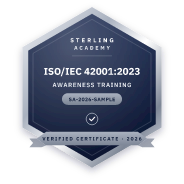
Verifiable certificate with a QR code anyone can scan, plus a digital badge to add to your LinkedIn profile.
See how verification works →Save when you take more than one course
The discount is added automatically in your basket.
Standard and editionISO/IEC 42001:2023
Last updated31 October 2026
Preview this course
Watch a sample from ISO/IEC 42001:2023 Awareness before you enrol.
What learners say
Every course is built by the experts behind 8,100+ client engagements in 60+ countries, so you learn what auditors and regulators actually expect. Here is what professionals said after finishing their course.
Informative
10/10 for Philippines Data Privacy Act and DPO Training
Best value
All-Access Pass
A pharma and life sciences professional from the USA started with one course, then upgraded to the All-Access Pass.
Every Sterling Academy course for 12 months.
US$499
See the passA selection of comments from learners who finished a course and answered our feedback request, shortened from their own words. Client names available on request.
Learning outcomes
Connect the subject to the responsibilities and decisions people encounter in their roles.
Part of: AI Governance and ISO 42001 Training
Part of: Information Security & Privacy
Inside the course
15 modules, 15 practice checkpoints and a final exam. Video runtimes are approximate; allow additional time for the practice questions and the final exam.
Shows what one AI mistake can cost, why AI needs managing beyond ordinary IT controls, and how an AI management system helps you know, decide and watch.
Opens the ISO/IEC 42001 Awareness training course, fifteen modules in three parts, with a Manila BPO whose AI chat assistant promises refunds the retailer never approved. Lists what one AI mistake can cost and where AI is already at work. Gives three reasons AI needs its own management, then shows how an AIMS helps you know, decide and watch, with a hospital in Riyadh, a school in Melbourne and a Toronto analyst pasting customer data into a public AI tool.
What you will be able to do
Why it matters
AI now drafts, ranks, predicts and decides across the business, and one wrong answer can cost you a client.
Practice: Practice: Why AI needs managing · 3 questions
Explains what an AI system is, why its behaviour can drift, and the roles an organisation can play with it.
Uses a Bengaluru fintech whose purchased credit-scoring model quietly changed its approvals, with the supplier and the fintech each blaming the other. Defines an AI system in plain words as software that learns from data to produce predictions, content, recommendations or decisions. Contrasts it with rule-based software, using a music app to show continuous learning. Lists the roles of provider, producer, customer, partner, subject and authority, and why they overlap.
What you will be able to do
Why it matters
When nobody knows who must watch an AI system, its mistakes reach customers first, and knowing your role decides which requirements apply to you.
Practice: Practice: What makes AI different, and your role · 3 questions
Explains what ISO/IEC 42001 requires, how its clauses and four annexes are built, and who issues a certificate.
Starts with a Singapore firm that lost a bank tender to a rival with a working AI management system and evidence. States that ISO/IEC 42001 sets requirements for any organisation that provides or uses AI, published jointly by ISO and IEC in 2023, with requirements in clauses four to ten. Describes Annexes A to D, and how the standard fits with ISO/IEC 27001, ISO/IEC 27701 and ISO 9001. Separates the roles of ISO, the organisation, a consultant and the certification body.
What you will be able to do
Why it matters
Customers increasingly ask how you govern AI before they sign, and a working system with evidence wins over promises.
Practice: Practice: ISO/IEC 42001: what it is and how it is built · 3 questions
Covers the context of an AI management system: the laws and expectations around it, the interested parties, and a documented scope.
Opens with a London HR-tech firm that missed rules on automated decisions in hiring. Covers external and internal issues, including laws on AI, privacy and data law, sector rules and contracts, and three further decisions: whether climate change is relevant, the intended purpose of each AI system, and your role with it. Then interested parties and their needs, and a scope set from context and parties and kept as documented information, with examples from Jakarta and Dubai.
What you will be able to do
Why it matters
Missing one law or one customer expectation can make the AI you sell the reason a client walks away, so context comes first.
Practice: Practice: Context, interested parties and scope · 3 questions
Covers what top management must do for AI, what the AI policy contains, and the roles and concern route that make the system work.
Begins with a Johannesburg bank where three departments bought AI separately and nobody owned it. Lists what top management must do under the standard, from building requirements into business processes to providing resources. Describes the AI policy, with example lines for a bank, and the two roles that must always be assigned. Covers the Annex A control on reporting concerns about AI across its life cycle, with a Chennai forecast exercise.
What you will be able to do
Why it matters
When every department buys AI on its own, nobody can answer a regulator, so one approach owned at the top gives a single, clear answer.
Practice: Practice: Leadership, AI policy and roles · 3 questions
Shows how to set AI risk criteria, assess and rank AI risks, treat them with controls, and record choices in a statement of applicability.
Uses a Sydney insurer whose claims-sorting AI failed in a flood season. Covers AI risk criteria, then the four parts of the assessment: identify, analyse, evaluate, and keep the process repeatable. Shows Sterling's recommended scoring of likelihood and consequence from one to five. Explains choosing treatment options, comparing controls with Annex A, the statement of applicability, the treatment plan and approval by designated management, and repeating the assessment when things change.
What you will be able to do
Why it matters
An AI risk nobody asked about becomes a crisis with customers, media and regulator at once, and asking early changes the story.
Practice: Practice: AI risk assessment and treatment · 3 questions
Explains the AI system impact assessment: who an AI system could affect, including through misuse, and how it feeds the risk assessment.
Opens with an Abu Dhabi hospital tool that ranks emergency patients, and a doorbell camera story that asks who else is affected. Separates the AI risk assessment from the impact assessment, which looks at individuals, groups and society in the real setting of use. Lists what the standard requires it to consider, including foreseeable misuse, and the four Annex A controls on impact. Covers repeating it at planned intervals and on significant change.
What you will be able to do
Why it matters
An AI that treats one group unfairly can cost customers, standing with regulators and public trust, and asking before go-live avoids it.
Practice: Practice: The AI system impact assessment · 3 questions
Covers AI objectives, the resources an AI system needs, competence and awareness, and the controlled documents that keep it running.
Uses a Pune plant whose AI inspection cameras depended on one outside contractor. Explains objectives that are consistent with the policy, measurable where practicable, owned and planned, with areas suggested in Annex C such as fairness, transparency, privacy, safety and robustness. Covers documenting data, tooling, computing and people resources, then competence with evidence, awareness, communication, and documented information that is created, controlled and kept.
What you will be able to do
Why it matters
When one person holds the only key to your AI, quality and deliveries are at risk the day they leave, so shared skills and steps matter.
Practice: Practice: Objectives, resources and people · 3 questions
Follows an AI system from requirements to daily operation: operational control, responsible design, the life cycle stages, logs and documentation.
Opens with a Kuala Lumpur SaaS provider whose untested Friday model update misread invoices for hundreds of customers. Covers four operational asks: criteria, controls, change control and outside suppliers. Then Annex A on responsibility by design, and the life cycle stages: specify, design, test, deploy, operate and log. Ends with technical documentation for users, partners and authorities, and an Accra exercise on missing logs.
What you will be able to do
Why it matters
One untested change to a live AI system can reach hundreds of customers before Monday, so planned, tested and logged changes avoid surprises.
Practice: Practice: The AI system life cycle · 3 questions
Covers the data AI systems learn from and work on: the Annex A data controls, data quality, provenance and data as a source of risk.
Opens with a Singapore bank whose fraud model had never seen a new way to pay, using a recipe card copied by hand as a story. Lists five Annex A controls on data management, acquisition, quality, provenance and preparation, plus documenting data resources. Defines data quality as meeting your own requirements for a specific use. Describes Annex C data risks: poor quality, weak collection and data poisoning, which can damage safety, fairness and robustness, with examples from Nairobi and Milan.
What you will be able to do
Why it matters
Bad or out-of-date data turns a good model into a poor decision-maker, and customers feel it first, so traceable data protects results.
Practice: Practice: Data for AI systems · 3 questions
Covers using AI as intended, human oversight, informing users, and sharing responsibilities with suppliers and customers.
Opens with a Cairo contact centre that stored AI call summaries without the check its supplier's documentation required. Covers the three Annex A controls on use of AI systems, and Annex B guidance on human oversight. Then information for users, a way to report adverse impacts and a plan for telling users about incidents. Covers third-party controls, three questions to ask an AI supplier, and a Dublin chatbot exercise on intended use.
What you will be able to do
Why it matters
Using AI outside its intended purpose turns a supplier's tool into your own liability, and buying AI does not hand over accountability.
Practice: Practice: Responsible use, users and suppliers · 3 questions
Explains how an AI management system is checked and improved through monitoring, internal audit, management review and corrective action, and your daily part.
A logistics firm in Dubai lets its AI route planner slip for three months while nobody analyses the dashboard. Covers the four decisions on monitoring and measurement, the internal audit programme, management review inputs and outputs, and four steps for a nonconformity. Sets out Sterling's recommended six steps to a working system, three moves when AI goes wrong, notice, report and record, and an open audit finding on an AI pricing tool in Mexico City.
What you will be able to do
Why it matters
An AI that slowly gets worse costs you clients long before anyone sounds an alarm, so its trends need an owner.
Practice: Practice: Checking, improving, and your part · 3 questions
Covers transparency, explainability and human oversight of AI: who needs to know what, what a good explanation looks like, and how to make oversight real.
A Hong Kong insurer's assessors approve hundreds of AI claim recommendations a day, and nobody can explain a referral. Separates transparency, explainability and interpretability using the NIST framework, and covers information tailored to each reader, telling people they are dealing with AI, and a good explanation. Explains automation bias, Sterling's four-word checklist of competence, authority, time and information, and four design decisions, with a Tokyo recruiter, an Amsterdam energy company and AI discharge notes in Seoul.
What you will be able to do
Why it matters
A decision nobody can explain is a decision nobody can defend, to a customer, a client or a regulator.
Practice: Practice: Transparency, explainability and human oversight · 3 questions
Explains AI incidents: what counts as one, the warning signs that spot it early, how to respond, and how corrective action stops it happening again.
Opens with the February 2024 tribunal decision holding Air Canada responsible for its chatbot's wrong answer. Defines AI incidents, including near misses, and five warning signs, each with a limit, an owner and an action. Gives Sterling's five-step response, contain, scope, inform, fix and learn, warns against the quiet quick fix, and links incidents to nonconformity. Outlines EU AI Act serious incident reporting, with examples from a Chicago bank, a Zurich software firm and a Vancouver electronics store.
What you will be able to do
Why it matters
When AI goes wrong it goes wrong at scale, and the hours before anyone acts decide the cost.
Practice: Practice: AI incidents: monitoring, response and nonconformity · 3 questions
Shows how ISO/IEC 42001 sits alongside the EU AI Act and the NIST AI RMF, and how one AI management system, mapped to each, can answer all three.
A Boston analytics firm receives three AI questionnaires in a month and starts three projects. Compares a voluntary standard, a binding law and a voluntary framework. Covers the EU AI Act's risk-based approach, provider and deployer roles, reach outside the EU and dates, and why certification is overlap, not equivalence. Describes the NIST framework's four functions and NIST's crosswalk to ISO/IEC 42001, then a Madrid HR software company's claim. Recaps this training course and four habits: know, protect, check and speak up.
What you will be able to do
Why it matters
Clients now ask about all three, and one well-run system with a map to each can answer them together.
Practice: Practice: ISO/IEC 42001, the AI Act and NIST, and your part · 3 questions
Frequently asked questions
About ISO/IEC 42001:2023 Awareness, its certificate and enrolment.
Ask SterlingYes. Sterling Academy's ISO/IEC 42001 courses are built by the Sterling consulting group, which has taken organisations to certification across 8,100+ client engagements in 60+ countries over 20+ years. They cover the awareness, implementation, internal auditor and specialist levels, always on the current edition, with practice questions that show the right answer. Each course ends with a final exam and a verifiable certificate that anyone can check online, plus a LinkedIn badge, and client administrators can show an auditor exactly who has been trained. You will understand what ISO/IEC 42001 asks of you, contribute to your organisation's implementation and audit readiness, and play your part with confidence when the auditor visits. Sterling Academy courses carry the same content as Sterling's classroom training, whose certificates are trusted and accepted by all major certification bodies, as evidence of training at client audits for over 20 years.
Awareness: ISO/IEC 42001:2023 Awareness · Implementation: ISO/IEC 42001:2023 Implementation Training · Internal auditor: ISO/IEC 42001:2023 Internal Auditor Training · Specialist: AI Risk & Impact Assessment (ISO/IEC 42001:2023 and ISO/IEC 42005:2025)
It is for employees, managers and teams who develop, provide or use AI systems in their organisation. No technical AI background is needed. The course helps people understand why an AI management system matters to trust, customers and regulators, and what responsible use and development of artificial intelligence looks like in their own daily work.
It covers why an AI management system matters; key terms such as AI system and AI management system, and the roles organisations play; context, scope and AI policy; AI risk assessment and treatment; AI system impact assessment; the Annex A controls in plain words; performance evaluation and continual improvement; and each person's part in responsible AI use.
ISO/IEC 42001 Awareness is a set of short video modules followed by practice questions and a final exam. The course page shows the current number of modules and the approximate video runtime; allow additional time for the practice questions and the exam. With 12 months of access, you can complete it in one sitting or spread it over several sessions.
Yes. Learners who reach the 70% pass mark in the final exam receive a Sterling Academy Certificate of Completion for ISO/IEC 42001 Awareness. Each certificate carries a unique number and a QR code, and anyone can check it online using the certificate number and the holder's surname. It is a training certificate for the individual learner.
Yes. ISO/IEC 42001 Awareness is a self-paced online course made of short video modules, in English with captions. You study at your own pace during 12 months of access, and practice questions after modules help you check your understanding before the final exam. If a point is unclear, questions are answered by a Sterling consultant.
ISO/IEC 42001 Awareness is US$19 per learner. Teams save 20% for 11 to 50 learners and 30% for 51 to 200 learners; 201 or more learners are priced on request. Client administrators can track their team's progress. Prices are in US dollars, excluding taxes, and Sterling confirms final pricing and enrolment.
It gives your people the knowledge ISO 42001 asks of them, and each learner's verifiable certificate is evidence of that training when the auditor asks. The Certificate of Completion is a training certificate: it shows that one person completed ISO/IEC 42001 Awareness and reached the pass mark in its final exam. An organisation is certified by an independent certification body after that body's own audit.
Under ISO/IEC 42001:2023 they are separate activities. An AI risk assessment looks at risks to the organisation and its AI management system, which are then treated. An AI system impact assessment looks at the effects an AI system can have on individuals, groups and society. The course explains both and why an organisation needs each.
Learning path
This course
Understand the purpose of an AI management system and how governance, risk and individual responsibilities support responsible use of artificial intelligence.
Next step
Implement and audit the 38 Annex A controls of ISO/IEC 42001:2023, the international standard for an AI management system.
View courseNext step
Put every clause and Annex A control of ISO/IEC 42001:2023 in place for the AI your organisation develops, provides or uses, from AI risk and impact assessment to the Statement of Applicability and certification readiness.
View courseYour certificate
You will understand what ISO/IEC 42001 asks of you, contribute to your organisation's implementation and audit readiness, and play your part with confidence when the auditor visits. Your certificate can be verified online in seconds, so certification body auditors, employers and clients can confirm your training instantly.
Complete the course and its final exam and you receive a Sterling Academy Certificate of Completion, verifiable online by QR code, with a LinkedIn badge to share.
Sterling Academy courses carry the same content as Sterling's classroom training, whose certificates are trusted and accepted by all major certification bodies, as evidence of training at client audits for over 20 years.
Ask about course requirementsYour next step
Not sure which course?